Stellar V Capital (SVCC): Supplier Map and Operational Signals for Investors
Stellar V Capital Corp. operates as a blank‑check investment vehicle focused on high‑growth opportunities in technology and digital assets; it monetizes by raising public capital through an IPO/unit offering, investing the proceeds in a target business, and capturing value through post‑business combination equity appreciation. SVCC’s supplier relationships—underwriting, listing, and investor‑relations services—are transactional and timing‑sensitive, directly tied to capital markets activity rather than recurring operating revenue. For a concise supplier risk snapshot and ongoing monitoring, visit https://nullexposure.com/.
How SVCC’s suppliers fit into the economics of a SPAC-like vehicle
SVCC carries the structural hallmarks of a special purpose acquisition company: no operating revenue, negative book value per share, high institutional ownership, and concentrated, event-driven spend around underwriting and listing. The company funds its lifecycle through capital markets transactions; suppliers are therefore critical around deal execution windows, not as permanent operating vendors. Market data for the latest quarter (2025-12-31) shows a market capitalization of $225.2 million and shares outstanding of 15.555 million, underlining that service providers tied to IPO and listing activity determine near‑term cash outflows and reputational exposure.
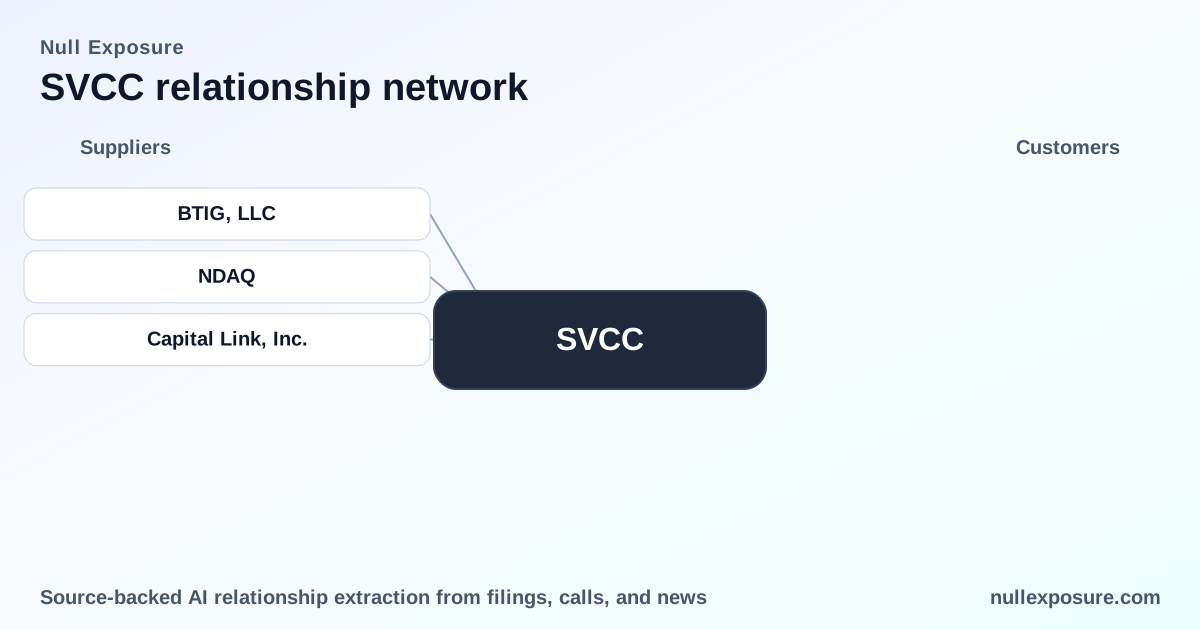
The three supplier relationships you need to know
BTIG, LLC — the deal runner
BTIG is acting as the sole book‑running manager for SVCC’s offering, a role that places it at the center of pricing, distribution and underwriting economics for the capital raise. According to a Yahoo Finance press release announcing SVCC’s offering, BTIG was designated as sole book‑running manager (reported March 10, 2026; covering activities beginning January 2025). This relationship drives the largest single cash outflow disclosed in offering costs and is material to successful capital formation.
Nasdaq (Nasdaq Global Market) — the trading venue
SVCC’s units were slated to trade on the Nasdaq Global Market under the ticker SVCCU beginning January 30, 2025, making Nasdaq the exchange partner enabling liquidity and secondary‑market access for investors. A Yahoo Finance announcement documenting the unit listing and ticker assignment confirms Nasdaq’s role in establishing public trading (reported March 10, 2026). Listing is a binary operational constraint: without exchange acceptance, the monetization pathway for public investors is constrained.
Capital Link, Inc. — investor relations contact
Capital Link is listed as the designated investor relations and media contact for SVCC, providing investor communications and public relations support from an office address on Park Avenue in New York. The Yahoo Finance release includes Capital Link’s IR contact (Daniela Guerrero) and corporate contact details (reported March 10, 2026). Investor relations is lower dollar but higher reputational spend—material for messaging during the offering and any potential business combination.
What the constraints say about operating posture and spend behavior
SVCC’s extracted constraints paint a coherent operating model:
-
Contracting posture: short‑term and event‑driven. The sponsor agreed to a non‑interest bearing promissory note of up to $300,000 due at IPO closing or March 31, 2025, indicating short‑term financing bridge arrangements common to sponsor‑led vehicles. This is a company‑level signal rather than a supplier‑specific commitment.
-
Service relationships are transactional and active. The company reports active use of sponsor‑provided office space and support services; sponsor payments include $25,000 exchanged for founder shares during the inception period—signals of early‑stage operational support rather than long‑term outsourcing.
-
Spend concentration around deal execution. Transaction costs totaled $8,782,919—comprised of a $3,000,000 cash underwriting fee, $5,250,000 deferred underwriting fee, and $532,919 of other offering costs—placing underwriting and offering services firmly in the $1M–$10M spend band for the IPO event.
-
Lower recurring professional fees. Audit and IPO accounting fees to WithumSmith+Brown, PC were approximately $97,240 (sub‑$100k band) for the audit and IPO work, indicating modest audit spend relative to offering costs. The record explicitly names Withum as the independent registered public accounting firm, which signals a typical professional services footprint for a newly public shell entity.
-
Ongoing administrative costs are modest but present. The company pays its sponsor up to $10,000 per month for office, secretarial and administrative services (a mid‑range recurring contract signal falling in the $100k–$1M annualized band if extended), reflecting low‑intensity operational outsourcing.
What this means for supplier risk, concentration and criticality
-
High dependency on a narrow set of event suppliers. Underwriting (BTIG) and listing (Nasdaq) are one‑time but critical engagements: successful execution determines cash on hand, public market credibility, and timing for any business combination. Counterparty failure at that stage would be highly consequential.
-
Low ongoing vendor complexity; high episodic spend. Aside from audit and IR support, most spend is concentrated around a single event (the offering), which makes runway and underwriting economics the primary procurement risk.
-
Sponsor entanglements and related‑party dynamics. Sponsor funding, office provision, founder share transactions, and sponsor fees are company‑level governance and liquidity signals; these dynamics influence supplier choice and negotiation leverage but are not attributed to the third‑party relationships unless explicitly named.
-
Maturity: early, market‑dependent. With zero reported revenue, negative book value per share, and classification in shell‑company industry data, SVCC is an early‑stage, market‑timed vehicle—supplier maturity is therefore short, concentrated, and reversible once the offering concludes or the company completes a business combination.
For further supplier intelligence and to monitor changes in SVCC’s market relationships, visit https://nullexposure.com/ to access curated supplier risk profiles.
Investor takeaways and recommended actions
-
Treat BTIG and Nasdaq as systemically important counterparties for SVCC’s near‑term valuation: underwriting fees and listing status determine capital access and secondary‑market liquidity. Confirm fee structures and underwriting commitments before underwriting portfolio exposure.
-
Expect episodic cash volatility around deal windows; budget for the disclosed $8.78M of transaction costs when modeling shareholder dilution and post‑transaction cash reserves.
-
Monitor sponsor arrangements and related‑party disclosures for governance risk and potential operational dependencies, especially given sponsor‑provided office space and short‑term promissory financing.
-
Validate communications and IR cadence through Capital Link engagements during roadshows and investor outreach—effective messaging materially affects aftermarket performance.
If you need a tailored supplier risk brief or ongoing monitoring for SVCC or comparable vehicles, start here: https://nullexposure.com/.
Final verdict
SVCC’s supplier footprint is compact, highly event‑driven and concentrated around underwriting, exchange listing, and investor relations. That creates a clear risk profile: low recurring vendor complexity but high sensitivity to execution quality in the offering window. For investors and operators underwriting exposure to SVCC, the priority is to validate the underwriting commitment, confirm Nasdaq listing mechanics, and review sponsor‑related financing terms. For ongoing supplier monitoring and alerts on any material change, visit https://nullexposure.com/.