SaverOne (SVRE): Supplier Relationships and Strategic Takeaways for Investors
SaverOne builds sensor-driven safety solutions that prevent phone-related driving accidents and monetizes through product sales and intellectual property licensing; the company is now extending its platform into RF-based defense and international automotive pilots through third-party partners and distributors. For an investor, the critical lens is whether these supplier and IP relationships transform SaverOne from a small consumer-safety vendor into a scalable platform business with recurring licensing economics. Learn more about how we track supplier ties at https://nullexposure.com/.
How SaverOne makes money and why supplier ties matter to valuation
SaverOne markets hardware and software safety solutions for vehicles and licenses core technology to third parties. The company’s 2025 financials show low revenue (about $1.96M TTM) and significant operating losses (EBITDA -$34.26M), which means commercial partnerships and licensing deals are central to any path to profitability and valuation upside. Supplier and licensing relationships therefore act as de-risking levers—they can accelerate go-to-market, generate license fees, and expand addressable markets beyond consumer vehicles into defense and OEM applications.
If you want to map these relationships to counterparty risk and commercial runway, start at the company homepage and our supplier coverage hub: https://nullexposure.com/.
The supplier relationships that matter today
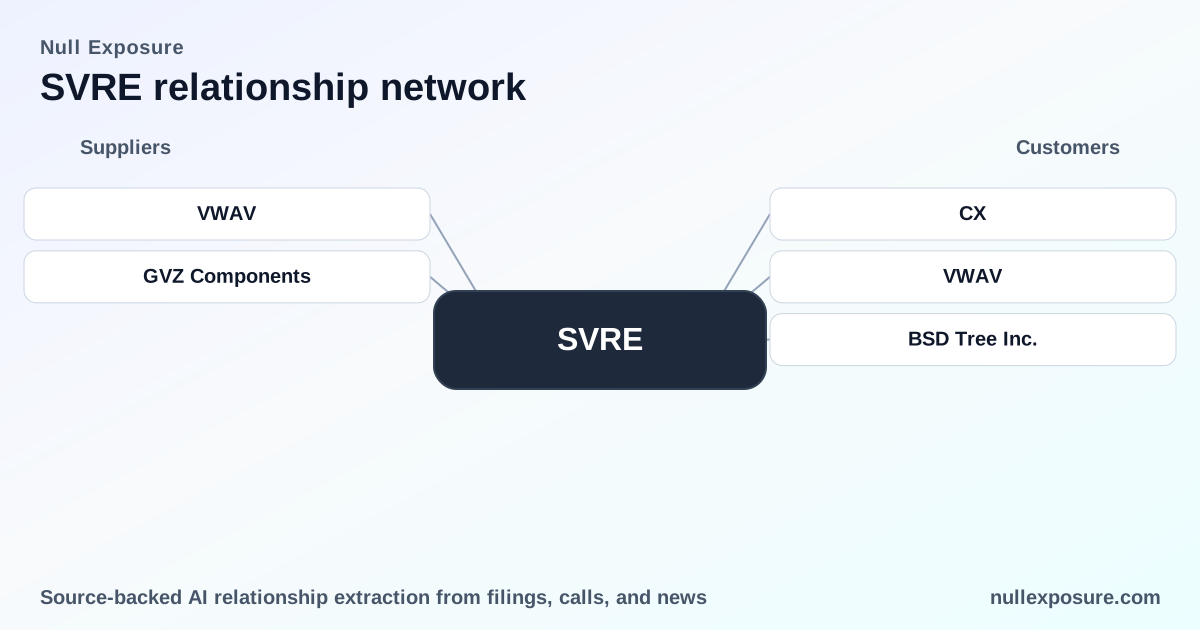
The public record for SVRE shows two active counterparty relationships in our monitoring window: VisionWave (RF sensing IP) and GVZ Components (regional distributor for Italian expansion). Below are plain-English summaries of each relationship with source context.
VisionWave Holdings, Inc. — RF sensing and analytics licensing
SaverOne will serve as the core operating platform for specified RF-based defense and security applications and has been granted a non-exclusive global license to VisionWave’s RF sensing and analytics technologies for defense and homeland-security use. According to a March 10, 2026 press release syndicated on Yahoo Finance and covered by InvestorIdeas, the agreement positions SaverOne to integrate RF sensing into its platform for defense customers. A contemporaneous report on Intellectia notes that SaverOne received a full license to use VisionWave’s defense-related intellectual property during the initial stage of the collaboration. (Sources: Yahoo Finance / press release, March 10, 2026; InvestorIdeas coverage, March 10, 2026; Intellectia report, March 10, 2026.)
GVZ Components — Regional distributor for Italian market rollout
SaverOne’s entry into the Italian market is being led by an Italian partner (Tal Yhie) together with a regional distributor, GVZ Components, which is supporting a pilot project with an Italian sports-car manufacturer. The Manila Times reported this pilot arrangement on December 3, 2024, identifying GVZ Components as the regional distributor facilitating local market access. (Source: Manila Times via GlobeNewswire, December 3, 2024.)
What these relationships reveal about SaverOne’s operating model
The counterparty map signals a hybrid commercialization strategy: direct-to-market product sales plus IP licensing and distributor-led international rollout. From that, several company-level operational characteristics follow.
- Contracting posture: SaverOne executes licensing and reseller/distribution agreements rather than exclusive technology takeovers. The VisionWave relationship is explicitly non-exclusive, which accelerates market entry but limits exclusivity-based moats.
- Concentration and go-to-market: International expansion is channeled through named regional partners (GVZ Components and a local lead partner), which implies concentrated go-to-market risk at the pilot and early-commercial stages.
- Criticality and optionality: The VisionWave license is strategically critical in enabling entry into defense and homeland-security markets, but non-exclusivity provides the company with product optionality rather than exclusive control.
- Maturity and commercialization runway: Public filings and press releases show pilot-stage commercialization (Italian OEM pilot) and nascent defense licensing, consistent with the company’s small revenue base and large operating losses—this is an early-stage commercial profile, not a mature licensing business.
These characteristics should drive your due diligence: evaluate whether non-exclusive licensing and distributor-led pilots scale into recurring revenue or remain one-off commercial proofs.
Investment implications and risk checklist
SaverOne’s supplier relationships create both strategic upside and concentrated execution risk. Key investment points:
- Upside: The VisionWave license opens a new, higher-value market (defense/homeland security) where per-customer contract sizes and margin profiles can be meaningfully higher than consumer products. The Italian OEM pilot, supported by GVZ Components, proves the company can access premium automotive channels.
- Execution risk: Non-exclusive licensing reduces competitive moats, and distributor dependence leaves the company exposed to partner execution and local OEM acceptance. The company’s financial profile—low revenue (~$1.96M TTM), negative EBITDA (-$34.26M), and small public float/institutional ownership—means capital markets will price in commercialization risk.
- Valuation watch: Key public metrics show low revenue scale and negative profitability, so market re-rating requires demonstrable, recurring licensing revenue or rapid OEM rollouts.
Monitor these short list indicators in upcoming quarters:
- Confirmation of commercial contracts or recurring license fees from VisionWave-enabled defense clients.
- Expansion beyond pilot programs to production contracts with automotive OEMs (Italy and additional regions).
- Balance sheet changes or capital raises that alter dilution risks and market capitalization.
If you are tracking counterparty exposure across a portfolio, our supplier coverage tools make it easy to map these relationships—start at https://nullexposure.com/.
Practical next steps for investors and operators
For portfolio managers and operators, the tactical playbook is clear:
- Prioritize verification of license revenue and the timing of any defense contracts tied to VisionWave IP.
- Assess distributor performance metrics for GVZ Components (conversion from pilot to production, order cadence, exclusivity clauses).
- Stress-test scenarios where non-exclusive licenses lead to competition from other integrators using the same RF IP.
Key takeaways: VisionWave provides strategic technology access but under a non-exclusive license; GVZ Components manages localized OEM engagement, currently at the pilot stage. Scaling either relationship into reliable revenue will require demonstrable production wins rather than proofs of concept.
For deeper supplier coverage and ongoing monitoring of counterparties for SVRE and other tickers, visit our homepage: https://nullexposure.com/.
Conclusion
SaverOne is pivoting beyond phone-safety products into RF-enabled defense applications and premium automotive pilots through targeted supplier and licensing relationships. These partnerships are essential to any path to profitability, but they also concentrate execution risk in a company with limited current revenue and substantial operating losses. Investors should focus on concrete license revenue recognition and OEM production conversions as the primary catalysts for re-rating. For continuous updates on SVRE suppliers and counterparties, use our tracking portal: https://nullexposure.com/.