SVV (Savers Value Village): supply-driven thrift retail with concentrated sourcing and processing leverage
Savers Value Village monetizes by buying and processing donated second‑hand goods from non‑profit partners and individual donors, then reselling curated inventory across its retail footprint in the U.S., Canada and Australia. Revenue and margin expansion hinge on scale of intake, processing efficiency at centralized processing centers (CPCs), and the company’s ability to convert low‑cost supply into retail margin. For investors and operators evaluating supplier risk, the most important facts are concentration of supply, proprietary processing arrangements, and the contractual cadence with non‑profit partners. Learn more at https://nullexposure.com/.
The business model in plain language: throughput is the driver
Savers operates as a volume‑led retailer: it purchases donated goods from non‑profit partners (NPPs) and accepts on‑site donations at Community Donation Centers, processes these goods centrally and sells them through retail. The company reported roughly $1.678 billion in trailing revenue and EBITDA of $213.9 million, which underscores a low margin, high turnover retail model where processing economics and sourcing scale are primary value levers. According to public filings, operating margin and gross profit show there is room to extract incremental value through better sorting, pricing, and supply partnerships.
Supplier relationships you need to know
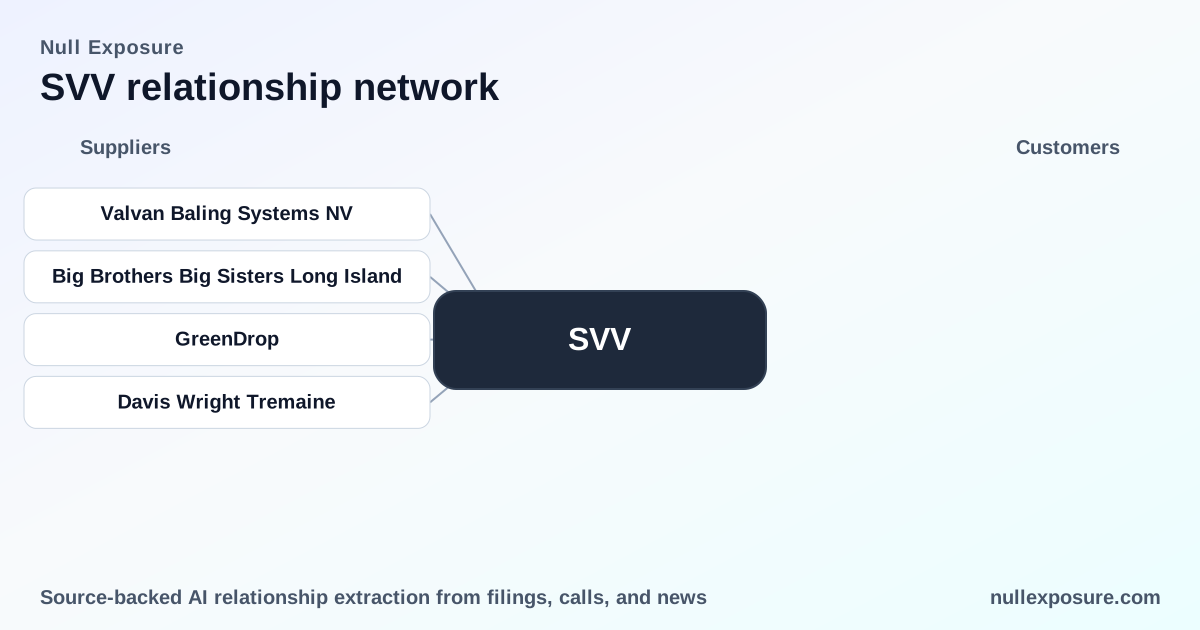
Savers’ supplier ecosystem mixes contractual technology partners, repeat non‑profit partners, community nonprofits and service counsel. Below are the relationships identified in recent public materials; each entry includes a concise description and a source reference.
Valvan Baling Systems NV
Savers has a contractual arrangement granting exclusive rights to use CPC (centralized processing center) and ABP technology, indicating a technology and equipment relationship that supports its processing footprint. According to the company’s 2024 Form 10‑K, those agreements include exclusive usage rights for the CPC and ABP technology (FY2024, Savers 10‑K).
GreenDrop
GreenDrop is a material supply channel: Savers processes significant poundage sourced from on‑site donations and GreenDrop locations, and the company states GreenDrop is a primary contributor to its supply mix. TradingView coverage of Savers’ SEC filings noted 261 million pounds processed with 79.8% sourced from on‑site donations and GreenDrop (FY2024 SEC 10‑Q cited on TradingView); marketscreener and earnings transcripts reiterate that Savers purchases goods from GreenDrop locations and discusses GreenDrop as a core collection channel (FY2025–FY2026 press coverage and earnings call).
Big Brothers Big Sisters Long Island
Local nonprofit partners supply donations that Savers purchases; reporting on community practices shows nonprofits collect items from donors and then sell or transfer them to Savers, reflecting the company’s reliance on local NPP supply flows (Newsday coverage of community donation practices, FY2025).
Davis Wright Tremaine
Davis Wright Tremaine appears in public news related to legal proceedings and representation tied to Savers’ operating disputes; coverage referenced a legal statement from a Savers‑related attorney in litigation with a state agency (Courthouse News, FY2023). This highlights the company’s engagement with outside counsel on regulatory and constitutional matters.
What the contract and constraint signals reveal about operational risk
Savers’ public constraints and disclosures provide a clear picture of how supplier relationships are structured and where operational risks concentrate.
-
Contracting posture: The company discloses that contracts with NPPs are typically short‑term (1–3 years), which creates a recurring renewal risk and necessitates active relationship management to preserve supply continuity. This short formal term sits alongside a different signal on relationship longevity, creating an operational nuance worth monitoring.
-
Relationship maturity and stickiness: Savers reports that relationships with its non‑profit partners average approximately 20 years, indicating deep, longstanding partnerships that offer stability despite short formal contract terms. That combination suggests renewal friction is manageable in practice but not contractually locked in.
-
Counterparty mix and sourcing channels: The company documents two primary counterparty types: individual donors (via Community Donation Centers) and non‑profit partners. Those channels feed the retail supply chain and drive throughput.
-
Concentration and criticality: OSDs (on‑site donations) and GreenDrop together accounted for 76.3% of total pounds processed in FY2024, making that pairing a critical single point of supply concentration and a key operational dependency. GreenDrop is therefore a material supplier for the company’s intake volume (company disclosures, FY2024).
-
Roles and capability signals: Public excerpts classify Savers as a buyer of secondhand goods and indicate involvement in manufacturing/design for processing equipment (agreements covering design and commissioning of CPCs), as well as reliance on external service providers such as auditors and counsel. These roles underscore that processing technology and external service relationships are part of the firm’s operating fabric.
Taken together, these constraints show a company that is operationally mature and relationship‑intensive, but structurally exposed to a small number of sourcing channels and to equipment/processing partners that shape throughput economics. If processing capacity or major channel access is disrupted, margin and sales conversion would be meaningfully affected.
Explore a structured supplier risk view at https://nullexposure.com/ for a deeper read.
Investor implications: where upside and risk intersect
-
Upside drivers: Scale improvements at CPCs, improved pricing conversion on intake, and tighter cost control can expand the relatively thin profit margin characteristic of thrift retail. Analysts show bullish leanings with a consensus analyst target price of $14.75 and a mix of buy ratings (analyst coverage summary).
-
Key risks: Supply concentration (OSDs + GreenDrop) and reliance on proprietary processing equipment introduce single‑point operational risk; short formal contract terms with NPPs increase renegotiation exposure even if relationships are long‑standing. Legal and regulatory disputes require prudent governance and may create episodic costs, as public counsel involvement indicates.
-
Balance sheet and valuation: With trailing revenue of roughly $1.68 billion and EBITDA near $214 million, the market assigns a multiple that reflects growth optionality and operational leverage; the forward P/E sits substantially lower than the trailing P/E, suggesting analysts expect earnings normalization or improvement.
Bottom line and next steps
Savers is a throughput‑centric retailer whose value depends on maintaining high‑volume, low‑cost intake and extracting processing and retail margin through proprietary operational elements. Investors and operators should prioritize monitoring GreenDrop and OSD supply trends, the health and exclusivity of CPC arrangements, and renewal dynamics with non‑profit partners. For further intelligence on supplier concentration and contractual posture visit https://nullexposure.com/.
If you want a granular supplier risk briefing or a comparison across retail peers, start here: https://nullexposure.com/.