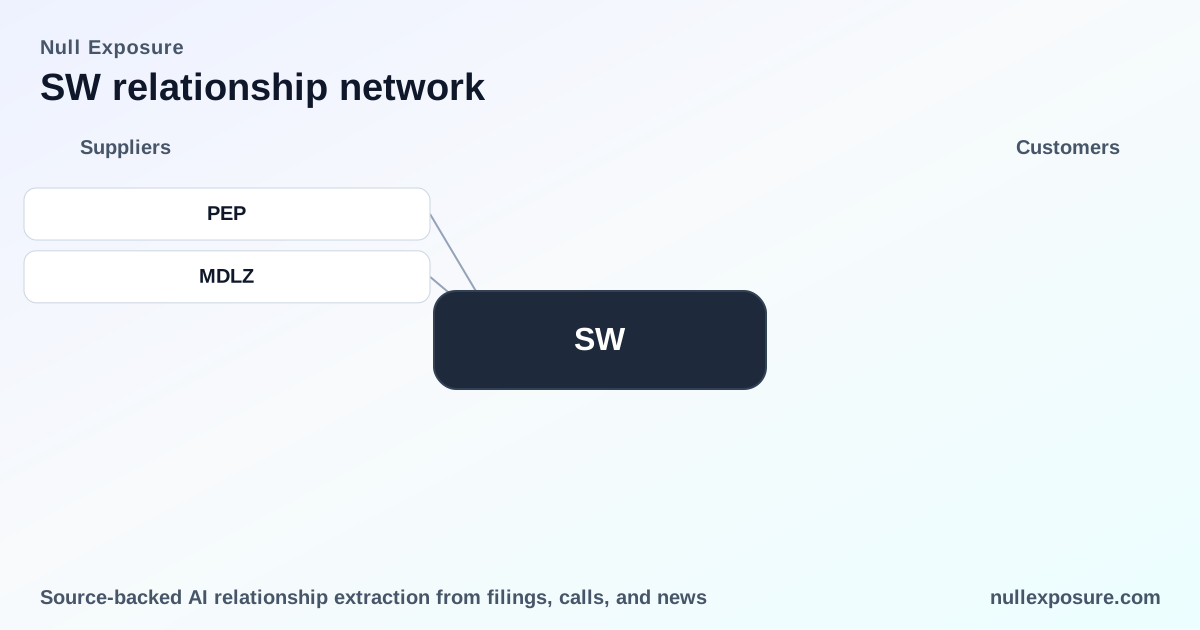
Smurfit WestRock (SW): Packaging scale, marquee CPG customers, and a financing posture that underwrites growth
Smurfit WestRock manufactures containerboard and corrugated packaging and monetizes by selling high‑volume, value‑added paper packaging solutions to global consumer packaged goods companies and distributors; the company converts raw material and manufacturing scale into predictable revenue streams (Revenue TTM $31.18bn; EBITDA $4.80bn) and supports working capital and capex through a mix of short‑ and long‑term liquidity facilities. For investors and operators, the key takeaway is simple: Smurfit WestRock is executing a supplier‑led growth model that depends on operating continuity, deep commercial relationships with large CPGs, and a financing stack that balances multi‑year credit capacity with short‑dated commercial paper.
Explore integrated supplier risk profiles and commercial signals at https://nullexposure.com/.
Operational snapshot and why supplier relationships matter Smurfit WestRock’s business is built on scale and reliability: it sells standardized and custom corrugated packaging that is mission‑critical to customer supply chains. Winning procurement awards from blue‑chip customers is a commercial moat signal—it drives repeat demand, supports price negotiation power for specialty work, and helps fill plant capacity planning. At the same time, the company's margins are modest for the scale (Operating margin TTM ~6.17%, Profit margin ~2.24%), so reliability of feedstock and predictable payment flows are decisive inputs to free cash flow. Institutional ownership is high (roughly 95.6% institutional holders), indicating the stock is held primarily by sophisticated investors who track supplier performance closely.
Client and customer wins: what the filings disclose Smurfit WestRock highlights specific customer recognitions in its 2024 annual filing; these are explicit commercial signals rather than marketing anecdotes.
PepsiCo
Smurfit WestRock reports that it was the winner of PepsiCo’s Supplier of the Year award as disclosed in its 2024 Form 10‑K. This designation signals a strategic operational relationship with a major food & beverage OEM that prizes on‑time delivery and packaging innovation (Smurfit WestRock 2024 10‑K disclosure, FY2024).
Mondelez
The company also states it won Mondelez Supplier of the Year award alongside a broad sweep of industry trophies—16 Flexographic Industry Association UK awards and 13 WorldStar 2024 awards—which underscores both creative capability and recognized quality across multiple channels (Smurfit WestRock 2024 10‑K disclosure, FY2024).
Constraints and what they reveal about the operating model The filing provides direct excerpts that characterize Smurfit WestRock’s contracting posture, liquidity maturity, and operational dependencies. Presenting these as company‑level signals:
- Dual financing posture (long‑ and short‑term): The company maintains a five‑year revolving credit facility (the New RCF) with two potential one‑year extensions, reflecting a long‑term committed liquidity buffer for capex and working capital. Concurrently, Smurfit WestRock runs a short‑term commercial paper program for up to $1.0bn with maturities up to 397 days, enabling tactical funding at lower costs when markets are favorable (excerpted from the 2024 Form 10‑K).
- Buyer role in supplier finance: Smurfit WestRock operates supplier finance programs that permit participating suppliers to sell receivables to financing institutions; the company’s contractual obligation is to pay those institutions in full according to the original supplier terms (which generally do not exceed 120 days). This places Smurfit WestRock in a buyer‑led payment role that supports supplier liquidity while not materially altering the company’s payment obligations (10‑K excerpt).
- Seller and operational continuity risk: The company explicitly identifies interruptions in the delivery of raw materials and other manufacturing inputs as a direct operational risk, signaling that plant uptime and raw material sourcing are mission‑critical for revenue continuity (10‑K excerpt).
- Related‑party service interactions: Smurfit WestRock discloses that it sells products to and receives services from affiliated entities at normal trading terms, indicating internal supply chain and service arrangements that are settled on market terms (10‑K excerpt).
- Active liquidity availability: As of December 31, 2024, Smurfit WestRock reported $241 million of unused borrowing capacity under its facility, a live indicator of near‑term liquidity headroom (10‑K disclosure).
What these characteristics mean for investors and operators Taken together, these signals form a coherent operating profile that investors should treat as a set of tradeoffs:
- Contracting posture and maturity: The combination of a multi‑year RCF plus a commercial paper program gives Smurfit WestRock flexible funding—long‑term committed capacity for cyclical stress and short‑term, lower‑cost funding for working capital optimization. This reduces refinancing risk versus a pure short‑dated funding profile and supports the company’s capital‑intensive operations.
- Commercial concentration and criticality: Recognition from PepsiCo and Mondelez is a quality signal for revenue stickiness with major CPG buyers; however, the broader implication is that disruptions to manufacturing or raw‑material channels would have disproportionate revenue and margin impact because these buyers require scale and reliability.
- Operational risk remains the central sensitivity: While awards and large contracts are positive, the filing’s explicit call‑out of supply interruptions elevates the priority of contingency planning—inventory strategies, alternative feedstock sourcing, and cross‑site capacity flexibility. Operating continuity is the principal lever for preserving EBITDA and cash conversion.
Actionable investor considerations
- For credit and working capital investors: the mixed funding strategy is constructive—the RCF provides committed backup while short‑term commercial paper provides opportunistic savings; monitor utilization and CP spreads to assess stress.
- For equity investors: focus on operational KPIs—mill run rates, utilization, and raw material cost pass‑through to customers—since margins are modest and earnings are sensitive to disruptions.
- For procurement and risk teams at trading partners: the buyer finance program and supplier awards indicate Smurfit WestRock actively manages counterparty liquidity and supplier relationships; partner firms should evaluate payment term dynamics and the 120‑day ceiling in contract terms.
If you want a deeper supplier relationship brief, we provide structured summaries and risk signals for strategic suppliers—start here: https://nullexposure.com/.
Conclusion and next steps Smurfit WestRock combines scale manufacturing, recognized commercial relationships with major CPGs, and a financing mix that balances committed backup with short‑dated flexibility. Primary investor risks are operational: raw material interruptions and plant uptime can compress thin margins quickly, while the supplier finance posture creates predictable but finite buyer obligations. For investors and operators evaluating supplier exposure, the combination of supplier awards and explicit operational constraints points to a company that is commercially strong but operationally levered.
For a full supplier risk dossier and continuous monitoring, visit https://nullexposure.com/.