SWAG supplier relationships: what investors need to know
Software Acquisition Group III Inc (SWAG) operates as a blank‑check acquisition vehicle that monetizes by completing a business combination and converting trust capital into an operating company; until a deal closes the company’s economics are driven by sponsor promote, trust interest, and the trajectory of any post‑combination operating entity. With roughly $108 million in trailing revenue reported for the underlying business activities disclosed and a market capitalization around $51 million, the company is operating at thin margins and relies on outsourced partners for investor relations, ERP implementation, manufacturing and logistics. Investors should evaluate supplier relationships as immediate operational levers that will determine integration speed and gross‑margin recovery post‑combination. For more context on supplier mappings and strategic implications, visit https://nullexposure.com/.
Snapshot: why supplier ties matter for a SPAC-turned-operating concern
SWAG’s public disclosures show it sources manufactured and branded goods through third‑party factories and decorators while relying on external professional services for investor communications and enterprise systems. That mix implies a light asset base but high dependency on service providers and contract manufacturers to deliver revenue and fulfill customer commitments. Given the company’s negative EPS and modest EBITDA, supplier execution and contract terms will be primary drivers of profitability after any business combination.
The operational constraints that shape vendor risk
Company‑level disclosures provide direct signals about how SWAG contracts and where supply risk concentrates:
- Long‑term occupancy commitment. The company signed a seven‑year lease for new office space in North Quincy effective June 1, 2025, with an option to extend five years—this is a fixed operating cost that raises the importance of predictable revenues to cover overhead.
- Global supplier footprint. Management states it sources products and raw materials from domestic and international factories, which implies exposure to cross‑border logistics, tariffs, and lead‑time volatility.
- Buyer / manufacturer / service provider posture. SWAG characterizes its role as purchasing branded products through third‑party manufacturers and decorators and reselling finished goods; it also maintains a network of service providers including printers, logistics firms, and warehouses. This structure signals low vertical integration and higher outsourcing risk, but also rapid scalability if supplier relationships hold.
These constraints are company‑level signals about contracting posture, concentration, criticality and operational maturity: SWAG is contractually committed (lease), globally sourced (supplier dispersion), and operationally dependent on third‑party manufacturing and service providers, which elevates counterparty and execution risk until integration and margin stabilization occur.
What the public record shows about named partners
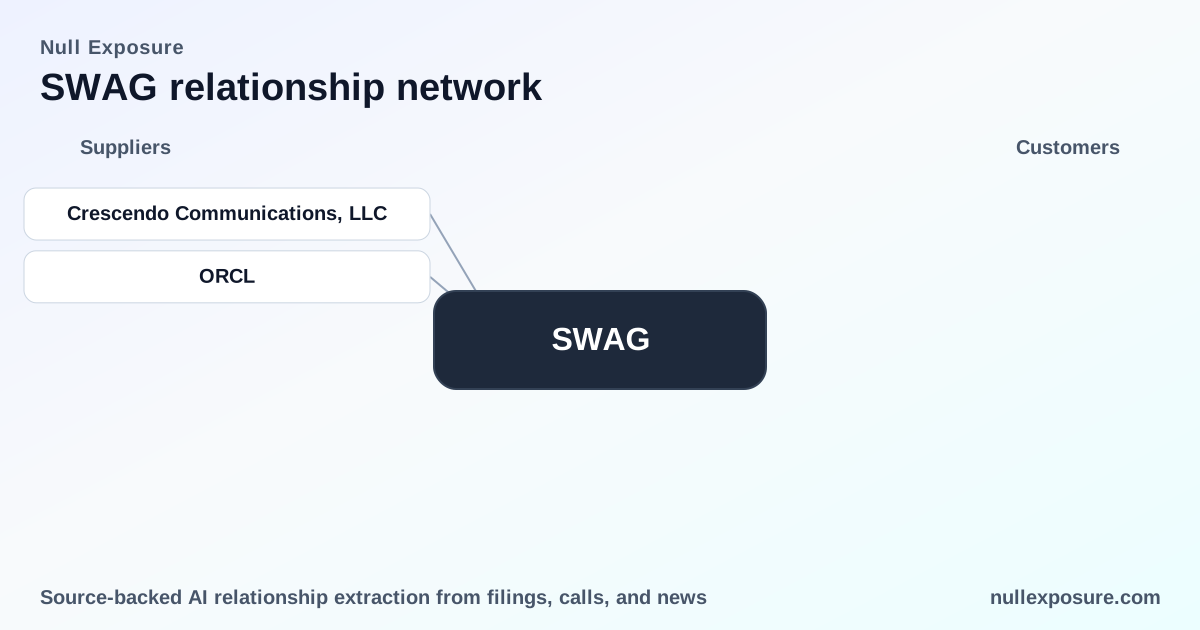
Crescendo Communications, LLC — investor relations partner
Crescendo appears repeatedly as the investor relations contact on SWAG press releases, indicating a formal IR engagement used to manage market communications and press distribution. According to a GlobeNewswire press release carried by The Globe and Mail in March 2026, Crescendo is listed as the investor relations contact for SWAG’s Q1 2025 sales disclosure. A Manila Times republish of a GlobeNewswire release in January 2026 again cites Crescendo as the investor relations contact for a multimillion‑dollar contract announcement, and a Yahoo Finance distribution in March 2026 repeats Crescendo’s contact details. Crescendo’s repeated appearance signals a stable outsourced IR arrangement rather than ad‑hoc press outreach. (GlobeNewswire/The Globe and Mail, March 2026; Manila Times/GlobeNewswire, January 2026; Yahoo Finance, March 2026.)
NetSuite (Oracle) — enterprise systems provider
SWAG reports a full NetSuite ERP rollout in January (FY2025), which management credits with improvements in automation, real‑time visibility and centralized process control; this is framed as a scaling enabler for client service and operations. The NetSuite implementation is described in the same GlobeNewswire filing referenced for the company’s Q1 results. An enterprise‑grade ERP implementation is a material operational milestone: it reduces financial reporting friction and can accelerate margins by improving order‑to‑cash and inventory controls, but it also concentrates operational dependency on a single ERP provider during the integration phase. (GlobeNewswire/The Globe and Mail, March 2026.)
What each relationship implies for investors
- Crescendo Communications, LLC: Outsourced investor relations reduces internal overhead and professionalizes communications, but it also centralizes public messaging control outside management; for investors this is a positive for disclosure quality but one more vendor dependency to monitor (GlobeNewswire press distributions, FY2025–FY2026).
- NetSuite (ORCL): An enterprise‑wide ERP rollout signals improved operational maturity and scale potential; however, reliance on NetSuite during a high‑growth period concentrates execution risk and requires disciplined change management (GlobeNewswire press release, FY2025).
Financial context and risk framing
SWAG reports $108.4 million in trailing revenue and negative EPS, with a Price‑to‑Sales ratio under 0.3 and a market cap materially below trailing revenue—a structure that makes supplier terms and cost control central to any re‑rating. Key investment risks tied to suppliers include: supplier concentration across international factories, logistics disruption, the cost impact of the long‑term office lease, and transition risk associated with ERP adoption. Operational execution from manufacturers and service providers will determine near‑term cashflow outcomes given the company’s compressed margins and modest institutional ownership.
- Primary operational risk: global manufacturing and logistics exposure could widen gross margin volatility.
- Structural cost risk: fixed lease obligations raise the break‑even revenue requirement.
- Execution risk: ERP rollout reduces manual controls but creates a dependency window during stabilization.
Tactical takeaways for investors and operators
- Monitor vendor payment terms and order lead times from the company’s post‑combination disclosures; they will reveal how much working capital is being transferred to suppliers.
- Track Crescendo‑branded press releases and investor presentations for early signals on customer wins and supply constraints, since Crescendo is SWAG’s external IR conduit.
- Evaluate NetSuite go‑live milestones and KPIs around order processing speed, inventory turns and billing accuracy to assess margin recovery prospects.
For a deeper supplier risk map and operational diligence resources visit https://nullexposure.com/ — the supplier view frames contract and concentration risk that underwriting models must incorporate.
Bottom line
SWAG’s supplier footprint is typical of a light‑asset, brand‑and‑service dependent business: outsourced IR through Crescendo, third‑party manufacturing and logistics, and an enterprise ERP backbone via NetSuite. These relationships collectively reduce capital intensity but concentrate operational risk in counterparty performance and integration execution. Investors should prioritize supplier‑level disclosures, vendor contract terms, and NetSuite stabilization metrics as leading indicators of whether the company can convert its top‑line into sustainable profitability.
If you want a structured supplier review tailored to diligence or portfolio monitoring, start here: https://nullexposure.com/.