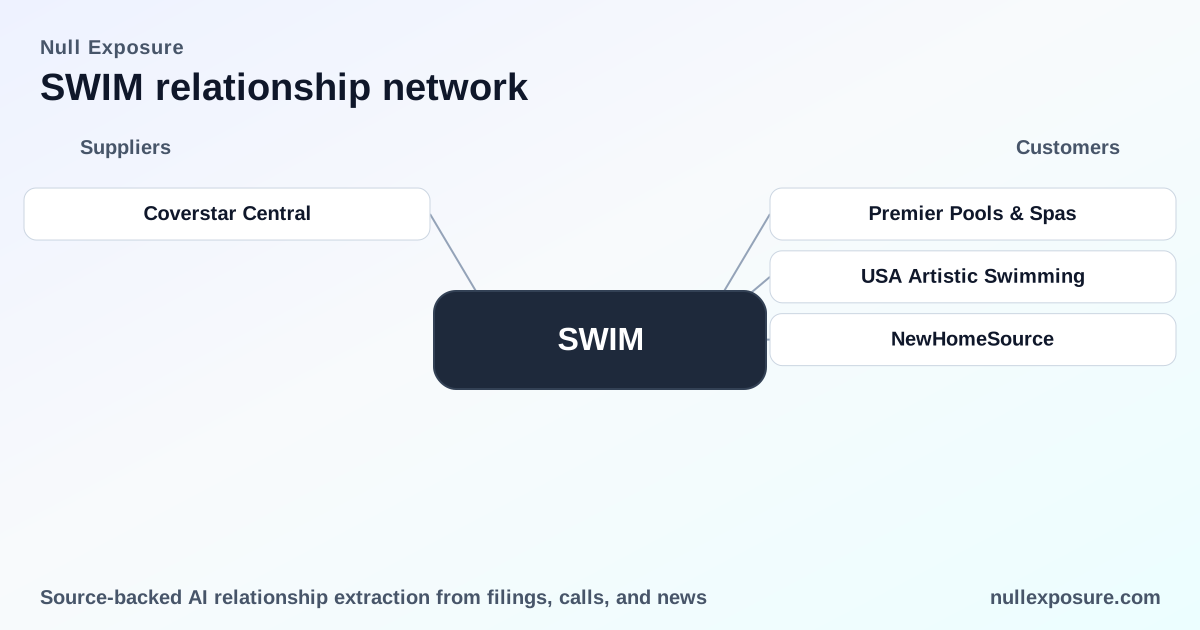
Latham Group (SWIM): Supplier posture drives margins and operational leverage
Latham Group designs, manufactures and sells residential inground swimming pools, monetizing through direct product sales and a growing aftermarket/cover business that supplements core pool revenues. The company’s financial profile — roughly $546m revenue TTM, $715m market capitalization, and thin net margins — is sensitive to raw-material inputs and supplier concentration, which creates both operating leverage in upcycles and margin pressure in inflationary periods. For investors evaluating supplier risk, Latham’s contracting style and supplier concentration are the primary levers to monitor.
Explore more supplier risk intelligence at https://nullexposure.com/.
Why supplier relationships matter for a pool manufacturer
Latham’s product economics are straightforward: raw materials such as PVC, fiberglass, resins and metals comprise the majority of cost of sales, and finished-goods throughput scales revenue quickly when demand is strong. With a market capitalization of roughly $714.6m and revenue of $545.9m (TTM), small swings in input pricing and availability translate directly to earnings volatility given a thin profit margin (~2.0%) and negative operating margin noted in recent periods. The company’s strategy of expanding adjacent product lines — notably automatic safety covers — changes supplier mix and introduces acquisition integration risk alongside procurement complexity.
Supplier relationship snapshot — what’s on the record
Below I cover every supplier relationship noted in the available intelligence.
Coverstar Central
Latham has expanded its automatic safety cover business through acquisitions, including Coverstar Central, signaling a move to broaden its product set and aftermarket revenue. According to a MarketMinute report on January 8, 2026, the Coverstar Central integration is part of an aggressive push into automatic covers that helps diversify product offerings and capture higher-margin recurring sales. (MarketMinute / FinancialContent, Jan 8, 2026)
How Latham contracts with suppliers — practical implications
Latham’s public disclosures and excerpts show a procurement posture that is predominantly short-term and spot-oriented, punctuated by occasional strategic bulk buys for select raw materials. This contracting approach creates a set of predictable characteristics:
- Short-term/annual agreements dominate: Latham negotiates key supply agreements on an annual basis, which reduces long-term price certainty for buyers and increases exposure to commodity cycles.
- Spot purchases are routine: The company buys many materials “on an as-needed basis,” negotiating prices continuously in line with market conditions, which preserves flexibility but transmits price volatility to margins.
- Selective strategic purchases: Management will make larger strategic buys for specific materials when advantageous, indicating active working-capital and inventory management to smooth supply shocks.
Together, these behaviors form a company-level signal: Latham prioritizes flexibility and cash efficiency over long-term price hedging, which is consistent with seasonal demand patterns in the pool industry but leaves margins exposed in inflationary input cycles.
Concentration and criticality — structural supply risk
The procurement profile also shows meaningful supplier concentration and material criticality that investors must weigh:
- Top-ten supplier concentration is high: In 2024, 64% of supplies were purchased from the top ten suppliers, and the largest supplier accounted for 13% of purchases. This raises the cost of any single supplier disruption and diminishes bargaining power if a major vendor tightens capacity.
- Raw materials are critical to cost structure: PVC, galvanized steel, fiberglass, resins, polystyrene and related inputs represent a majority of cost of sales, making procurement execution a direct determinant of gross margin.
These are not abstract facts — they translate into measurable financial sensitivity: a persistent jump in PVC or resin costs without offsetting price increases to dealers and consumers will compress gross margins and slow EBITDA recovery.
What this means for investors and operators
Operationally, Latham’s model is mature but procurement-sensitive. The company’s high institutional ownership and thin earnings per share profile imply that markets price in execution risk and cyclicality. For investors and operators, the priority checklist is clear:
- Monitor quarterly disclosures for changes in supplier mix and any long-term agreements that reduce spot exposure.
- Track management commentary on inventory and strategic purchases — these are the levers Latham uses to blunt commodity shocks.
- Evaluate integration progress of acquisitions like Coverstar Central for both revenue diversification and any added supply-chain complexity.
If you want ongoing coverage of supplier risk and concentration for industrials like Latham, visit https://nullexposure.com/ for structured supplier intelligence.
Risk factors that deserve premium attention
Several risk vectors are elevated and deserve active monitoring:
- Commodity-driven margin risk: Given inputs are a majority of cost of sales, commodity inflation without price passthrough compresses margins quickly.
- Supplier concentration: Reliance on a concentrated pool of vendors increases single-point-of-failure risk and gives suppliers leverage if capacity tightens.
- Contracting posture: Annual and spot contracting preserves flexibility but transfers market price volatility to Latham’s P&L.
- Integration risk from acquisitions: Adding businesses like Coverstar Central broadens revenue but introduces supplier overlaps, new vendor relationships and potential inventory mismatches.
Each of these factors is actionable in investment due diligence — examine supplier payment terms, inventory turns, and the percentage of purchases subject to long-term contracts versus spot purchase.
Bottom line and next steps
Latham is a scaled, revenue-generating manufacturer with clear exposure to raw-material economics and supplier concentration, and a strategic push into aftermarket products that can increase recurring revenue if integrations are successful. For investors, the primary value drivers are commodity pass-through ability, procurement execution, and the pace at which acquisitions bolster margin profiles.
For deeper supplier-level analytics and to track evolving relationships and constraints for SWIM, visit https://nullexposure.com/ — the hub for ongoing supplier risk intelligence.
Explore the supplier network, monitor procurement signals, and prioritize management disclosures; Latham’s profitability will be determined as much by supply-chain execution as by market demand.