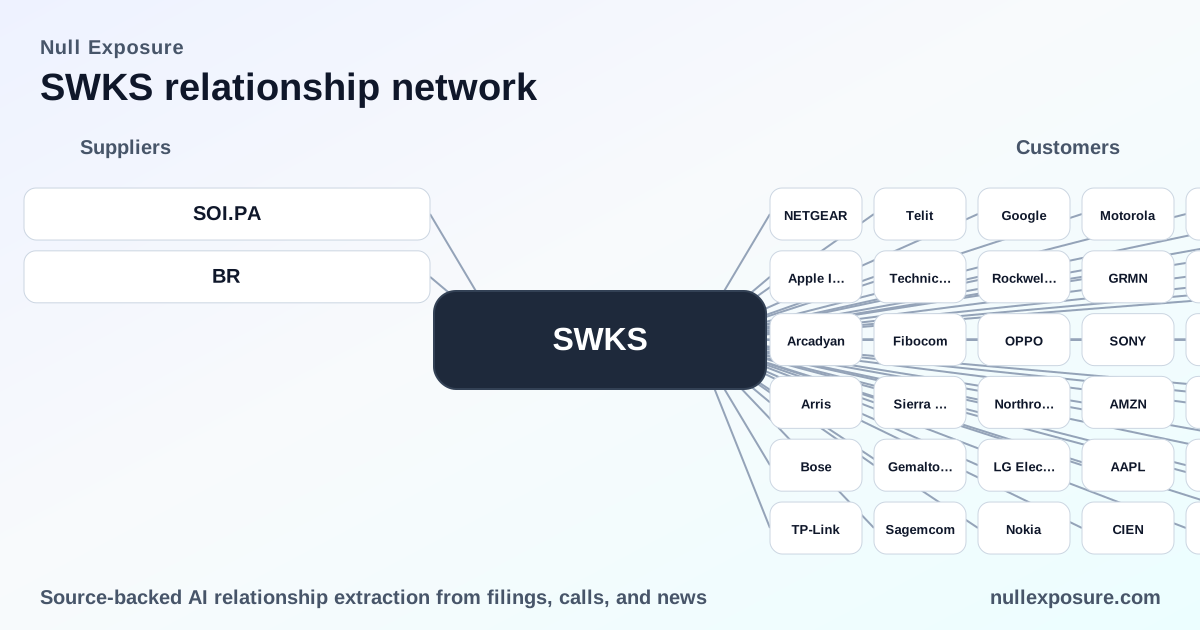
Skyworks Solutions (SWKS): Supplier relationships, operating posture, and what investors should price in
Skyworks Solutions manufactures RF semiconductors and monetizes by selling integrated RF front-end and connectivity components into smartphones and other wireless devices, capturing revenue through product sales tied to multi-generational platform ramps (for example Sky5). Revenue derives from design wins and ongoing supply agreements with OEMs and component suppliers, with margins driven by mix, scale, and manufacturing sourcing. For investors evaluating supplier relationships, the operating risk is concentrated in a small set of critical suppliers and a mix of framework and spot purchasing that together shape cost, availability, and execution risk. Learn more about supplier intelligence and counterparty exposure at https://nullexposure.com/.
How Skyworks makes money and why supplier links matter
Skyworks sells RF solutions to mobile handset and wireless infrastructure customers; the company’s top-line is closely tied to product lifecycles in 5G smartphones and connectivity modules. With Revenue TTM of $4.05B, gross profit of $1.67B, and operating margin around 14.7%, the business scales profitably but requires tight supply coordination to meet product launch timing and quality standards. The balance between long-term framework agreements and purchase-order (spot) buying determines Skyworks’ flexibility versus its exposure to supplier scarcity and price swings.
- Supplier concentration is a strategic lever and a risk: company disclosures note dependence on a limited number of sole-source suppliers and a global supplier footprint, which increases execution risk during cycle stress or geopolitical disruptions.
- Contract mix matters for forecasting: the firm uses both framework agreements with minimums and spot purchase orders, creating a hybrid contracting posture that affects predictability of costs and volumes.
The supplier relationships you must account for
Soitec — wafer supply for Sky5 RF platform
Soitec will supply POI (pathways on insulator) wafers for Skyworks’ Sky5 platform to meet the RF requirements of 5G smartphones. According to a March 10, 2026 Yahoo Finance report describing Soitec’s multi-agreement supply win, this is a direct materials relationship tied to a core Skyworks platform and therefore operationally critical for Sky5 production. (Source: Yahoo Finance, March 10, 2026.)
Broadridge — independent inspector role in corporate voting
Broadridge is referenced in proxy reporting as providing independent inspection services for shareholder votes; Terry Hassett of Broadridge served as the inspector of elections in a recent shareholder meeting. A March 10, 2026 corporate-governance report on Yahoo Finance documents Broadridge’s role in Skyworks’ shareholder vote process, reflecting a governance services relationship rather than a manufacturing supply chain dependency. (Source: Yahoo Finance, March 10, 2026.)
What the relationships collectively tell investors about operational risk
The Soitec supply arrangement is material and production-critical, directly tied to Sky5 wafer needs and therefore to product delivery risk and revenue realization for Sky5-dependent shipments. Broadridge’s role is governance-adjacent and does not affect manufacturing, but its inclusion in public filings signals routine third-party vendor use for corporate processes.
Company-level constraints extracted from filings and disclosures frame the sourcing posture:
- Contracting posture is hybrid: disclosures confirm Skyworks uses both framework agreements with minimum price/volume commitments and individual purchase orders; this creates a blend of committed supply and spot flexibility that impacts both cost control and responsiveness.
- Supplier geography is global: Skyworks operates a worldwide supplier base and has taken actions to secure sourcing globally, increasing complexity and exposure to cross-border logistics and geopolitical policy shifts.
- Concentration risk is elevated: Skyworks discloses dependence on a limited number of sole-source suppliers, which increases operational fragility when a single supplier is critical to a platform.
- Buyer role and negotiating leverage: Skyworks generally purchases materials via purchase orders and framework agreements, so pricing discipline depends on volume, platform importance, and the supplier’s rarity.
These constraints are company-level signals documented in Skyworks’ disclosures and should be mapped to platform timelines and inventory levels when modeling downside scenarios.
Financial implications for investors
Skyworks’ financial profile—market cap of roughly $8.2B, Revenue TTM $4.05B, EBITDA $945.7M, and trailing P/E ~20.9 with a forward P/E of ~11.5—reflects a semiconductor supplier with cyclic exposure but meaningful margin leverage when demand normalizes. A critical supplier such as Soitec that supplies POI wafers for Sky5 represents a direct lever on both near-term fulfillment and medium-term margin stability, because wafer pricing and availability affect unit COGS and shipment cadence.
Key investor takeaways:
- Positive: Platform design wins like Sky5 increase recurring content per handset and support gross margin expansion when volumes scale.
- Negative: Sole-source or limited-source suppliers increase tail risk; a disruption to a wafer supplier during a ramp can compress margins and delay revenue recognition.
- Neutral operational signal: Use of both frameworks and spot orders gives Skyworks flexibility but complicates near-term forecasting—investors must incorporate supply contract cadence into revenue models rather than assuming uniform gross margin progression.
Explore deeper counterparty exposure and supplier health at https://nullexposure.com/ to stress-test your Skyworks valuation under supply disruption scenarios.
What to watch next and how to prioritize research
Investors should monitor the following items over the next 12 months:
- Supply agreement announcements and execution timelines for Sky5 shipments, particularly wafer delivery schedules and minimum purchase quantities reported in company or supplier disclosures.
- Quarterly commentary and gross margin progression—specifically references to material costs or logistics that could indicate supplier pressure.
- Corporate filings for any updates on sole-source dependencies and mitigation actions, including qualifying secondary suppliers or inventory build strategies.
- Governance filings and shareholder meeting outcomes for corporate continuity signals; Broadridge’s role in vote inspection is routine but proxy outcomes can affect strategy.
Final assessment and action items
Skyworks’ business is platform-driven with concentrated supplier exposure that lifts upside when ramps succeed and magnifies downside when critical suppliers falter. For investors, the Soitec relationship is the operational headline: it is directly tied to Sky5 production and therefore to top-line and margin execution. Broadridge’s involvement is a governance footnote and does not alter manufacturing risk.
If you are modeling Skyworks, explicitly incorporate the hybrid contracting posture, global supplier footprint, and documented sole-source dependence into scenario analyses. For targeted supplier intelligence and counterparty exposure modeling, visit https://nullexposure.com/ for tools and reports that help quantify these supplier risks and their valuation impact.