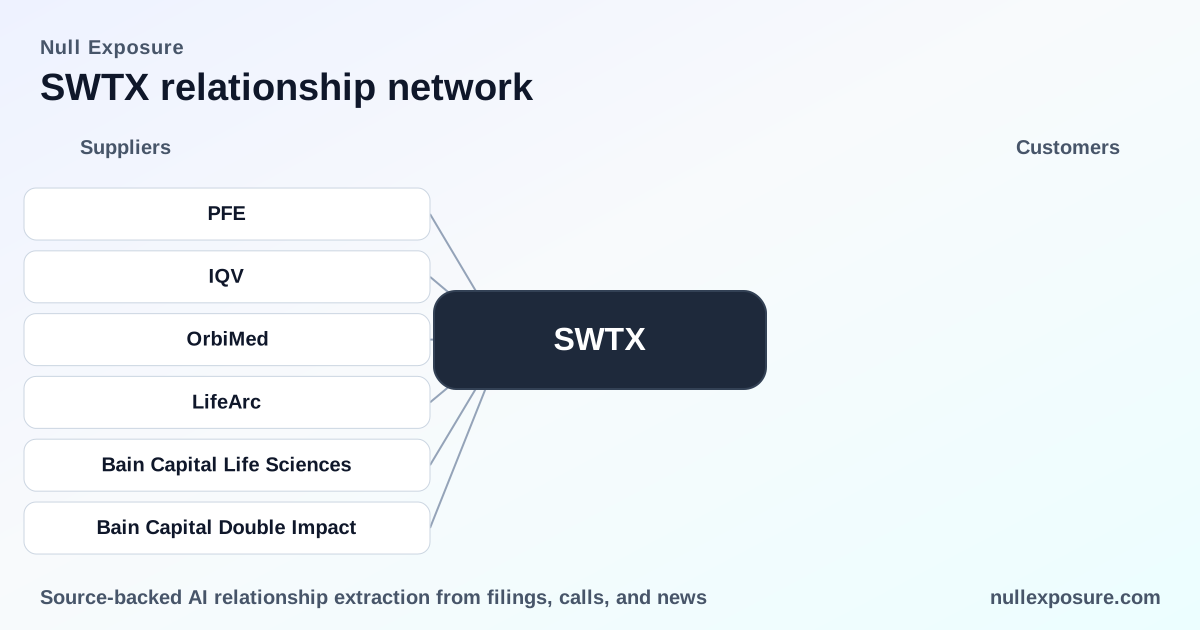
SpringWorks (SWTX) supplier map — what counterparties tell investors about risk and optionality
SpringWorks monetizes by acquiring or in‑licensing shelved or underdeveloped oncology and rare‑disease assets, advancing them through clinical proof points, and capturing value through milestone payments, royalties and eventual product sales or exits. The company’s operational model is built on license-first contracting with large pharma and selective venture capital backing, supplemented by outsourced medical communications and commercialization services that support regulatory and market access efforts. For investors and counterparties evaluating exposure to SpringWorks, the counterparty roster signals a highly curated, sponsor-backed growth strategy rather than a distributed, asset‑heavy manufacturing posture.
Explore more supplier maps and counterparty intelligence at https://nullexposure.com/.
How contracting and capital relationships drive the economics
SpringWorks’ path to cash flow is not built on manufactured scale but on contractual optionality. The company enters the market by taking on assets that incumbent pharma have deprioritized, then funds and derisks those assets through development milestones and targeted commercialization. This results in several company‑level signals relevant to suppliers and investors:
- Contracting posture: Predominantly license‑and‑milestone arrangements that shift late‑stage development and commercialization risk back to SpringWorks while reserving royalties and milestone upside for the original sponsor.
- Concentration: Early capital and in‑licensed asset flow is concentrated to a small set of institutional investors and a strategic pharma partner, which increases counterparty influence on capital strategy and deal structure.
- Criticality: Relationships that provide initial assets (licensor) and growth capital (investors) are strategically critical to SpringWorks’ pipeline generation model; vendor services (medical communications) are mission‑supporting but not core to R&D.
- Maturity signal: Founded through a spin‑out model in 2017 and scaled via selective in‑licenses and financing, SpringWorks presents as a matured biotech growth platform rather than a pre‑seed operation.
No explicit contractual constraints are present in the supplied relationship data, which is itself a company‑level signal: no single public constraint document was returned by the dataset for supplier‑scope relationships.
Counterparties, investors, and vendors that define exposure
Pfizer — the originator of key assets and an ongoing licensing partner
SpringWorks launched in 2017 by in‑licensing multiple oncology programs that Pfizer had shelved, and those licenses include milestone and royalty structures that underpin SpringWorks’ monetization pathway. According to Pharmaphorum’s 2017 coverage, Pfizer granted licences that pay milestones and royalties on the experimental therapies (https://pharmaphorum.com/transversal-categories/rd/springworks-spins-pfizer-rare-disease-rd-mission). Media coverage later framed SpringWorks’ formation as the company taking on Pfizer’s “ghost” drug assets and progressing them to patients (BioSpace, March 2026: https://www.biospace.com/business/how-springworks-took-pfizers-rare-disease-ghost-drug-and-got-it-to-patients). Additional reporting notes SpringWorks launched in 2017 with two in‑licensed drugs Pfizer had shelved after initial cancer development (MedCity News, April 2025: https://medcitynews.com/2025/04/merck-kgaa-springworks-therapeutics-acquisition-rare-tumor-cancer-ogsiveo-gomekli/).
IQVIA Medical Communications — outsourced medical writing and editorial support
SpringWorks funded writing, editorial and design assistance for at least one peer‑reviewed article through IQVIA Medical Communications, indicating routine use of contract communications vendors to support scientific dissemination and regulatory narratives (OJRD article acknowledgement, FY2025: https://ojrd.biomedcentral.com/articles/10.1186/s13023-025-04021-7).
OrbiMed — institutional life‑science investor in the launch financing
OrbiMed participated as an investor in SpringWorks’ formative capital raise, joining Pfizer, LifeArc and Bain Capital in a $103 million backing that established SpringWorks’ initial runway and governance profile (Pharmaphorum, 2017: https://pharmaphorum.com/transversal-categories/rd/springworks-spins-pfizer-rare-disease-rd-mission).
LifeArc — charitable/technology‑transfer partner in initial capital
LifeArc (formerly MRC Technology) provided early non‑dilutive or catalytic capital as part of the founding syndicate, signaling early academic/charitable support for the spin‑out model used to seed SpringWorks (Pharmaphorum, 2017: https://pharmaphorum.com/transversal-categories/rd/springworks-spins-pfizer-rare-disease-rd-mission).
Bain Capital Life Sciences — strategic venture capital backer
Bain Capital Life Sciences was part of the founding financing group that provided essential growth capital at launch, aligning SpringWorks with deep life‑science venture resources and governance (Pharmaphorum, 2017: https://pharmaphorum.com/transversal-categories/rd/springworks-spins-pfizer-rare-disease-rd-mission).
Bain Capital Double Impact — impact‑oriented investor in the founding round
Bain Capital Double Impact joined the initial syndicate, contributing capital that balanced commercial and mission‑oriented investor interests during the company’s spin‑out and early scale (Pharmaphorum, 2017: https://pharmaphorum.com/transversal-categories/rd/springworks-spins-pfizer-rare-disease-rd-mission).
What the relationship footprint means for suppliers and operators
The counterparty profile presents a clear investment thesis and supplier playbook:
- For strategic suppliers (development, CMC, clinical CROs): expect license‑driven project work with defined milestone gates; contracting will emphasize deliverables tied to regulatory or clinical inflection points rather than long‑term blanket purchase commitments.
- For commercial vendors (medical communications, market access): relationships are supportive and episodic; budgets and scope expand as programs hit regulatory or commercialization milestones—IQVIA’s engagement is a practical example (OJRD acknowledgment, FY2025).
- For investors and acquirers: the concentrated investor base and large‑pharma origin of core assets create binary value hooks (successful registrational readouts or buyouts) rather than broad recurring revenue streams.
Risk implications: concentration of originator assets with Pfizer and a small founding investor group raises governance and exit dynamics risk; milestone/royalty economics reduce near‑term cash inflows until regulatory success. Operational implication: suppliers should price for milestone pacing and prepare for rapid scope expansion tied to clinical success.
Explore more supplier intelligence or arrange a counterparty briefing at https://nullexposure.com/.
Practical recommendations and closing view
SpringWorks is a license‑centric growth platform that scales value by converting de‑prioritized pharma projects into fundable, de‑risked development programs. For investors and suppliers, the company’s relationships signal targeted upside with concentrated counterparties—an attractive profile for partners that can flex resources at clinical inflection points and for investors seeking event‑driven returns.
- Suppliers should structure contracts around clear milestone triggers and ramp clauses.
- Investors should underwrite concentration risk but value the asymmetric payoff profile attached to in‑licensed assets.
- Operators should monitor licensing terms and investor syndicate actions for governance shifts that affect deal making.
For a deeper supplier risk assessment or bespoke counterparty mapping, visit https://nullexposure.com/ and request a briefing.