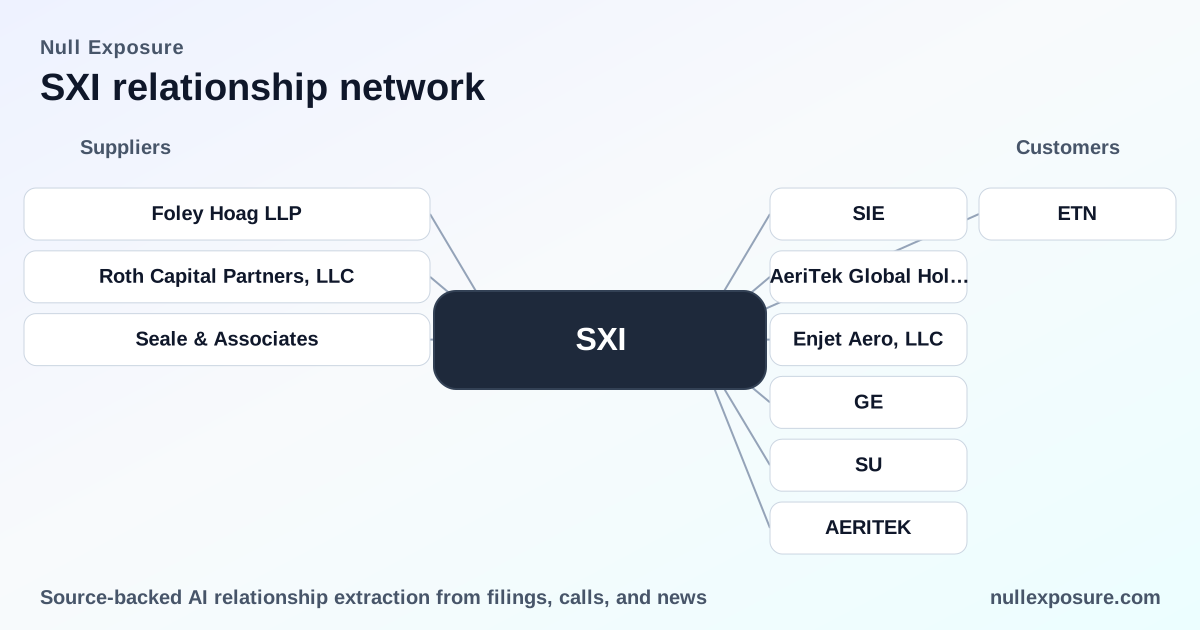
Standex International (SXI): Supplier relationships and strategic signals investors should track
Standex International manufactures specialty industrial machinery and sells components, finished equipment, and aftermarket services across multiple end markets, monetizing through product sales, service contracts, and recurring aftermarket revenue generated by a portfolio of vertical businesses. With roughly $869 million in trailing revenue and reported EBITDA of $181.4 million, Standex operates a capital-intensive manufacturing footprint that is managed through a mix of long-duration leases, short-cycle purchase commitments, and usage-linked contractual arrangements—a profile that shapes supplier dynamics, cost variability, and balance-sheet lease exposure. For an organized view of Standex’s counterparty footprint and strategic implications, visit the Null Exposure homepage: https://nullexposure.com/.
Why a supplier list matters for SXI investors
Standex’s supplier relationships are not abstract line items; they reflect the company’s operating posture. Long-term leases (some up to 55 years) give the company durable plant and equipment capacity but introduce multi-decade fixed obligations, while Standex’s procurement practice—keeping purchase contracts generally within one operating cycle—creates flexibility but increases sensitivity to commodity and freight price swings. The company also accepts variable, usage-based lease payments in some arrangements, which translates fixed-cost variability into operating volatility during demand swings.
Together these characteristics generate three practical investor implications:
- Capital intensity and lease visibility: long-term real estate and equipment leases add non-trivial operating cash outflows tied to capacity; the filings reference operating lease outflows in the tens of thousands (operating cash outflows from operating leases $12,615 in reported excerpts).
- Procurement flexibility with price exposure: short-term purchase agreements reduce supplier lock-in but increase earnings sensitivity to inflationary pressures on steel, aluminum, refrigeration components, freight, and repair parts.
- Variable-cost mechanics: usage-based lease terms shift some cost risk to operational throughput, making margins more cyclical across industrial cycles.
Identified advisor relationships and what they indicate
Below are the relationships surfaced in recent reporting. Each relationship is summarized in plain English with a concise source reference.
Foley Hoag LLP
Foley Hoag served as Standex’s legal advisor on a corporate transaction announced in FY2026, supporting deal execution and regulatory or transactional legal work. According to an Intellectia news summary published 10 March 2026, Foley Hoag LLP acted as exclusive legal advisor alongside financial counsel on the transaction.
Roth Capital Partners, LLC
Roth Capital Partners functioned as Standex’s exclusive financial advisor for the same FY2026 transaction, providing underwriting or deal advisory services that supported execution and shareholder communications. An Intellectia news summary dated 10 March 2026 records Roth Capital Partners, LLC as exclusive financial advisor on the engagement.
Seale & Associates
Seale & Associates acted as Standex’s exclusive financial advisor on the FY2021 divestiture of Enginetics Corp., a prior strategic sale that illustrates the company’s use of boutique M&A advisors for portfolio optimization. CityBiz reported the Enginetics divestiture and noted Seale & Associates’ advisory role in the FY2021 transaction.
What the relationships imply about Standex’s go-to-market and capital strategy
Standex’s disclosed advisor roster is concentrated among transaction specialists rather than large, ongoing supplier partnerships. That pattern indicates a corporate approach that prioritizes episodic, advisor-led capital actions—divestitures, acquisitions, and deal financings—over long-term, exclusive financial relationships. For investors, this translates to predictable advisor-driven outcomes for discrete strategic moves, but not necessarily a continuous advisory pipeline that would smooth strategic execution across cycles.
Operationally, the firm:
- Sources raw materials and components on relatively short contracts, keeping it flexible to tactical price shifts but exposing margins to commodity volatility.
- Uses long-term leases for capacity and facilities, introducing lease liability exposure and fixed cash outflows that are visible to creditors and investors (evidence excerpts reference lease terms up to 55 years and operating lease outflows).
- Employs third-party specialist services—investment consultants and boutique advisors—where expertise is episodically required, signaling a lean internal M&A and capital-markets team.
These traits create a balanced but cyclical profile: durable capacity on the balance sheet, short-cycle purchasing, and advisor-dependent corporate transactions.
Visit Null Exposure for a structured supplier-risk view and historical counterparties: https://nullexposure.com/.
Risk and opportunity vectors investors should prioritize
Focus capital allocation and monitoring on the following elements:
- Lease liabilities and operating cash outflows: quantify lease commitments and their maturity profile relative to free cash flow, because long-term lease terms create duration risk that can amplify downturns.
- Commodity and freight exposure: Standex purchases large quantities of steel, aluminum, refrigeration components, and freight services; short purchase cycles mean margins will track input-price cycles closely.
- Transaction execution capability: the use of boutique advisors for divestitures and Roth/Foley for more recent transactions shows the company executes through external expertise—monitor advisor selection and transaction timelines for clues on deal quality and speed.
Actionable conclusions for investors and operators
- For investors: stress-test cash flow against lease obligations and commodity cost inflation; run scenarios that combine moderate revenue contraction with fixed lease outflows to assess covenant and liquidity risk.
- For procurement teams at Standex: lock selective multi-period supply agreements for the most volatile inputs while keeping other categories flexible to capture deflationary cycles.
- For corporate development: continue engaging specialized advisors for discrete deals but build internal capability to accelerate integration and reduce execution friction.
If you want a deeper map of Standex’s counterparty network and historic advisor engagements, explore our analysis hub at Null Exposure: https://nullexposure.com/.
Standex’s supplier and advisor footprint reflects a company that runs durable, capital-heavy manufacturing capacity while relying on short-cycle purchasing and episodic external advisors for strategic moves. That combination creates a clear set of monitoring priorities—lease maturity, input-cost exposure, and transaction execution—that will drive both downside risk and upside optionality for investors.