Sensient Technologies (SXT): Supplier Relationships and Operational Constraints that Drive Margin Stability
Sensient Technologies operates as a global manufacturer and marketer of colors, flavors, and specialty ingredients, monetizing through B2B product sales to food, beverage, pharmaceutical, and industrial customers. The company converts commodity and specialty raw materials into differentiated, higher-margin formulations, supporting a $1.61bn revenue base and $284m EBITDA (TTM) while trading with a market capitalization near $3.76bn. For capital allocators and procurement officers evaluating Sensient as a supplier or partner, the critical questions are how its supply contracts, logistics footprint, and vendor relationships support production continuity and cost control. Learn more about our supplier intelligence at https://nullexposure.com/.
Overview: how Sensient runs procurement and monetization Sensient sources a mix of agricultural commodities and specialty ingredients, deliberately balancing short-term purchase flexibility with annual production contracts for key vegetable inputs. That operating posture supports product customization revenue while enabling margin protection through selective forward purchases. Sensient’s business model is asset-light on distribution and product-heavy on formulation expertise, translating commodity inputs into proprietary finished goods that carry higher relative pricing power.
A quick read of the books: Sensient's Revenue (TTM $1.61bn), Profit Margin (~8.3%), and Operating Margin (~11.3%) underline a specialty-chemical profile: structural demand, moderate cyclicality, and pricing power tied to product differentiation.
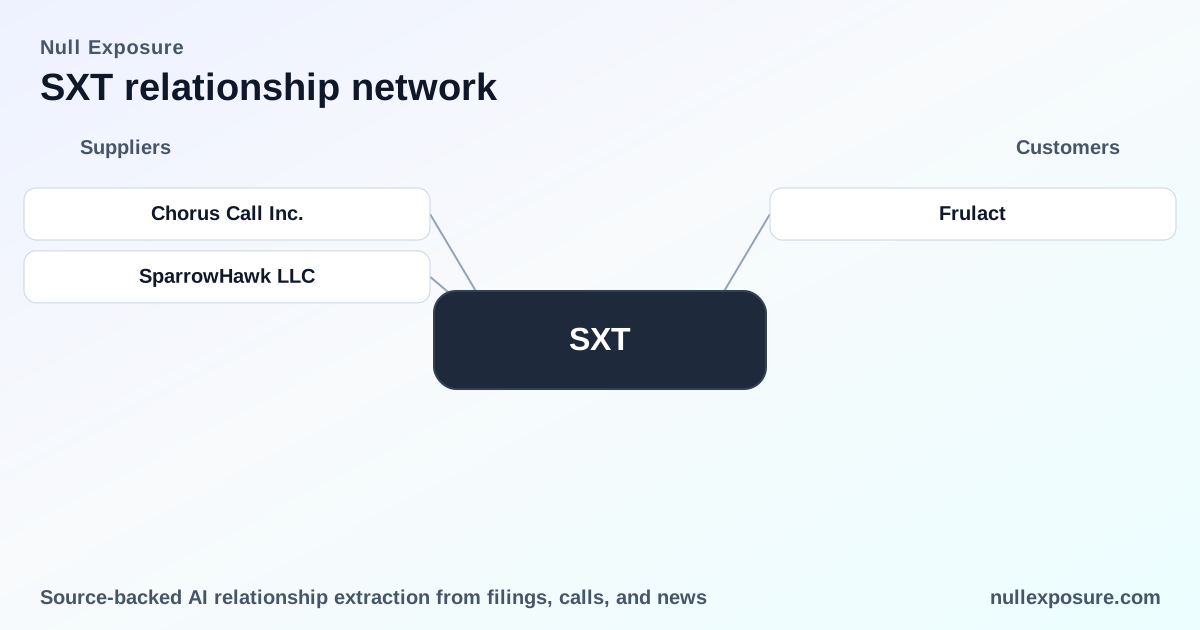
What the two disclosed third-party relationships tell investors Sensient’s public footprint in the supplied results shows two distinct external relationships: a conference services provider and a real‑estate/logistics lessor. Each relationship is operationally different in scale and criticality to the core manufacturing business.
Chorus Call Inc. — conference call services Sensient used Chorus Call Inc. to host an investor conference call for results covering the quarter ended June 30, 2025. The company’s press release instructed participants to contact Chorus Call for access to the Sensient conference call (BioSpace, Q2 2025: https://www.biospace.com/press-releases/sensient-technologies-corporation-reports-results-for-the-quarter-ended-june-30-2025). This relationship is transactional and supporting—important for investor communications but not for production continuity.
SparrowHawk LLC — logistics/leasing in St. Louis Sensient completed a lease during FY2021 for a 300,481-square-foot space in the 255 Logistics Center in St. Louis that was managed by SparrowHawk LLC, according to a market report on the property (REjournals, FY2021: https://rejournals.com/sparrowhawks-255-logistics-center-in-st-louis-now-fully-leased/). This lease signals a strategic logistics footprint decision that supports distribution and inventory staging for manufacturing customers; real‑estate leases of this scale are more operationally material than conference services.
Constraints and what they imply about Sensient’s supplier posture Sensient’s extracted constraint signals describe procurement practices and relationship maturity that are material to risk assessment. Treat these as company-level characteristics rather than tied to any single vendor unless explicitly named.
- Contracting posture: Sensient runs a mixed contracting model. The company uses annual production contracts with numerous growers—particularly for vegetables sourced in the western United States—which provides predictable volumes and continuity. At the same time, Sensient purchases many commodities on market (spot) pricing, and it will enter non‑cancelable forward purchase contracts when management chooses to hedge price risk. This blend supports cost flexibility while preserving access to specialty inputs.
- Relationship stage and maturity: The constraints list Sensient’s supplier relationships as active; language describing annual contracts and repeat purchases implies established, operationally mature relationships with agricultural suppliers rather than one-off or ad-hoc sourcing.
- Concentration and geography: Evidence points to diversified grower exposure but with geographies of importance—the western United States is identified for vegetables—so regional production shocks (weather, labor) can create localized input risk.
- Criticality: Commodities like vanilla, corn, sugar, soybean meal, fruits, and certain vegetables are explicitly identified as key purchased inputs, establishing high criticality for those supply streams to finished-goods production and margin outcomes.
Implications for investors and procurement partners
- Operational resilience: Annual grower contracts for vegetables reduce volumetric risk for core product lines; however, spot exposure to other commodities introduces earnings sensitivity to raw‑material price swings. The company’s occasional use of forward contracts gives management tactical control over cost volatility.
- Supplier concentration: Numerous growers implies lower single‑vendor concentration risk, but regional concentration (western U.S. for vegetables) creates geographic exposure that is not diversified by vendor alone.
- Non-production vendors: Relationships like Chorus Call are immaterial to manufacturing but reflect Sensient’s investment in investor communications and corporate functions—important for governance but not for supply continuity.
- Logistics strategy: The St. Louis lease indicates a multi-node logistics approach, enhancing distribution capability and potentially lowering lead times into North American customer channels.
Portfolio and sourcing risk checklist for counterparties
- Verify which commodity lines are covered by annual contracts versus spot purchasing to model input-price pass-through and margin leverage.
- Map regional supplier exposure (western U.S. growers) and assess contingency plans for weather or labor disruptions.
- Confirm the strategic role of leased logistics facilities in overall distribution—these can be leverage points for service-level improvements or cost reductions.
Middle-of-article action For deeper supplier intelligence or to benchmark Sensient against its specialty-ingredient peers, visit https://nullexposure.com/ for tailored exposure analysis and sourcing risk reports.
Final takeaways and recommendations
- Sensient’s procurement posture balances predictability and flexibility: annual contracts for vegetables coexist with spot buys and tactical forward hedging for other commodities.
- Supplier relationships are active and operationally mature, with the company relying on a mix of agricultural suppliers plus specialized service providers (conference services) and logistics lessors.
- Key operational risk: regional concentration in vegetable sourcing and ongoing exposure to commodity price swings; management’s selective use of forward contracts is the principal mitigant.
Near-close action If you evaluate supplier risk for strategic sourcing, M&A diligence, or investment due diligence, consider commissioning a focused supplier-mapping exercise at https://nullexposure.com/ to quantify concentration, criticality, and contract maturity across Sensient’s supply chain.
Sources cited in-text include Sensient’s Q2 2025 press materials published on BioSpace and a REjournals property report from FY2021; these identify respectively the Chorus Call engagement and the SparrowHawk logistics lease and underpin the relationship summaries above.