60 Degrees Pharmaceuticals (SXTP): supplier relationships that define near‑term execution
60 Degrees Pharmaceuticals operates as a small, specialty pharmaceutical company that develops and commercializes therapies for vector‑borne infectious disease, monetizing primarily through product sales (notably ARAKODA®/tafenoquine), distribution partnerships and selective IP licensing. The company is building commercial reach by leveraging third‑party distribution and promotional partners while pursuing an exclusive license to scale a botanical source for an active pharmaceutical ingredient — a model that trades capital intensity for partner dependence and supply‑chain concentration. For a deeper supplier‑risk profile, visit https://nullexposure.com/.
Quick financial and operating snapshot for investors
60 Degrees is an early commercial‑stage biotech with tiny market capitalization (~$2.9M), negative EBITDA (~‑$7.8M) and modest revenue (~$1.36M TTM), which forces reliance on external partners for manufacturing, distribution and market access. The firm discloses it does not own manufacturing facilities, and historically has sourced tafenoquine inventory from a sole vendor, creating supply concentration that is operationally critical given current commercialization of ARAKODA. Institutional ownership is low and volatility is high (beta >3), so supplier outcomes will materially affect operating liquidity and commercial traction.
Supplier and partner map: the relationships you must evaluate
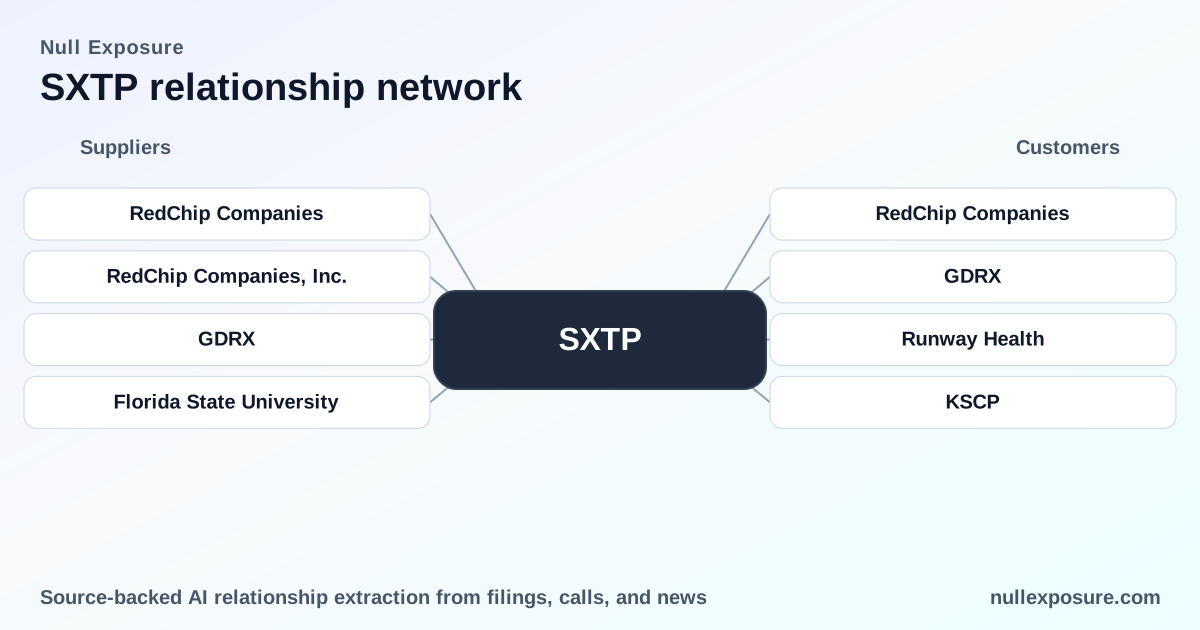
Below are the counterparties surfaced in public reporting and what each relationship means to SXTP’s execution.
RedChip Companies — investor relations / promotional services
60 Degrees is listed as a client of RedChip Companies in multiple syndicated press releases announcing interviews to air on the RedChip "Small Stocks Big Money" show on Bloomberg TV (syndicated March 2026 across EnterpriseNews, DesMoinesRegister, RecordNet and other outlets). This relationship signals an active investor‑relations and media outreach posture to drive awareness among small‑cap investors and potential retail buyers. (Press releases syndicated March 2026: EnterpriseNews, DesMoinesRegister, RecordNet, Desertsun, Cincinnati.com, et al.)
GoodRx — prescription savings and patient access partnership
60 Degrees announced a partnership with GoodRx to offer eligible consumers up to 30% savings on ARAKODA® (tafenoquine), explicitly aimed at expanding patient access and reducing out‑of‑pocket cost (announced in early 2026 via QuiverQuant and investor news outlets). This is a commercial distribution/access deal intended to broaden demand capture at retail pharmacies and specialty channels. (GoodRx partnership announced March 2026: QuiverQuant; SahmCapital press release Feb 2026.)
Florida State University — IP license for castanospermine purification
60 Degrees exercised an option to negotiate an exclusive license with Florida State University to use large‑scale purification techniques for extracting castanospermine from Australian Chestnut seeds, and began U.S. regulatory steps for a non‑Rx extract (announced Jan 2026). This is an upstream supply‑chain maneuver that aims to internalize or diversify a critical raw material pathway rather than rely solely on external chemical suppliers. (SahmCapital Jan 28, 2026; GlobeNewswire Jan 15, 2026.)
What the constraints and disclosures reveal about the operating model
The public evidence forms a coherent company‑level signal about concentration, criticality, contracting posture and maturity:
-
Concentration and criticality: Management states inventory of tafenoquine historically came from a sole vendor, and the company lacks manufacturing facilities — that creates a single‑point supply risk where vendor continuity is business‑critical. Rebuilding an API supply chain would require substantial cost and time. This is a material supply concentration for an early commercial product.
-
Contracting posture: The company’s commercial approach is outsourced and partnership‑heavy — promotional services (RedChip), price‑access platforms (GoodRx), and licensing of academic purification methods (FSU) instead of capital‑intensive in‑house manufacturing. That reduces capex but increases counterparty dependence and commercial execution risk.
-
Geography and distribution redundancy: One constraint excerpt explicitly names Kodatef as a distributor that can cover shortages through a specialty pharmacy with capacity to ship to all 50 states, signaling a planned domestic distribution redundancy if primary supply is interrupted. Investors should treat this as a mitigating distribution layer but not as a substitute for API manufacturing diversification.
-
Service provider relationships: Vendor membership records and press coverage show the company uses a mix of service providers for IR and commercial distribution; these relationships are operationally necessary and have been expanded in 2024–2026 as SXTP moves from development to commercialization.
For a full supplier‑risk review and to monitor counterparty changes, see https://nullexposure.com/.
Investment implications: how relationships change the risk/reward profile
The counterparties documented alter both upside and downside for investors in clear ways:
-
Upside drivers
- GoodRx partnership directly improves patient affordability and could lift uptake for ARAKODA, increasing revenue with limited incremental cost.
- FSU license for castanospermine purification offers a route to secure or lower the cost of a raw material, which could materially improve gross margins and supply resilience if successfully commercialized.
-
Risk concentrations
- Sole‑vendor dependency for tafenoquine API is a primary operational risk that can interrupt revenue and force expensive, time‑consuming supply‑chain rebuilds.
- Small market cap and negative cash flow mean counterparty performance (timely deliveries, successful licensing, and effective promotional campaigns) has outsized impact on solvency and stock performance.
- High reliance on third‑party promotional channels (RedChip) increases the company’s dependence on investor sentiment cycles rather than organic prescription demand.
Key takeaways for investors:
- Monitor supply contracts and any disclosures about alternative API sourcing or manufacturing agreements.
- Track uptake metrics tied to the GoodRx program (prescription fill rates, patient coupons used) as an early indicator of commercial traction.
- Watch regulatory and licensing progress with FSU — successful scale‑up of extraction would materially reduce supply risk.
Bottom line and recommended next steps
60 Degrees is executing a capital‑efficient path to commercialization that trades manufacturing ownership for partner dependence. GoodRx and the FSU license are constructive commercial and supply‑chain moves, while the historic dependence on a sole vendor for tafenoquine API is the single biggest operational vulnerability. Investors and operators should prioritize contract diligence, timelines for FSU‑derived supply, and empirical metrics from GoodRx distribution to validate revenue growth.
For a continuously updated supplier risk profile and broader counterparty mapping, visit https://nullexposure.com/. If you want a tailored supplier analysis or ongoing monitoring for SXTP counterparties, start at https://nullexposure.com/ and request a focused supplier‑risk brief.