SXTPW supplier profile: what investors need to know about 60 Degrees Pharmaceuticals’ commercial plumbing
60 Degrees Pharmaceuticals operates as a specialty infectious-disease developer that monetizes through product commercialization, licensing arrangements, and point-of-sale access programs for its marketed product Arakoda. The company leverages licensing deals and third-party commercialization channels rather than integrated manufacturing, and it generates economic returns through sales, licensed technology fees and defined royalty streams. For investors evaluating SXTPW (the 60 Degrees warrant), the supplier relationships and contractual structure drive both revenue optionality and concentrated operational risk.
Discover deeper supplier exposure and relationship signals at https://nullexposure.com/.
Quick read: how 60 Degrees runs and where money comes from
60 Degrees brings products to market by combining licensed intellectual property with outsourced development, manufacturing and commercial distribution. Revenue drivers are commercial sales of Arakoda, licensing receipts and structured royalty commitments; the company outsources manufacturing and relies on specialty-pharmacy and retail channels for patient access. The warrant SXTPW sits on a company profile with no reported trailing revenue in public summaries, underscoring that supplier and partner execution will determine near-term value realization.
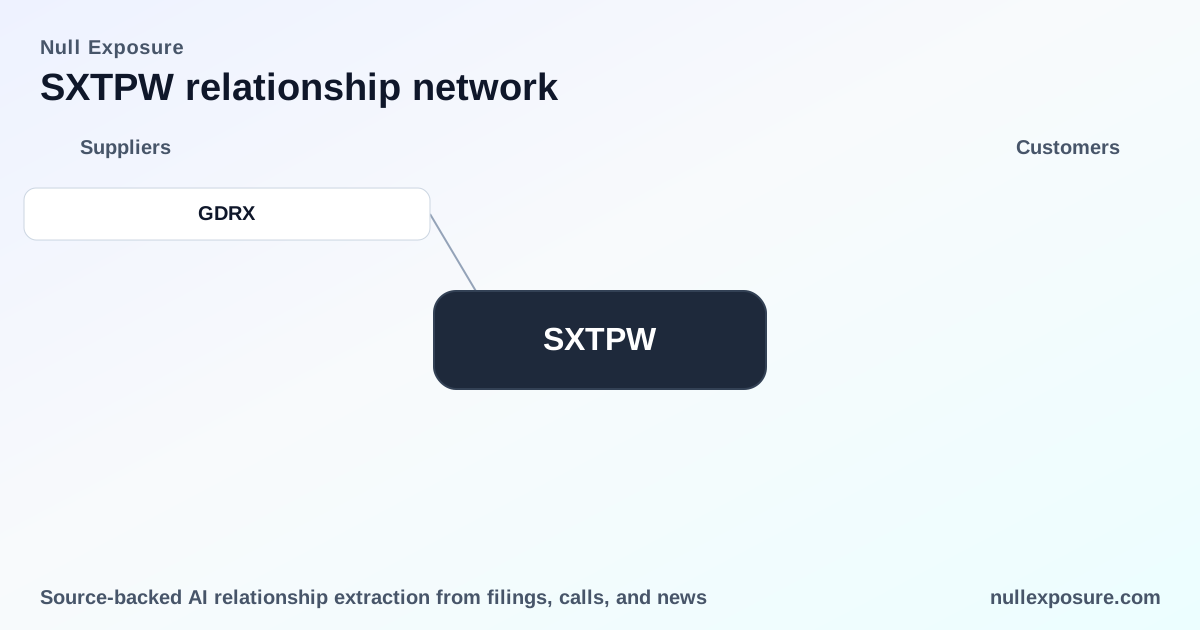
The visible supplier relationship: GoodRx for point-of-sale visibility
60 Degrees has formalized a partnership to expand point-of-sale visibility for Arakoda through GoodRx, enhancing how patients and prescribers see savings at the pharmacy counter. According to a company news release reported by Sahm Capital on December 11, 2025, the company will engage GoodRx to provide broader coverage of its point-of-sale Arakoda offer, intended to make savings information more accessible at prescribing and dispensing points. This arrangement is a distribution/marketing channel relationship that directly supports patient uptake and price transparency (Sahm Capital, news release, Dec 11, 2025).
All supplier and partner signals in the record
This dossier contains one explicit external partner record and a set of contractual constraints that together paint the supplier posture:
- GoodRx — point-of-sale visibility partner for Arakoda, intended to expand patient and prescriber access to savings information (Sahm Capital news, Dec 11, 2025).
- Company-level contractual and operational signals (from company filings and disclosures):
- Long-term royalty commitment: the company agreed to pay a royalty equal to 3.5% of net sales to a lender for a period effectively tied to a long-term financing window (language covers January 1, 2022 up to conversion/redemption events). This is a binding cashflow allocation that reduces net revenue capture on sales.
- Short-term office lease posture: the company records office rental as a short-term lease (12 months), indicating limited fixed-asset lease commitments on the balance sheet and a lightweight fixed-cost base for corporate operations.
- Licensing footprint: the company holds licenses that grant development and commercialization rights for certain therapeutic applications while explicitly excluding some indications (for example, radical cure of symptomatic vivax malaria), demonstrating selective field-of-use licensing.
- Geographic supply signals: the company supports U.S. availability via a specialty pharmacy with shipping capacity across all 50 states, and regulatory import allowances (FDA authorization in Feb 2025) to bring Kodatef from Australia to cover potential U.S. supply disruptions—this shows a North America commercial focus with APAC supply contingency.
- Role posture: licensee / outsourced manufacturer / service provider: filings show 60 Degrees acts as licensee in multiple agreements and does not own manufacturing facilities, relying on third-party manufacturers and a small internal team augmented by contractors and external consultants.
- Service provider engagement: the company uses part-time contractors, and a separate lender engagement includes a planned consulting retainer at material monthly amounts (documented terms indicate $30,000 per month for five years in a negotiated consulting arrangement).
Each of these constraints is taken from company disclosures and public filings (company filing excerpts; regulatory and investor communications, 2024–2025).
What these signals say about operational posture
The contract mix signals a highly outsourced commercialization model with concentrated operational dependencies: Arakoda’s market access relies on specialty pharmacy distribution, point-of-sale channel partnerships like GoodRx, and third-party manufacturing. The royalty to a lender is a structural cash outflow that reduces gross-up from sales and creates a longer-term claim on revenue streams; treat it as a recurring margin pressure item in valuation scenarios.
- Contracting posture: hybrid — short-term corporate overhead (short leases, small headcount) coupled with long-term financial encumbrances (royalty arrangements) and multi-year licensing commitments.
- Concentration and criticality: high — limited internal manufacturing and a handful of channel partners create single points of failure; the GoodRx arrangement improves demand-side visibility but does not replace manufactured supply dependence.
- Maturity: early commercial — limited reported revenues in public summaries and a small employee base point to a company still institutionalizing commercial scale; regulatory maneuvers (FDA import authorization) indicate active continuity planning rather than established vertical scale.
If you are modeling downside scenarios, assign greater probability to supply-chain or partner execution failures; if modeling upside, attribute value to successful channel penetration and license monetization.
Explore a more detailed supplier exposure breakdown at https://nullexposure.com/.
Investor implications and risk checklist
For investors and operators evaluating SXTPW exposure, prioritize these items:
- Revenue dilution from royalty commitments — incorporate the 3.5% net-sales royalty into forward-margin forecasts and scenario analysis.
- Dependence on third-party manufacturing — evaluate counterparty reliability, capacity and contract terms; manufacturing failure is an outsized operational risk.
- Channel effectiveness vs. supply continuity — GoodRx expands visibility and potentially prescription conversion, but commercial upside requires unbroken supply and specialty-pharmacy throughput.
- Concentration of personnel and outsourced services — small internal team means execution risk is concentrated in external vendors and key consultants.
Practical due-diligence steps: request visibility into manufacturing agreements, specialty-pharmacy distribution contracts, GoodRx commercial terms, and the lender royalty schedule.
Bottom line and recommended action
60 Degrees runs a lean internal operation that monetizes through licensed rights, third-party manufacture, and channel partnerships like GoodRx, while carrying a material royalty obligation that reduces net receipts from sales. For SXTPW stakeholders, the core valuation lever is partner execution—both on the demand side (GoodRx and pharmacy networks) and supply side (third-party manufacturers and APAC import allowances).
For a targeted supplier-risk review and ongoing monitoring of counterparty shifts visit https://nullexposure.com/.