Stock Yards Bancorp (SYBT) — Supplier Relationships, Contracting Posture, and Strategic Implications for Investors
Stock Yards Bancorp is a regional bank holding company operating through Stock Yards Bank in Louisville, Indianapolis and Cincinnati, monetizing primarily through net interest margin on loan portfolios, fee income, and measured inorganic growth such as the announced Field & Main transaction. The company’s capital and liquidity mix combines long-dated trust obligations with active short-term wholesale funding, while advisory and legal relationships support M&A execution and public market participation. For a concise view of counterparties and implications, see NullExposure’s homepage: https://nullexposure.com/.
Why investors should care: a compact investment thesis
Stock Yards runs a highly conventional community bank model with attractive operating margins (Operating Margin TTM 48.6%) and above-average return on equity (ROE ~13.9%). The bank’s earnings power is driven by stable loan yields and fee income, but its balance-sheet management reflects a deliberate mix of long-term structural liabilities and short-term liquidity tools that change sensitivity to funding stress and rate cycles. The recent strategic steps and counterparties engaged for the Field & Main transaction underscore management’s focus on regional scale and disciplined external advice.
Who Stock Yards is working with — the deal advisors and market counterparties
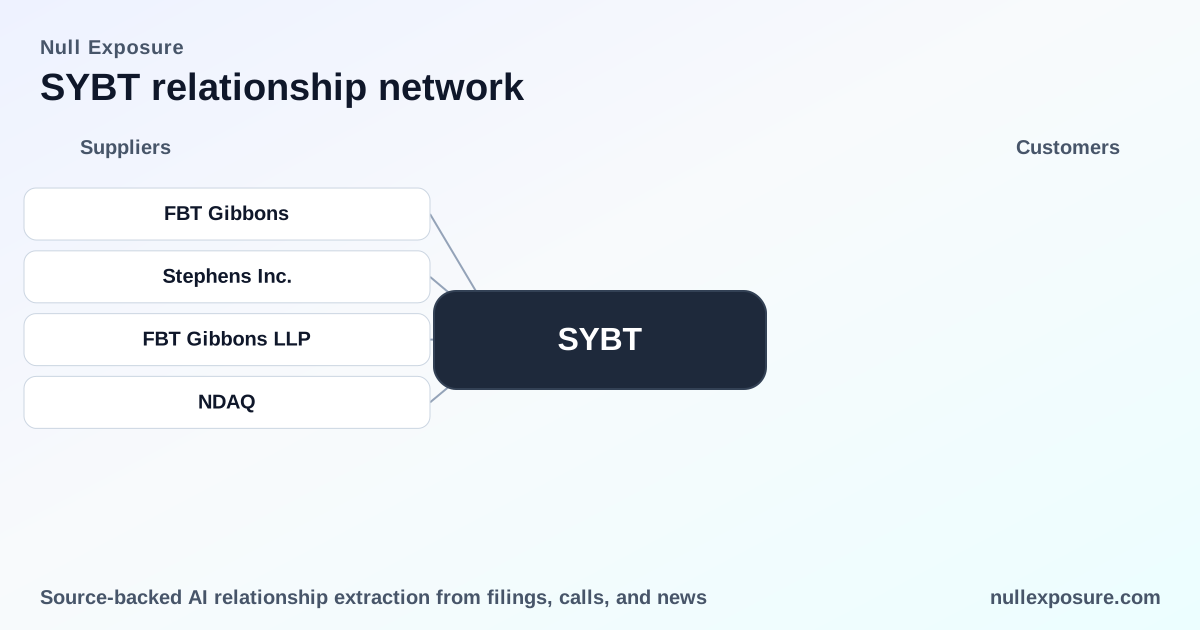
Below are every relationship captured in the public results set, each described in plain English with the original source cited.
-
FBT Gibbons
FBT Gibbons acted as legal counsel to Stock Yards in connection with the Field & Main merger, providing transaction-level legal work for the acquirer. This engagement is disclosed alongside the merger announcement. (GlobeNewswire, January 27, 2026; Pulse2, March 10, 2026.) -
Stephens Inc.
Stephens Inc. served as the financial advisor to Stock Yards on the Field & Main all-stock transaction, handling deal structuring, valuation, and advisory execution. The role is documented in the public merger releases announcing the transaction. (GlobeNewswire, January 27, 2026; Pulse2, March 10, 2026.) -
FBT Gibbons LLP
The firm is also referenced by its LLP designation in the merger release; its role is identical to the FBT Gibbons reference and confirms the legal advisory relationship for the same transaction. (GlobeNewswire, January 27, 2026.) -
The NASDAQ Stock Market
Stock Yards’ common shares trade on The NASDAQ Stock Market under the ticker SYBT, establishing the exchange relationship that governs market listing, disclosure cadence, and trading liquidity. (The Globe and Mail press release citing the company’s public listing, FY2025/press release timing.)
What the counterparty map tells investors
The advisor slate for the Field & Main transaction—Stephens as financial advisor and FBT Gibbons as legal counsel—is a standard mid-market advisory configuration that signals a conventional M&A approach: rely on experienced regional investment banking and law firms to preserve deal economics and integration flexibility. The Nasdaq relationship is routine but important for liquidity and institutional ownership, which stands at about 63.6% institutional by the latest disclosure.
For more granular supplier intelligence and to compare counterparty mixes across peers visit https://nullexposure.com/.
Contracting posture, maturity profile, and funding constraints
Company-level disclosures reveal a mixed maturity profile and a nuanced contracting posture:
-
Long-term structural obligations exist in the form of statutory trust issuances with maturities stretching into the mid-2030s (examples include trust maturities in 2034, 2035, and 2037). This indicates multi-decade tail risk on certain legacy financing vehicles and contributes to predictable long-term funding assumptions documented at year-end. (Company filing disclosures as of December 31, 2024.)
-
Short-term wholesale funding is material to liquidity management. Disclosures note a rolling $300 million three-month Federal Home Loan Bank (FHLB) advance and routine overnight repurchase agreements secured by GSE obligations and agency MBS. This creates short-term refinancing exposure that management actively hedges with interest rate swaps. (Company filings at December 31, 2024.)
-
One contractual arrangement was categorized as a prospect-stage land lease that had not commenced by December 31, 2024, signaling pipeline real estate commitments that are not yet cash-flowing and therefore represent contingent obligations. (Company disclosure as of December 31, 2024.)
Together, these signals present a bank with deliberate funding layering—long-term vehicles for base capital and shorter-term facilities for tactical liquidity—producing both stability and sensitivity depending on funding markets and rate dynamics.
Risk and concentration considerations investors should price in
- Funding concentration: the use of sizable FHLB advances and overnight repos is a core part of liquidity management; a sudden disruption in access to these markets would increase funding costs and compress net interest margin. The disclosed rolling $300 million facility is substantial relative to balance-sheet scale and is therefore material.
- Maturity concentration: long-dated trust maturities create carryable obligations that limit balance-sheet flexibility in a rate shock, but they also lock in stable funding costs for the long term.
- Deal execution risk: reliance on external advisors for M&A (Stephens; FBT Gibbons) is appropriate, but the success of the Field & Main integration will determine whether the merger delivers accretion consistent with current multiples and analyst expectations (analyst target price reported at $76).
Financial posture and market signals
Stock Yards trades at roughly a 13.4x trailing P/E and about 1.73x price-to-book, reflecting a valuation that prizes consistent profitability and a modest growth runway. The balance of long-term capital structures and short-term liquidity facilities combined with a dividend yield of ~2.0% positions the bank as a yield-oriented regional name for investors seeking dividend income with moderate growth.
If you want to benchmark these supplier and funding relationships across the regional bank universe, explore NullExposure for comparative supplier intelligence: https://nullexposure.com/.
Investment implications and near-term catalysts
- The Field & Main merger will be the principal near-term operational catalyst and will test management’s ability to extract cost saves while preserving credit quality.
- Funding markets and the cost of short-term wholesale borrowings are direct profit drivers; monitoring FHLB advance rollovers and repo conditions is essential for forecasting margin volatility.
- The listed advisor relationships reduce execution risk on the transaction side but do not alter the underlying funding and asset-quality dynamics of the bank.
Bottom line and next steps
Stock Yards is a well-capitalized, conventionally managed regional bank with a layered funding structure that balances long-term obligations and active short-term liquidity tools. Key investor watchpoints are funding concentration, the outcome of the Field & Main integration, and how short-term wholesale costs evolve.
To dive deeper into counterparties, contract maturities, and comparative supplier risk across financial institutions, visit NullExposure’s homepage and research toolkit: https://nullexposure.com/.