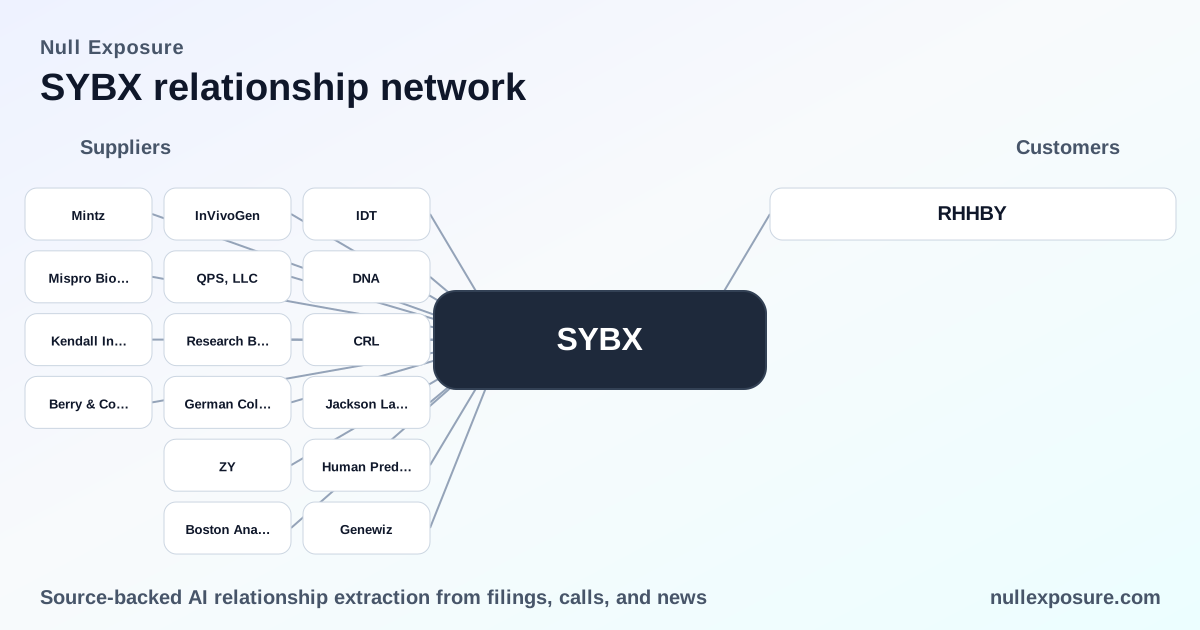
Synlogic (SYBX) supplier map: who they hire, why it matters to investors
Synlogic is a clinical‑stage synthetic biology company that builds living medicines by engineering microbial strains and then outsources much of the experimental, manufacturing and ancillary work to specialized vendors. The company monetizes by advancing drug candidates through preclinical and clinical milestones to attract partner licensing, milestone payments and eventual commercialization; with negligible product revenue today, value is driven by pipeline progress and partner collaborations. For investors, the supplier list is a proxy for operational leverage: how dependent Synlogic is on CRO/CMO networks, specialized engineering platforms, and a handful of external service providers to execute programs. Visit https://nullexposure.com/ to benchmark supplier concentration and supplier risk across portfolios.
Why the supplier roster matters for valuation and risk
Synlogic’s operating model is outsourced and partnership-forward. The relationship constraints in company disclosures identify third-party manufacturing and service provision as expected, long‑term operating characteristics: Synlogic routinely uses CROs/CMOs for development and manufacturing and relies on external parties for formulation, preclinical and clinical studies. That contracting posture implies execution risk concentrated in vendors, potential single‑point failures for assays or animal work, and a need to track vendor performance and reputational risk as a core part of diligence. Visit https://nullexposure.com/ to see supplier dependency scoring and comparator screens.
Below I walk through every supplier relationship surfaced in the available public coverage, with a plain-English read of what each partner does for Synlogic and where investors should watch for operational impact.
Supplier relationships — line by line
-
IDT (Integrated DNA Technologies) — In FY2020 Synlogic used codon‑optimized genes synthesized by IDT that were subcloned into Synlogic vectors for construct development. This is a straightforward synthetic biology supply relationship tied to early engineering work. According to Nature Communications (2020), IDT provided synthesized genes for Synlogic constructs (FY2020): https://www.nature.com/articles/s41467-020-16602-0.
-
Ginkgo Bioworks — Ginkgo provided cell‑programming and foundry services to accelerate building and testing thousands of microbial strains and later expanded the cooperation to include additional preclinical assets alongside a financing relationship. Mintz documented the initial collaboration and financing in 2019, and Synlogic’s FY2022 announcements reference continued joint preclinical work with Ginkgo: https://www.mintz.com/industries-practices/case-studies/fueling-synlogics-growing-pipeline and https://finance.yahoo.com/news/synlogic-announces-fourth-quarter-full-120000855.html (FY2019, FY2022).
-
Charles River Laboratories — Charles River performed non‑human primate studies under standard regulatory animal‑welfare frameworks, supporting Synlogic’s in vivo toxicology and safety work. Nature Communications (2021) reports NHP studies at Charles River (FY2021): https://www.nature.com/articles/s41467-021-26524-0.
-
Jackson Laboratory — Synlogic purchased several mouse strains from Jackson Laboratory for in vivo experiments, indicating typical reliance on established animal vendors for preclinical models. The Nature Communications paper lists Jackson Laboratory as the source for mice (FY2020): https://www.nature.com/articles/s41467-020-16602-0.
-
Genewiz — Genewiz synthesized and subcloned plasmids used in Synlogic constructs, a common early‑stage molecular biology supplier relationship. This is documented in Nature Communications (2020) where Genewiz created a plasmid bearing luxABCDE for use in experiments (FY2020): https://www.nature.com/articles/s41467-020-16602-0.
-
InVivoGen — Synlogic procured specialized reporter cell lines from InVivoGen to run cellular assays (IRF/NF‑κB reporters and knockout variants), reflecting dependency on vendor‑supplied cell biology reagents. Nature Communications (2020) cites InVivoGen for THP1‑Dual and knockout cell lines (FY2020): https://www.nature.com/articles/s41467-020-16602-0.
-
QPS, LLC — QPS performed assay development and qPCR validation for detection of SYNB1891 bacterial DNA under good laboratory practices, a critical analytical service for clinical readouts. The validation work is described in Nature Communications (2020) (FY2020): https://www.nature.com/articles/s41467-020-16602-0.
-
Research Blood Components LLC — Fresh healthy human serum samples used in experiments were sourced from Research Blood Components, a standard bioreagent supplier for ex vivo assays. This sourcing is noted in Nature Communications (2020) (FY2020): https://www.nature.com/articles/s41467-020-16602-0.
-
German Collection of Microorganisms and Cell Cultures (DSMZ) — Synlogic purchased the Escherichia coli Nissle strain from DSMZ for use as a chassis organism, signaling reliance on international culture collections for core biological inputs. This is reported in Nature Communications (2021) (FY2021): https://www.nature.com/articles/s41467-021-26524-0.
-
Zymergen — Zymergen’s sensor engineering platform was used to create a TCA‑responsive biosensor for Synlogic’s work, showing Synlogic’s reliance on proprietary platform partners for specialized biological tooling. Nature Communications (2021) references Zymergen’s sensor engineering contribution (FY2021): https://www.nature.com/articles/s41467-021-26524-0.
-
Boston Analytical Laboratory — Boston Analytical performed antimicrobial susceptibility testing for Synlogic’s engineered strains in accordance with CLSI standards, a compliance‑critical lab service for safety characterization. This testing is cited in Nature Communications (2020) (FY2020): https://www.nature.com/articles/s41467-020-16602-0.
-
Mintz (law firm) — Mintz acted as legal counsel and represented Synlogic in the Ginkgo financing and collaboration, indicating reliance on external legal advisors for transaction execution. Mintz’s case study documents representation in the 2019 financing (FY2019): https://www.mintz.com/industries-practices/case-studies/fueling-synlogics-growing-pipeline.
-
Mispro Biotech Services — Mispro provided institutional animal care and review for in vivo experiments, a governance and compliance supplier for animal studies. Nature Communications (2020) notes Mispro’s IACUC review and animal housing (FY2020): https://www.nature.com/articles/s41467-020-16602-0.
-
Human Predictions, LLC — An external consultant and employer relationship shows Synlogic uses individual consultants for specialized work; Human Predictions had an employee listed as a consultant to Synlogic in a 2021 research paper. This consulting link is noted in a Communications Biology article (FY2021): https://www.nature.com/articles/s42003-021-02183-1.
-
Kendall Investor Relations — Kendall is named as Synlogic’s investor relations contact in corporate announcements, underscoring the outsourced communications model for investor engagement. Finance Yahoo press releases list Kendall Investor Relations (FY2022): https://finance.yahoo.com/news/synlogic-announces-appointment-michael-jensen-120000058.html.
-
Berry & Company Public Relations — Berry & Company is identified as Synlogic’s media contact for press releases, reflecting the use of external PR for market communications. Finance Yahoo press releases list Berry & Company Public Relations (FY2022): https://finance.yahoo.com/news/synlogic-announces-appointment-michael-jensen-120000058.html.
What the supplier mix implies for investors
-
Contracting posture: Synlogic operates a heavily outsourced model that uses both platform partners (Ginkgo, Zymergen) and transactional suppliers (IDT, Genewiz, Charles River). The company explicitly states it will use CROs and CMOs for development and manufacturing in filings; this is a core operating choice rather than a temporary measure.
-
Concentration and criticality: Platform relationships like Ginkgo and analytical/GLP vendors such as QPS and Charles River are high‑criticality points because failures there would directly delay clinical timelines and de‑risking events. Legal/IR/PR are lower operational risk but important for market-facing execution.
-
Maturity and substitution: Many vendors are mature, well‑established firms (Charles River, IDT, Genewiz, DSMZ), which reduces single‑vendor execution risk; platform partners (Ginkgo, Zymergen) introduce dependency on proprietary tools that are not trivially substitutable.
-
Operational constraints: Company disclosures list third‑party manufacturing and service provision as expected, which elevates counterparty operational risk and requires active vendor management and contractual protections.
Midway action: if you evaluate biotech counterparties, compare supplier concentration metrics and vendor criticality across peers at https://nullexposure.com/ to quantify execution risk.
Bottom line and investor action points
Synlogic’s supplier footprint is consistent with a small, R&D‑intensive biotech that outsources core lab work, GLP assays and platform engineering while retaining program control. The most important suppliers for near‑term valuation are Ginkgo (strain engineering and foundry), GLP vendors (QPS, Charles River) and analytical labs (Boston Analytical). Investors should monitor contract terms, program milestone schedules tied to these vendors, and any press reporting on vendor performance.
Explore supplier risk scoring, concentration reports, and vendor comparators at https://nullexposure.com/ to incorporate supplier dependency into your investment model.