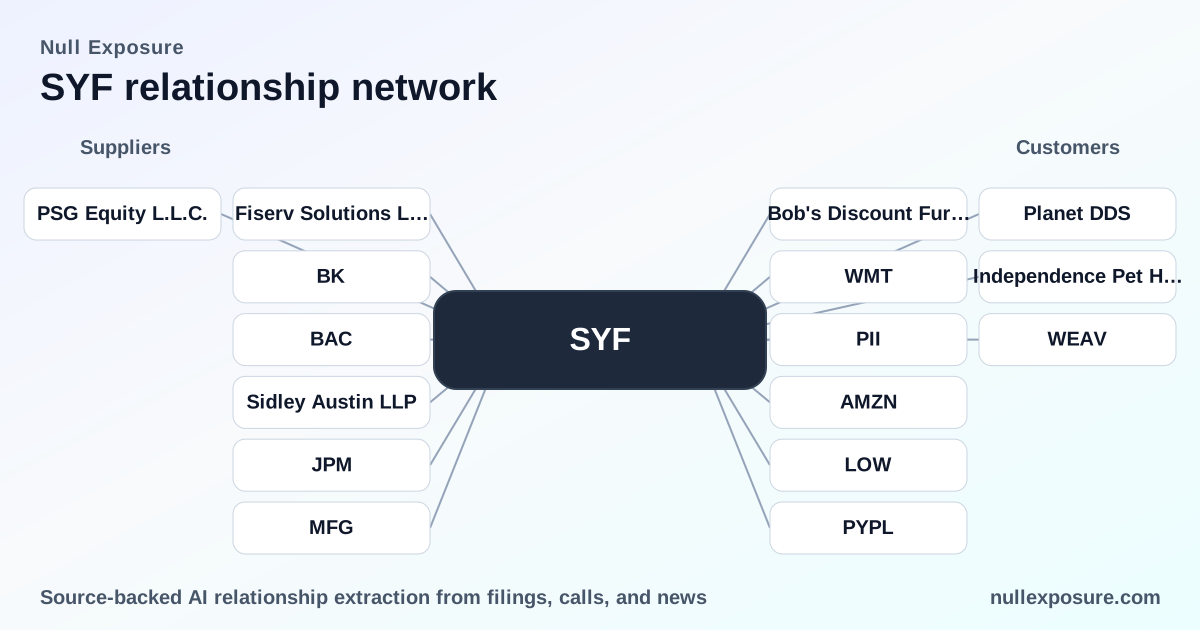
Synchrony Financial (SYF) — supplier and capital markets counterparties investors should track
Synchrony Financial underwrites consumer credit, promotional financing, installment lending and deposit products through its bank subsidiary, monetizing via interest income, merchant and cardholder fees, and partner-branded financing programs. The company outsources key production and servicing functions while leaning on large global banks and legal counsel for capital markets execution and documentation; these supplier and counterparty relationships are operationally material to day-to-day execution and capital strategy. For a broader supplier risk view and ongoing monitoring tools, visit https://nullexposure.com/ for comprehensive supplier intelligence.
How Synchrony structures outsourced operations and capital execution
Synchrony centralizes credit and deposit product economics while delegating certain executional tasks to specialists: card and statement production flows to a payments services vendor, capital raises use major investment banks as underwriters, and trustee and legal firms secure note documentation. That operating model blends high margin credit economics with concentrated service-provider reliance — a structure that supports scalability but increases operational dependency on a small set of counterparties.
Two company-level signals stand out as context for investors evaluating these relationships:
- Geographic concentration: Synchrony’s corporate headquarters operate from leased premises in Stamford, Connecticut, confirming a North American operational hub and typical regional concentration of staff and corporate services.
- Service-provider posture: Synchrony explicitly relies on third-party vendors and subcontractors for business operations, signaling an ongoing outsourcing strategy rather than full vertical integration.
These signals inform contracting posture (outsourced execution), concentration risk (focal suppliers for critical functions), and maturity (established relationships rather than ad-hoc vendors). Learn more about supplier mapping at https://nullexposure.com/.
Named counterparties and what they do for Synchrony
Fiserv Solutions LLC
Fiserv is Synchrony’s production services and card/mailings supplier, responsible for producing cards, statements and other mailings for Synchrony’s deposit customers, making it a critical operational vendor for customer communications and card fulfillment, according to Synchrony’s FY2025 Form 10‑K.
BNY Mellon
BNY Mellon serves as trustee under the indenture for Synchrony’s senior notes issued in FY2026, a standard capital markets role that establishes BNY Mellon as the legal custodian of noteholder rights and obligations for the issuance reported in March 2026 (TradingView coverage of the notes offering).
Bank of America (BofA)
Bank of America acted as one of the lead underwriters on Synchrony’s $750 million senior notes offering in FY2026, placing it among the investment banks facilitating Synchrony’s public debt issuance and market access (TradingView report, March 2026).
J.P. Morgan
J.P. Morgan is another lead underwriter for the $750 million senior notes, positioning the bank as a primary distribution partner in Synchrony’s capital markets activity and liquidity management (TradingView report, March 2026).
Mizuho
Mizuho joined BofA and J.P. Morgan as a lead underwriter on the March 2026 senior note deal, indicating a syndicated underwriting strategy with both U.S. and international banking partners (TradingView report, March 2026).
Sidley Austin LLP
Sidley Austin provided a legal opinion on the validity of the notes issued in FY2026 and prepared definitive documentation filed with the 8‑K, establishing the firm as the primary external legal adviser on the offering’s enforceability and legal form (TradingView summary, March 2026).
PSG Equity L.L.C.
Synchrony acquired Versatile Credit, Inc. from PSG Equity L.L.C. in October (reported in market coverage), signalling targeted inorganic growth in specialty credit capabilities and an expansion of Synchrony’s product or portfolio capabilities through acquisition activity (SimplyWall.St summary, FY2026 reporting).
What each relationship implies for investors and operators
These relationships cluster into two functional groups with distinct risk and value profiles: operational suppliers (Fiserv) and capital markets/legal partners (BNY Mellon, BofA, J.P. Morgan, Mizuho, Sidley). Operational continuity hinges on Fiserv’s performance for card production and customer mailings, a high-frequency, high-impact service where disruption would directly affect account access and customer experience. Capital flexibility and execution quality rest on the firm’s ongoing access to major underwriters and a trustee, which influence funding costs, deal timing and documentation integrity. The PSG transaction reflects an active M&A posture to augment originations or product capabilities.
Collectively these relationships show a mature outsourcing model: Synchrony retains core credit and deposit economics while delegating production and market-execution tasks to established third parties. That reduces operating complexity but concentrates exposure: losing or severely degrading a primary supplier or underwriter relationship would impose short-term operational stress or raise financing costs.
Risk checklist for investors and procurement teams
- Operational supplier resilience (Fiserv): validate contingency plans, SLAs, and multi-vendor fallback for card production and customer communications.
- Capital markets dependency: monitor underwriter availability and pricing environment; repeated use of the same lead banks reduces friction but can raise negotiation leverage for those banks.
- Documentation and legal enforceability: confirm counsel engagement and the presence of trustee arrangements for investor protections, particularly around indentures and supplemental indentures.
- M&A integration risk: track post‑acquisition integration of Versatile Credit, product migration, and any incremental credit concentration introduced by the acquisition.
- Regional concentration: factor Stamford headquarters lease and North American operational hub into business continuity planning and talent concentration risk.
Midway action: for an updated supplier map and real‑time alerts on these counterparties, see https://nullexposure.com/.
Bottom line and investor action points
Synchrony runs a scalable consumer finance franchise while outsourcing executional tasks and relying on top-tier banks and legal firms for capital markets access. Key monitoring priorities are Fiserv’s operational reliability, the terms and cadence of debt issuance with major underwriters, and integration outcomes from recent acquisitions. Investors should track 8‑K filings and subsequent vendor disclosures for material changes; procurement and risk teams should validate SLAs and contingency plans with critical suppliers.
For continuous monitoring and supplier relationship intelligence tailored to institutional due diligence, visit https://nullexposure.com/ — the starting point for building a targeted counterparty oversight program.