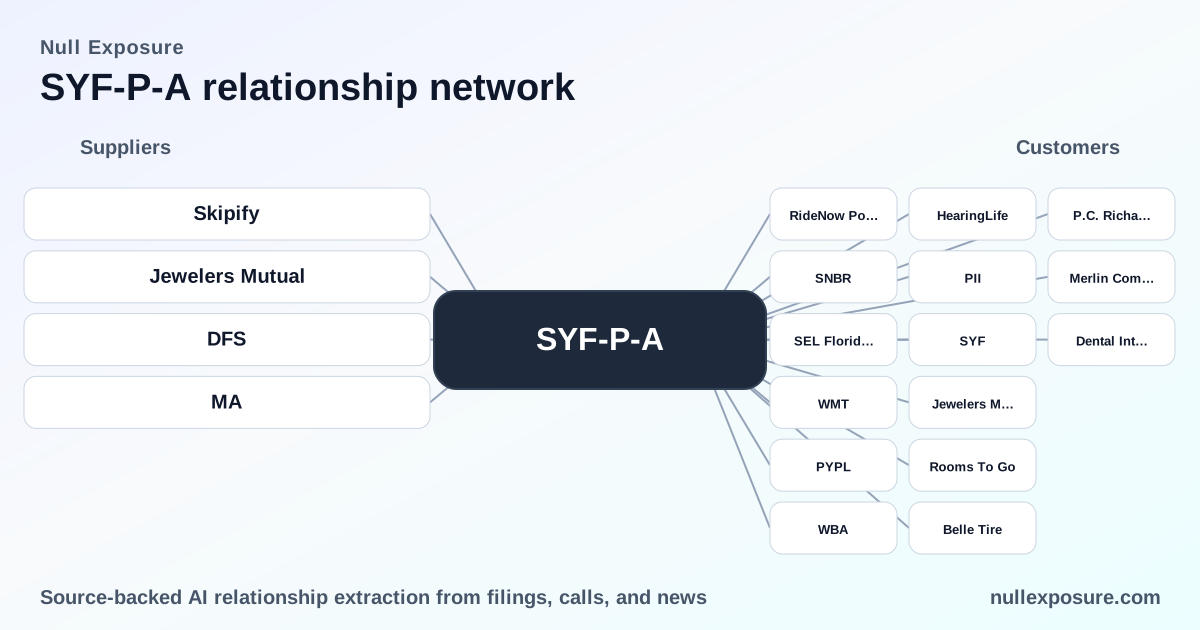
SYF-P-A supplier relationships: a concise map for investors and operators
Synchrony Financial (SYF), here considered through the lens of its preferred security SYF-P-A, operates as a consumer finance platform and bank: it originates and services retail credit, promotional financing and installment loans, runs loyalty and co-branded programs, and deposits FDIC-insured savings through Synchrony Bank. The company monetizes through interest income on consumer credit, fees and interchange from payment products, revenue-sharing with merchant partners, and by embedding third-party services into its merchant and marketplace channels. For investors evaluating counterparty exposure and operational risk, the supplier relationships below reveal how Synchrony expands distribution, seeds product innovation, and cross-sells non-credit services into its ecosystem.
Explore further at the Null Exposure home page: https://nullexposure.com/
What the partner roster says in plain English
Synchrony’s recent supplier and partnership mentions reflect a two-track commercial strategy: strategic minority investments and integrations that extend product capabilities, and co-marketing/distribution relationships that deepen merchant and cardholder reach. These partnerships are not incidental — they are functional levers to increase acceptance, origination volume, and ancillary revenue streams.
The partner map — every relationship and what it means
Skipify (investment + commercialization)
Synchrony made a strategic investment through Synchrony Ventures and committed to partnering on commercializing Skipify’s checkout and financing capabilities across Synchrony’s merchant network and financial ecosystem in FY2021. According to CityBiz, the intent is to leverage Skipify to streamline checkout and embed Synchrony financing offers at the point of sale, turning a venture equity stake into channel and product expansion: https://www.citybiz.co/article/190653/synchrony-invests-in-skipify/?abkw=citybizsanfrancisco.
Takeaway: This is a growth-oriented bet to improve merchant checkout conversions and deepen financing penetration.
Jewelers Mutual (sponsorship and marketplace marketing)
In FY2025 Synchrony entered a collaborative sponsorship with Jewelers Mutual to combine finance and insurance marketing efforts, including featuring Jewelers Mutual offers across Synchrony marketing materials and on Synchrony Marketplace. PR Newswire reports the agreement focuses on joint consumer-facing campaigns and marketplace placement: https://www.prnewswire.com/news-releases/synchrony-and-jewelers-mutual-collaborate-on-innovative-new-sponsorship-agreement-combining-finance-and-insurance-marketing-efforts-302466317.html.
Takeaway: This relationship signals a broader strategy to monetize non-credit product placements and to generate fee income from third-party service referrals.
Discover ® Global Network (payments acceptance extension)
Synchrony continues to partner with Discover Global Network to improve acceptance within the automotive category and elsewhere, a relationship highlighted in company communications for FY2021. PR coverage of Synchrony Car Care notes the ongoing partnership to expand network acceptance and merchant reach: https://www.prnewswire.com/news-releases/synchrony-car-caretm-achieves-significant-milestones-in-its-fourth-year-in-the-market-301271059.html.
Takeaway: Partnerships with alternative payment networks increase card acceptance and reduce distribution friction — a direct driver of originations and interchange revenue.
MasterCard (branded card issuance)
Synchrony issues MasterCard-branded credit products, including consumer-facing options such as a Premier card with cash-back features, enabling direct card acquisition through Synchrony’s channels. A consumer review piece from FY2023 notes the availability of MasterCard credit cards through Synchrony and highlights the product offerings: https://www.thepennyhoarder.com/bank-accounts/synchrony-bank-review/.
Takeaway: Global network affiliation with MasterCard secures broad merchant acceptance and underpins interchange economics for Synchrony-issued cards.
How these relationships translate into operating signals
The partnership set is a cohesive expression of Synchrony’s operating model. Read as company-level signals, these relationships imply the following:
- Contracting posture — strategic and opportunistic: Synchrony pursues equity investments (Skipify) and sponsorships (Jewelers Mutual) in addition to network agreements (Discover, MasterCard), indicating a blended posture that mixes long-term strategic stakes with scalable distribution contracts.
- Concentration — diversified across functions: Relationships span checkout technology, insurance distribution, and payment networks, reducing single-counterparty concentration risk while increasing reliance on a few global networks for acceptance.
- Criticality — network partners are mission-critical: Payment network agreements and branded card issuance (MasterCard, Discover) are operationally critical; they directly affect merchant acceptance, card usage, and interchange income.
- Maturity — mix of established and innovative plays: Network and card-issuing partnerships reflect mature, durable contracts, while venture investments like Skipify represent an innovation pipeline to capture future distribution and conversion gains.
Bold conclusion: Synchrony’s partner mix balances stability (payment networks) with growth optionality (strategic investments and marketplace placements).
Explore a fuller supplier analysis at Null Exposure: https://nullexposure.com/
Risk and opportunity implications for investors and operators
- Revenue upside: Co-marketing and marketplace placements (Jewelers Mutual) and checkout integrations (Skipify) create low-capex paths to incremental fee and referral revenue.
- Operational dependency: The firm depends on major payment networks for acceptance; any disruption in those relationships would materially affect card spend and interchange flows.
- Execution sensitivity: The commercial payoff from Skipify and marketplace strategies requires effective merchant rollout and consumer adoption; execution determines whether these are marginal revenues or meaningful growth drivers.
Key risk to monitor: contractual terms with global networks and the economics of marketplace offer placements — both influence margin and scale.
Bottom line: what to watch and next steps
For investors and operators focused on SYF-P-A exposure, the supplier map confirms that Synchrony leverages partnerships to extend distribution, diversify revenue, and test product innovations, while relying on large payment networks for core acceptance economics. Monitor three vectors: 1) deployment cadence and merchant adoption for Skipify integrations, 2) monetization metrics from marketplace placements and co-marketing with partners like Jewelers Mutual, and 3) any shifts in payment-network arrangements that affect interchange and acceptance.
If you want ongoing, relationship-focused intelligence and operational impact analysis, visit the Null Exposure homepage to subscribe or request deeper briefings: https://nullexposure.com/
Final action: evaluate contract terms and rollout milestones from these partners, and track quarterly disclosures and press statements for updates on commercialization and revenue attribution. For curated supplier risk dashboards and supplier-specific notes, start here: https://nullexposure.com/