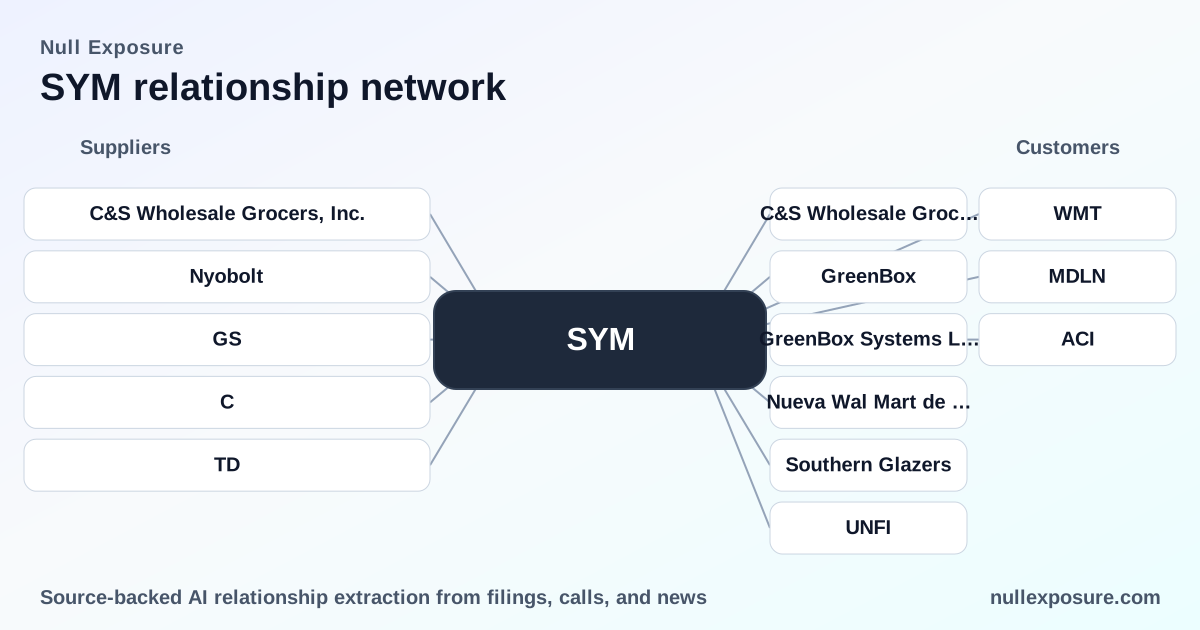
Symbotic (SYM): How supplier relationships shape growth, margins and operational risk
Symbotic builds and sells large-scale robotic warehouse systems and monetizes through system sales, licensing and recurring services tied to operations and maintenance of installed fleets; the company also leases space and integrates third‑party logistics capabilities into its deployments to accelerate customer go-live and cash conversion. Revenue comes from capital equipment sales, software and service contracts, and logistics partnerships that convert product into recurring, sticky cash flows — an attractive profile for investors focused on automation-driven supply‑chain disruption. Learn more and track third‑party exposures at NullExposure: https://nullexposure.com/.
What the footprint and contract signals tell investors
Symbotic is a capital‑intensive industrial technology provider: scale is large but margins are compressible in early deployment, and supplier dynamics are operationally critical. Three company‑level constraints extracted from filings and disclosures are central to underwriting exposure:
- Short‑term contracting posture: Symbotic reports that the bulk of purchase commitments are for periods of less than one year, totaling approximately $893.9 million as of September 27, 2025, indicating rolling procurement cycles and working‑capital sensitivity. This is a company‑level signal that procurement timing and supply chain disruption can immediately affect margin and delivery cadence.
- Buyer role and procurement complexity: The company explicitly describes itself as the buyer of materials and components required to build its Systems, and notes the complexity of estimating total revenue and cost at completion because of third‑party material availability and pricing. This drives project execution risk and variable gross margins.
- Concentration of spend: For FY2025, one supplier accounted for greater than 10% of total purchases, with aggregate purchases of $198.9 million, signaling a material concentration risk in the vendor base that can cause outsized impact if the relationship deteriorates.
These constraints shape Symbotic’s contracting posture, capital intensity, and supplier management priorities: the firm must actively manage short horizon purchase commitments, prioritize supplier diversification or redundancy where feasible, and preserve margin through favorable procurement terms.
Relationships you need to know (concise, analyst‑grade)
Below are every supplier/third‑party relationship captured in the disclosure set and public reporting we reviewed, with a one‑to‑two sentence plain‑English summary and the source.
C&S Wholesale Grocers, Inc.
Symbotic entered into lease agreements with C&S for warehouse space in Plant City, FL and Coppell, TX, and has a licensing arrangement where C&S provides receiving and logistics services inside a C&S distribution facility for Symbotic. According to Symbotic’s FY2025 Form 10‑K, these arrangements support installations and operational throughput by combining Symbotic technology with C&S logistics capability (FY2025 10‑K).
Nyobolt
Symbotic has rolled out Nyobolt’s advanced battery technology across its SymBot autonomous mobile robots, upgrading energy capacity and reducing weight for both new and retrofit deployments; the company announced a full incorporation of Nyobolt batteries in late September 2025. Multiple industry write‑ups covering October 2025 and early October commentary reported the enhancement (Sahm Capital coverage, Oct 3 and Oct 11, 2025), and market reaction was notable as investors priced the improved robotics performance into the equity.
Goldman Sachs & Co. LLC
Goldman Sachs acted as a lead book‑running manager on Symbotic’s public offering of 10 million shares of Class A common stock, supporting capital markets execution and primary capital formation. The role is documented in transaction coverage of the offering (QuiverQuant news, March 2026; Sahm Capital commentary, Dec 4, 2025).
Citigroup Global Markets Inc. / Citigroup
Citigroup served as a co‑lead book‑running manager alongside Goldman Sachs on the same March 2026 public offering, participating in underwriting and distribution of primary shares to institutional investors. This participation is noted in the offering coverage (QuiverQuant news, March 2026; Sahm Capital commentary, Dec 4, 2025).
TD Securities
TD Securities participated as an additional book‑running manager on the March 2026 offering, providing distribution support and syndicate capacity for Symbotic’s issuance. Market reports from late 2025 and coverage of the offering list TD Securities in the syndicate (Sahm Capital commentary, Dec 4, 2025; QuiverQuant news, March 2026).
What these relationships imply for operations and valuation
Together, the supplier and capital‑markets relationships reveal a hybrid operating model: product engineering and system sales at scale, supplemented by logistics partnerships and battery component upgrades, while capital markets support growth through equity offerings. Key takeaways for investors:
- Operational criticality: Logistics partners like C&S are not peripheral; they provide warehouse capacity and integrated receiving services that accelerate deployment and revenue realization. That makes these partners operationally critical to rollout timelines and near‑term cash generation.
- Technology upgrades improve unit economics: The Nyobolt battery integration is a clear productivity lever—higher energy density and lower weight translate to longer run times, lower replacement cadence and potential OPEX savings, which can lift lifetime customer economics for installed fleets.
- Financing dependence for growth: The March 2026 equity offering underwritten by Goldman, Citigroup and TD shows Symbotic is actively accessing capital markets to fund expansion and R&D; underwriting relationships therefore matter for execution and market credibility.
Risk framework and investor actions
From a risk perspective, prioritize monitoring these items:
- Procurement cadence and $893.9m of short‑term commitments: This creates working‑capital exposure that can compress free cash flow if deliveries or customer payments slip.
- Supplier concentration ($198.9m from one supplier): A single supplier representing >10% of purchases is a tangible operational risk that could affect margins or project timelines.
- Execution on retrofits and Nyobolt rollout: Technology integration across existing fleets requires careful program management; successful rollouts de‑risk unit economics, but failures would create reputational and financial cost.
For researchers and operators evaluating SYM supplier relationships, the next steps are straightforward: validate counterparties, request detailed procurement term sheets for top suppliers, and quantify the projected OPEX uplift from Nyobolt battery integration.
Explore deeper third‑party exposure analytics and supplier concentration tools at NullExposure: https://nullexposure.com/.
Bottom line: investable strengths and watch‑list items
Symbotic is a high‑growth, capital‑intensive automation platform with clear levers for margin expansion (technology upgrades, logistics partnerships) and identifiable operational risks (short‑term procurement, supplier concentration). Investors should value the company on a forward roll‑out and retrofit thesis while actively monitoring supplier concentration, procurement cadence and capital markets activity that underwrite growth. For a focused view of Symbotic’s supplier exposures and to integrate these signals into your underwriting process, visit NullExposure: https://nullexposure.com/.