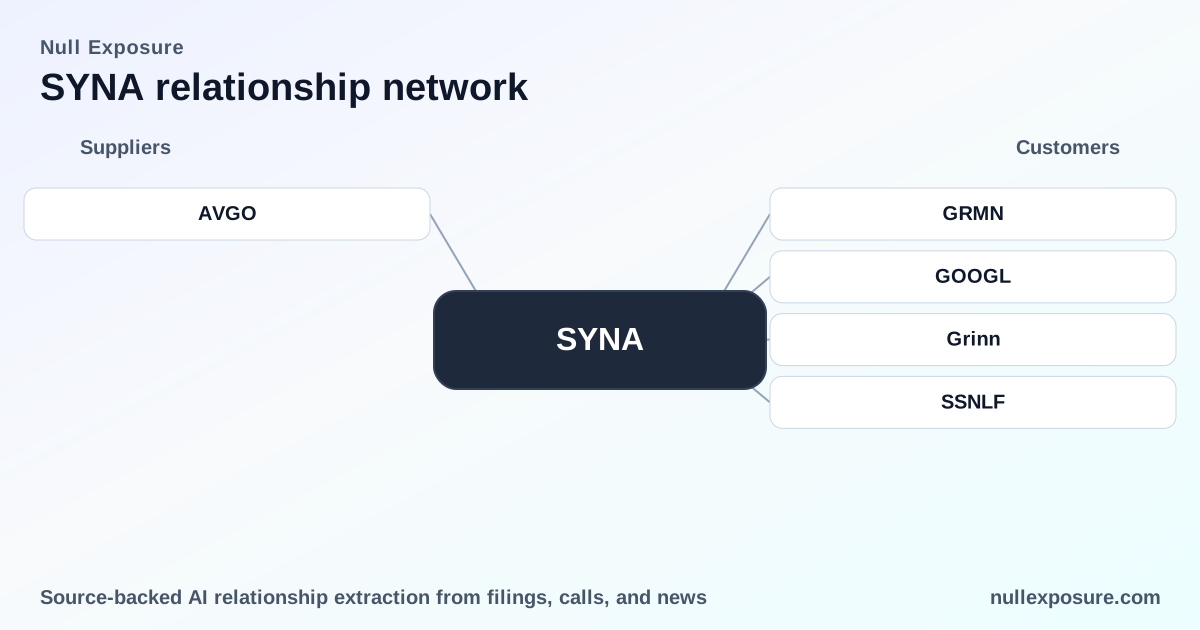
Synaptics (SYNA) — supplier relationships, constraints, and what investors should price in
Synaptics develops and sells human‑interface and wireless connectivity silicon and software to OEMs and contract manufacturers, monetizing through product sales, licensing, and broader platform plays in Edge AI and wireless connectivity following strategic asset acquisitions. Revenue is driven by device OEM adoption of Synaptics’ touch, audio, wireless, and newly expanded Wi‑Fi/Bluetooth portfolios; margin recovery depends on integration of acquired assets and stable manufacturing capacity under long‑term supplier arrangements. For a deeper supplier-risk view and relationship mapping, visit https://nullexposure.com/.
How Synaptics sources production and what that implies for operations
Synaptics runs a fabless semiconductor model: design and product management are internal while wafer fabrication, assembly, packaging and test are outsourced to third parties. The company’s cost of revenue explicitly includes products built to Synaptics’ specifications by contract manufacturers and wafers from independent foundries, which signals an operational posture that relies on external manufacturing partners for volume and quality control.
Key company‑level constraints that shape the supplier profile:
- Long‑term contracting posture. Synaptics entered long‑term capacity and pricing agreements as a direct response to industry‑wide supply shortages, signaling deliberate efforts to stabilize input costs and secure wafer and assembly capacity.
- Geographic concentration in APAC. Contract manufacturers and wafer fabricators are predominately Asia‑based, introducing concentration risk around geopolitical, logistics, and regional health or labor disruptions.
- Manufacturer relationships are critical and institutionalized. Synaptics selectively partners with foundries and backend processors to preserve long‑standing supply-chain relationships, reflecting maturity and negotiation leverage in manufacturing sourcing.
These constraints together create a supplier model that is contractually defensive, operationally dependent on APAC manufacturing networks, and strategically integrated with selected foundry partners—factors investors must incorporate into scenario analysis for margins and revenue continuity.
Publicly identified supplier/partner relationships (all entries in the record)
Broadcom — Finviz market note (March 10, 2026)
News coverage highlighted Broadcom’s Wi‑Fi assets purchase as a key enabler of Synaptics’ wireless strategy, noting the acquisition strengthens Synaptics’ Wi‑Fi 7/8 and Bluetooth capabilities and supports growth in Edge AI products. (Finviz, 2026-03-10) https://finviz.com/news/326024/synaptics-incorporated-syna-a-bull-case-theory
Broadcom — Simply Wall St analysis (March 10, 2026)
An analyst write‑up connected stronger Synaptics revenue and guidance to the company’s push into Edge AI and wireless, explicitly referencing the earlier purchase of Broadcom’s Wi‑Fi assets as supportive of the wireless roadmap. (Simply Wall St, 2026-03-10) https://simplywall.st/stocks/us/semiconductors/nasdaq-syna/synaptics/news/is-synaptics-syna-still-undervalued-after-stronger-revenue-g
Broadcom — Bitget Asia news item (March 10, 2026)
A regional markets piece reiterated that Synaptics’ January 2025 acquisition of Broadcom’s Wi‑Fi assets expanded its wireless stack and Bluetooth capabilities, positioning Synaptics for higher value in AI‑enabled edge devices. (Bitget Asia, 2026-03-10) https://www.bitget.com/asia/amp/news/detail/12560605227953
Broadcom — Bitget global news (March 10, 2026)
The global Bitget feed carried the same transactional emphasis: the Broadcom Wi‑Fi asset purchase materially expanded Synaptics’ wireless portfolio and complements its Edge AI processor ambitions. (Bitget, 2026-03-10) https://www.bitget.com/news/detail/12560605227953
Each of these items references the same strategic relationship: the acquisition of Broadcom’s Wi‑Fi assets is publicly credited as a transformative product‑level input to Synaptics’ wireless and Edge AI roadmap. The coverage is uniform across outlets and emphasizes product and capability expansion rather than supplier payment or contract specifics.
What this means for procurement, risk, and valuation
The Broadcom asset purchase changes the supplier map in two ways: it reduces Synaptics’ dependence on third‑party wireless IP licensors and increases integration complexity, requiring additional manufacturing and test capacity for new RF‑centric products. Combined with the company’s long‑term supply agreements and APAC manufacturing concentration, investors should price both upside from higher product value and downside from execution or regional disruptions.
Financial context that frames supplier sensitivity:
- Revenue trailing twelve months: $1.144B; gross profit $493.6M.
- Operating margins and EPS are negative on a TTM basis (operating margin -4.96%, diluted EPS -1.59), indicating supplier cost structure and integration costs are material to near‑term profitability.
- Valuation multiples (EV/Revenue ~2.85, EV/EBITDA ~32.05) reflect growth expectations balanced against current margin pressure.
Key takeaways for investors:
- Long‑term capacity deals stabilize supply and reduce one axis of revenue volatility, but they lock Synaptics into capacity commitments that matter if product mix or demand shifts.
- APAC concentration creates a single‑region vulnerability; any supply shock in that geography translates immediately into revenue and margin risk.
- The Broadcom Wi‑Fi assets are a strategic revenue lever, but integration success will hinge on manufacturing scale‑up and supplier coordination.
For a mapped, decision‑grade view of Synaptics’ supplier network and constraints, see https://nullexposure.com/.
Investor checklist — concrete signals to monitor
- Integration milestones for the Broadcom Wi‑Fi assets: product rollouts, design wins, and time‑to‑revenue.
- Foundry and backend capacity utilization rates that affect gross margin trajectory.
- Geopolitical or logistics disruptions in APAC that would impair contract manufacturers.
- Guidance on gross margins and operating leverage as integration costs normalize.
Bottom line: calibrating upside against supplier execution risk
Synaptics has strengthened its product portfolio through the Broadcom Wi‑Fi asset acquisition and insulated production through long‑term supply agreements, positioning the company for higher‑value wireless and Edge AI content in customer devices. However, APAC concentration and the need to scale manufacturing for RF and AI workloads are the primary execution risks that will determine whether expanded product capability translates into durable margin expansion. For ongoing monitoring of supplier signals and to integrate supplier constraints into valuation scenarios, visit https://nullexposure.com/.