Sypris Solutions (SYPR): Supplier Relationships, Contracting Posture, and Strategic Implications
Sypris Solutions operates as a niche manufacturer of truck components, oil and gas pipeline components, and aerospace & defense electronics, monetizing through direct product sales, long-term manufacturing contracts, and selective intellectual-property acquisitions that expand its addressable market. With roughly $123 million in trailing twelve‑month revenue and a market capitalization near $72 million, Sypris runs a low-margin, capital‑intensive supply chain that emphasizes inventory-backed commitments and targeted IP investments. For procurement teams and investors, the supplier picture is defined less by a wide web of vendors and more by measurable purchase commitments and selective bolt-on acquisitions that shift product scope and aftermarket exposure. Learn more about supply‑chain positions and signals at https://nullexposure.com/.
How Sypris pulls revenue together and why supplier posture matters
Sypris sells physical components and engineered assemblies primarily in North America and Mexico, generating revenue from recurring production runs, aftermarket parts and, increasingly, acquired product lines. The firm’s operating profile is low margin, manufacturing-heavy, and dependent on inventory-backed buying: gross profit is roughly $13.4 million on $123.1 million of revenue (TTM), while EBITDA is minimal ($220k) and operating margins are negative on a trailing basis. These metrics drive a conservative contracting posture—Sypris needs stable supplier relationships and predictable input pricing to protect thin operating margins.
The company’s commercial behavior is explicitly buyer‑oriented: it locks in inventory and raw material purchases to reduce lead times and secure production continuity. That posture translates to concentrated, long‑dated purchase commitments that are meaningful relative to the company’s scale, and therefore important to counterparties and investors assessing counterparty credit exposure.
Recorded supplier relationships: what the public record shows
Sypris’ supplier and IP counterpart relationships in public sources are limited but strategic. Below is the single relationship captured in available reporting and the direct implication for operators and investors.
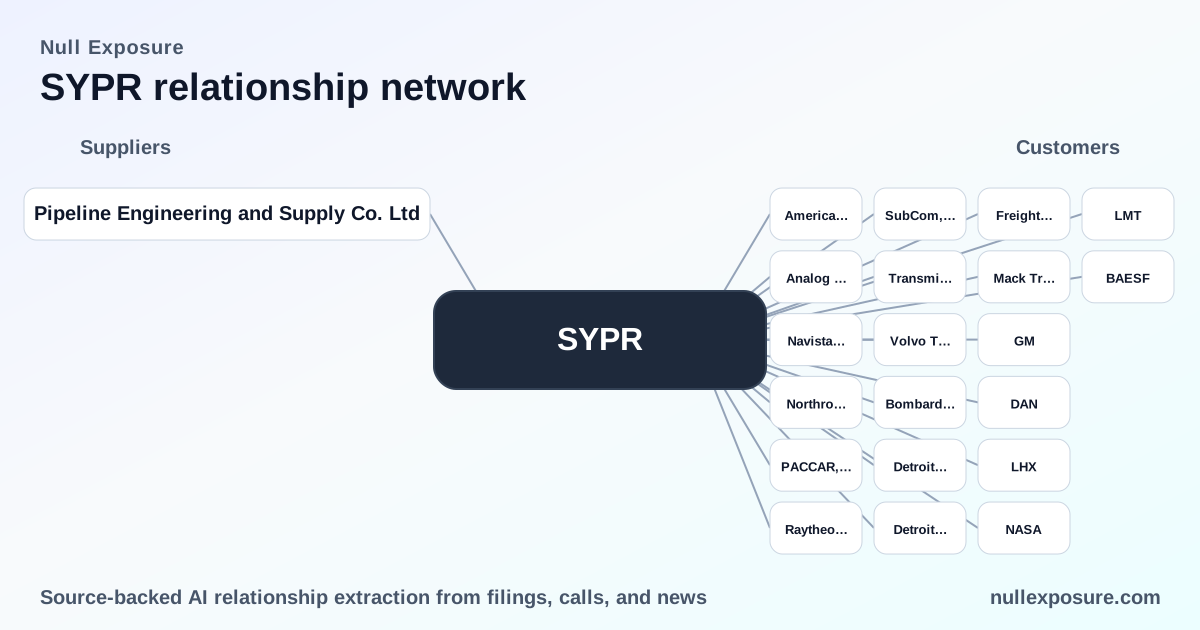
- Pipeline Engineering and Supply Co. Ltd — Sypris Technologies, a Sypris subsidiary, acquired the intellectual property rights for the rapid opening closure (ROC) product line from Pipeline Engineering and Supply Co. Ltd (PE) in Catterick, UK. According to a World Pipelines report from September 2022, the transaction transferred IP for the ROC line into Sypris’ product portfolio and expands its pipeline components offering in international markets. (Source: World Pipelines, Sept 2022)
This acquisition is a strategic supplier‑adjacent move: rather than relying solely on external vendors for ROC technology, Sypris internalized the product IP to control manufacturing, aftermarket parts and aftermarket pricing for that product family.
Contracting posture, spend concentration and maturity — corporate signals that drive supply risk
Company disclosures and subsequent analysis reveal three clear constraints that define Sypris’ supplier dynamics:
-
Long‑term commitments are material. Company filings show purchase commitments of $29.742 million as of December 31, 2024, with $28.671 million due in 2025 and $1.071 million due in 2026. This is a substantial, multi‑year locked spending profile for a company at Sypris’ revenue scale. (Source: company filings, FY2024 disclosures)
-
Buyer role and inventory‑backed procurement. Sypris explicitly enters agreements to purchase inventory based on its production requirements to reduce manufacturing lead times—an operational choice that creates predictable cash outflows and operational dependence on contract suppliers. (Source: company filings / operational disclosures)
-
Spend band consistent with mid‑tier supplier commitments. The magnitude of purchase commitments aligns with a $10M–$100M spend band—large enough to demand supplier attention and negotiate terms, but not so concentrated as to reflect enterprise-scale procurement bargaining power. (Source: company disclosures summarized, FY2024)
Collectively, these constraints indicate a mature, committed contracting posture: Sypris is a buyer that locks in supply to protect delivery cadence, but its overall scale prevents it from extracting the deepest commercial concessions available to larger OEMs.
Practical implications for investors and supplier managers
The operating and contracting signals translate into specific risks and negotiating realities:
-
Supplier leverage is asymmetric but limited. Sypris’ long‑term, non‑cancelable commitments create guaranteed volume for suppliers and reduce supplier risk. However, Sypris’ modest scale and negative operating margins limit its ability to secure preferential pricing or withstand major supplier price shocks.
-
Acquisition of IP reduces external dependency for specific product lines. The ROC IP acquisition reduces reliance on external licensors or suppliers for that product, shifting production and aftermarket margin capture in Sypris’ favor—critical for niche pipeline components where aftermarket sales are meaningful.
-
Working capital and cash‑flow sensitivity are elevated. Locked inventory purchases of nearly $30 million create cash‑flow timing risk for a company with minimal EBITDA cushion, meaning supplier failures or sudden cost inflation could rapidly pressure margins and liquidity.
If you want a deeper supplier‑level profile and ongoing monitoring for Sypris, see full coverage and tools at https://nullexposure.com/.
Financial context that amplifies supplier risk
A few financial metrics frame how supplier exposure transmits to equity outcomes:
- Trailing revenue: $123.1 million; gross profit: $13.387 million; EBITDA: $0.22 million.
- Profitability is negative (TTM operating margin ~ -6.58%, profit margin ~ -1.87%), implying limited buffers against input cost shocks.
- Insider ownership is unusually high (~46%), with institutional ownership low (~17%), concentrating decision control and potentially accelerating strategic moves like bolt‑on IP purchases.
These factors mean that supplier disruptions or adverse contract repricing will have a magnified impact on earnings and free cash flow.
What investors and procurement teams should watch next
- Monitor supplier concentration beyond the ROC acquisition: additional material suppliers, if consolidated, would increase counterparty concentration risk.
- Watch quarterly changes in purchase commitments—material increases or decreases will signal changes in production forecasting, new contract wins or cancellations.
- Track working capital metrics and inventory turns closely; a growing gap between purchase commitments and cash from operations is a red flag for payment or renegotiation risk.
For continued surveillance of supplier commitments, acquisitions, and contracting signals, visit https://nullexposure.com/ for tools and briefings.
Bottom line: measured exposure, targeted control, and asymmetrical risk
Sypris is a specialized manufacturer that uses long‑dated purchase commitments and selective IP acquisition to stabilize production and capture aftermarket value. The company’s buyer posture and roughly $29.7 million of purchase commitments are material relative to its scale, creating predictable supply flows but amplifying cash‑flow sensitivity given weak operating profitability. The Pipeline Engineering and Supply Co. Ltd ROC acquisition is a clear example of Sypris’ strategy to internalize product value and reduce external dependency for niche components.
Investors should view Sypris’ supplier footprint as decisive but concentrated—stable if managed, risky if input prices or production forecasts diverge—making ongoing supplier monitoring essential. For actionable supplier intelligence and continuous monitoring, explore the resources at https://nullexposure.com/.