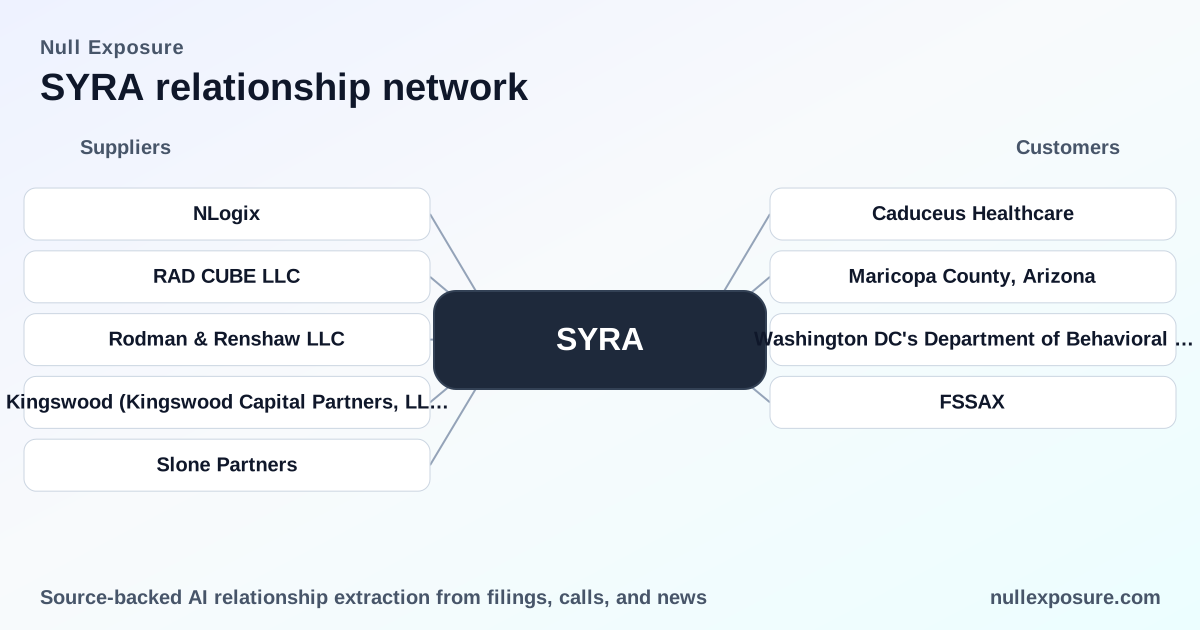
Syra Health (SYRA) — supplier relationships, contracting posture, and investor implications
Syra Health operates as a healthcare technology and medical care facilities company that monetizes by delivering prevention-focused, accessible clinical programs and related services; reported trailing twelve‑month revenue is $7.23 million while the market capitalization is roughly $1.55 million. This profile produces a supplier footprint that is concentrated, related‑party heavy, and operationally modest in dollar scale, which creates both governance questions and limited near‑term vendor leverage for investors.
For an at‑a‑glance supplier view and continuous monitoring, visit the Nillexposure homepage: https://nullexposure.com/
How the supplier map is organized and why it matters to investors
Syra’s disclosed supplier relationships fall into two clear categories: related‑party operating vendors that provide core HR and IT services, and capital markets / executive search firms that supported financing and leadership transitions. The operating vendors are small in absolute spend relative to revenue but are beneficially owned by Syra’s principals, which elevates governance and conflict‑of‑interest risk even when dollar amounts are modest. The financing and recruiting partners are transactional and signal capital‑markets activity and board/management transitions.
Below I cover each disclosed relationship in plain English, with source references to the company filing or public notices.
NLogix
Syra paid $516,129 in FY2024 (and $348,304 in FY2023) to NLogix for recruitment and human resources services; NLogix is beneficially owned by Syra’s principal owners and management team and those amounts were recorded in cost of sales. This underscores a direct related‑party reliance for talent acquisition and HR execution. According to Syra’s FY2024 Form 10‑K, the payments and ownership link are disclosed in the notes to the statements of operations.
RAD CUBE LLC
Syra incurred $22,233 in FY2024 (and $3,320 in FY2023) for outsourced IT services from RAD CUBE LLC, which is also beneficially owned by the principal owners and management team; these costs were recorded within selling, general and administrative expenses. The FY2024 Form 10‑K lists RAD CUBE as a related‑party service provider for IT support.
Rodman & Renshaw LLC
Rodman & Renshaw acted as the exclusive placement agent for a public offering announced in FY2024, supporting Syra’s capital raise activities. A news bulletin covering the pricing of a $2.1 million public offering identified Rodman & Renshaw LLC as the exclusive placement agent.
Kingswood (Kingswood Capital Partners, LLC)
Kingswood served as sole bookrunner for Syra’s IPO, a role that placed it at the center of Syra’s initial public offering and primary market distribution. PR Newswire reported Kingswood’s role in the closing of Syra Health Corp.’s IPO in FY2023.
Slone Partners
Slone Partners, a national executive search firm, executed the placement of Gregory R. Alexander as Syra’s CEO, signaling an externally sourced leadership appointment. Syra’s CEO placement through Slone Partners was announced in a PR Newswire release in FY2026.
What the disclosed constraints tell investors about operating posture
Syra’s filings include a small set of constraints and contract descriptors that illuminate the company’s procurement and facility posture:
-
Contracting posture — short, defined lease term. The company leases its corporate headquarters under a three‑year lease from STVentures, LLC, an entity beneficially owned by Syra principals; total lease payments disclosed amounted to $336,262. This indicates a near‑term, fixed occupancy commitment rather than a long duration real estate exposure, and it is a related‑party lease that requires governance scrutiny. (Company 10‑K disclosures; FY2024.)
-
Relationship maturity and spend scale. Spend bands and line items indicate mid‑five‑to‑six‑figure annual supplier relationships rather than high‑value outsourcing contracts; the lease and the NLogix HR spend land in the $100k–$1M band. These are company‑level signals that supplier dollars are meaningful to operations but not large enough to create outsized vendor dependence on a pure cash basis relative to reported revenue ($7.23M TTM).
-
Concentration and ownership alignment. Multiple vendor disclosures identify suppliers that are beneficially owned by principals and management, a structural characteristic that concentrates supplier risk inside the insider group and elevates oversight requirements.
Risk and opportunity implications for investors
- Governance risk is the primary concern. Related‑party spend for recruitment, HR, IT and leasing creates potential conflicts that require clear board oversight and transparent pricing; investors should prioritize disclosures of pricing comparability and board approvals.
- Operational risk is moderate but manageable. Absolute spend levels are modest relative to revenue, limiting single‑vendor operational exposure; however, the concentration of key functions (HR and IT) in insider‑owned entities raises resilience questions if transition is needed.
- Capital markets activity is ongoing. Use of placement agents and bookrunners (Rodman & Renshaw; Kingswood) and an executive search firm (Slone Partners) signals continued financing and leadership evolution, which investors should track for dilution and strategic direction.
If you want a concise supplier risk scorecard and governance flags tailored to SYRA, start with our supplier intelligence hub: https://nullexposure.com/
Practical next steps for investors and operators
- Request board minutes or approvals that document the commercial terms and competitive alternatives for the related‑party agreements (NLogix, RAD CUBE, STVentures lease).
- Monitor capital raises handled by placement agents for dilution and for any fee structures that increase operating leverage. The PR filings and press releases linked above are the primary public windows into those transactions.
- Maintain a watchlist for vendor concentration should Syra scale clinical operations; the current vendor spend profile would need to evolve as revenue grows.
For ongoing tracking and alerts on these supplier relationships, Nillexposure provides continuous monitoring and analysis: https://nullexposure.com/
Bottom line
Syra’s supplier landscape is defined by related‑party operational vendors and transactional capital‑markets partners. That structure compresses vendor spend into manageable dollar bands but amplifies governance and conflict‑of‑interest risk. Investors should insist on transparent board oversight and comparative procurement tests as the business scales and as leadership and financing activity continue.