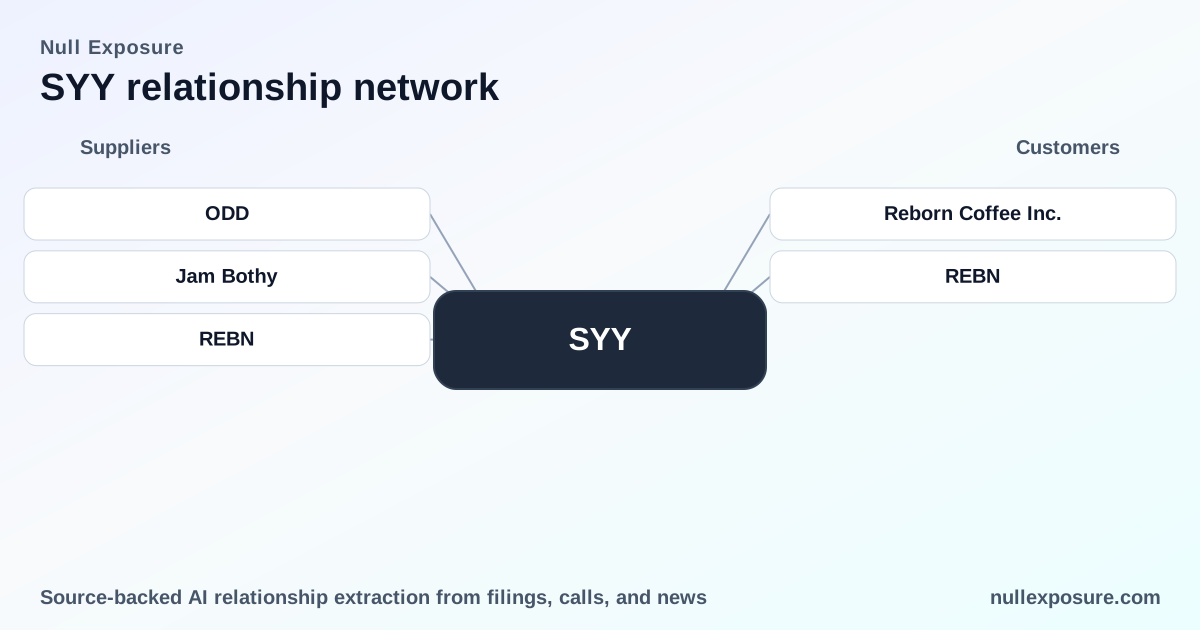
Sysco (SYY) supplier map: what three recent partnerships reveal for investors
Sysco operates as the global backbone of foodservice procurement and distribution, monetizing by aggregating purchases, distributing branded and private-label food and non-food items, and charging distribution and service margins to restaurants, institutions and hospitality operators. The company's scale produces predictable recurring revenue from product sales and value-added logistics and procurement services, with reported trailing revenue of about $82.6 billion (TTM) and an operating model centered on centralized purchasing and broad supplier coverage. For a deeper view of supplier exposures and relationship intelligence, visit https://nullexposure.com/.
Recent supplier headlines: concise takeaways for owners and operators
Sysco’s public newsflow in March 2026 highlights a mix of regional product deals and distribution partnerships ranging from small artisanal producers to international food brands. Each relationship is consistent with Sysco’s stated procurement posture: a centralized framework that supports long-term service commitments while buying from thousands of suppliers, keeping single-supplier concentration low but aggregate purchase commitments high.
If you are tracking supplier risk, focus on three structural signals:
- Long-term service commitments exist alongside short-cycle product agreements — Sysco reports some third‑party services committed into the 2030s while many product agreements roll annually.
- Supplier mix is intentionally broad — from small regional producers to large branded manufacturers, limiting single-vendor concentration.
- Scale creates material spend leverage — Sysco discloses minimum committed product purchases in the billions while individual vendors are immaterial to total purchases.
Explore more supplier-level intelligence at https://nullexposure.com/ to map how these signals affect counterparty concentration, contract maturity and operational criticality.
Odd Burger / Preposterous Foods — national distribution for a plant-based line
Odd Burger announced the launch of Preposterous Foods and said the new plant-based product line will be distributed exclusively through Sysco, positioning Sysco as the primary U.S. channel partner for the launch. According to Vegconomist (March 10, 2026), the exclusivity places Sysco in a traditional distributor role for a category that is driving incremental foodservice demand. Source: Vegconomist article, March 10, 2026, https://vegconomist.com/gastronomy-food-service/preposterous-foods-sysco/.
Jam Bothy — regional manufacturing placed into Sysco’s Brakes Scotland range
Jam Bothy confirmed that 3kg tubs of its product are being carried into Sysco’s Brakes Scotland assortment, a placement aimed at busy foodservice outlets that value Scottish-sourced ingredients. Morningstar/Accesswire reported the item placement as part of Sysco’s strategy to include specialty and locally sourced items in regional catalogues (March 10, 2026). Source: Morningstar Accesswire, March 10, 2026, https://www.morningstar.com/news/accesswire/1139286msn/sysco-supports-its-rural-farm-suppliers-meet-the-supplier-jam-bothy.
Reborn Coffee — distribution partnership for a specialty beverage brand
Reborn Coffee announced a distribution partnership with Sysco that gives the roaster access to Sysco’s foodservice channels, aligning a specialty beverage supplier with Sysco’s national distribution footprint. Reuters coverage syndicated on TradingView reported the agreement on March 10, 2026, underscoring Sysco’s role as distribution partner for beverage suppliers. Source: Reuters via TradingView, March 10, 2026, https://www.tradingview.com/news/reuters.com,2026:newsml_TUAJT8GX:0-reborn-coffee-announces-distribution-partnership-with-sysco/.
How these relationships map to Sysco’s operating model and constraints
Sysco’s corporate disclosures and the three recent supplier items together describe a procurement engine built on a consolidated framework with both long-term service contracts and high-frequency product purchases. Company-level signals drawn from public filings and corporate commentary include:
- Contracting posture (long-term + framework): Sysco discloses third-party service commitments with terms extending into fiscal 2036 and product aggregation agreements that have majority one‑year expiries but include contracts through fiscal 2030. This indicates a hybrid posture: long-term infrastructure and IT/warehouse arrangements combined with rolling product procurement frameworks.
- Counterparty diversity: Disclosures explicitly describe suppliers spanning large brand manufacturers, mid-market processors and small regional producers. That diversity reduces single-vendor concentration risk while expanding operational complexity across sourcing, quality and logistics.
- Geographic sourcing concentration: For U.S. Foodservice (about 70% of sales), over 90% of products are purchased domestically—a North America-centric sourcing footprint that concentrates supply-chain risk regionally while simplifying logistics.
- Materiality and spend dynamics: The company states no single supplier accounted for more than 10% of purchases in fiscal 2025, yet minimum committed product purchases totaled approximately $22.4 billion as of June 28, 2025, and remaining service costs for longer-term contracts were disclosed at roughly $184 million. Aggregate commitments are large even as individual counterparties remain immaterial.
- Relationship roles and stage: Sysco functions predominantly as a buyer and distributor while many counterparties act as manufacturers/suppliers; most relationships are active and operational. This signals dependency on logistics continuity rather than single-supplier product exclusivity, except where explicit exclusivity arrangements are announced.
Midway observers and investors tracking supplier concentration, contract tail risk, and regional sourcing should monitor how individual partnerships—especially exclusive or category-defining deals—shift procurement leverage. If you want a structured supplier risk scorecard for SYY, start here: https://nullexposure.com/.
Investment implications: what investors should watch next
Sysco’s supplier footprint supports a stable, low-margin, volume-driven business that benefits from scale but is exposed to logistics and category trends. Key investment considerations:
- Upside from new categories: Exclusive distribution deals in growing categories (e.g., plant-based proteins, specialty coffee) create incremental volume and higher-margin opportunities for Sysco’s value-added services. The Odd Burger Preposterous Foods launch is a concrete example.
- Operational risk is logistics- and contract-driven, not single-vendor concentration: Large aggregate commitments and long-dated service contracts create exposure to execution and cost inflation, while supplier diversity limits catastrophic single-supplier failures.
- Regional sourcing concentration creates correlated supply shocks: Over 90% domestic purchasing for U.S. operations simplifies delivery networks but increases vulnerability to domestic agricultural and labor disruptions.
Actionable checklist for investors and operators:
- Monitor announcements of category exclusivity or national rollouts that increase Sysco’s merchandising leverage.
- Review quarterly vendor dispute disclosures and any legal claims as they reveal where procurement friction exists.
- Track contracted service tails (IT/warehousing) for fixed-cost obligations into 2030–2036 that can compress margins under stress.
For ongoing updates on Sysco’s supplier relationships and to model counterparty risk into your investment thesis, visit https://nullexposure.com/.
Bottom line
Sysco’s recent supplier news—regional specialty placements and exclusive distribution partnerships—fits a large-scale, centrally procured distribution model that blends long-term infrastructure commitments with high-frequency product purchasing across thousands of vendors. Investors should view supplier headlines as signals of category momentum and incremental margin opportunity rather than indicators of concentrated counterparty risk, while remaining attentive to the company’s significant aggregate purchase commitments and long-dated service contracts. For a granular supplier exposure analysis tied to investment decisions, go to https://nullexposure.com/.