AT&T Inc (T) — The supplier ledger that runs the network
AT&T monetizes a national telecommunications franchise by selling wireless and fixed connectivity, layered services and device bundles while outsourcing critical infrastructure and software to a concentrated set of suppliers. The company captures scale economics from subscriber billing and fixed‑service ARPU expansion while deferring capital and technology risk through supplier contracting, licensing arrangements and vendor financing terms. For investors, the supplier book is both the lever for network modernization and a source of concentrated operational risk.
Explore supplier relationship intelligence at https://nullexposure.com/ to benchmark counterparty risk and payment posture.
How supplier relationships drive cash flow and capital efficiency
AT&T’s operating model is capital‑intensive but monetized through high recurring revenue and service bundles. The company reduces cash outflow and smooths capex through short‑term supplier payment terms and selective long‑term licensing, while keeping large supplier obligations on the balance sheet. Public disclosures show supplier financing payments are due within one year and the company targets payment terms of 90 days or longer, offering suppliers early‑payment bank facilities at their cost. AT&T also executes multi‑year software licensing arrangements (two to five years) that convert technology investments into predictable service capability without all capital being on AT&T’s balance sheet.
- Contracting posture: Mix of short‑term operational payables and multi‑year licensing, supporting rapid technology refresh while preserving liquidity.
- Spend concentration: Company‑level signals indicate supplier obligations in the high hundreds of millions to billions, creating material counterparty exposure.
- Role diversity: AT&T is both a licensee of third‑party IP and a large reseller of supplier‑manufactured handsets and devices.
For a deeper look at how supplier terms affect liquidity and risk, visit https://nullexposure.com/.
Relationship rundown — who supplies AT&T and what they deliver
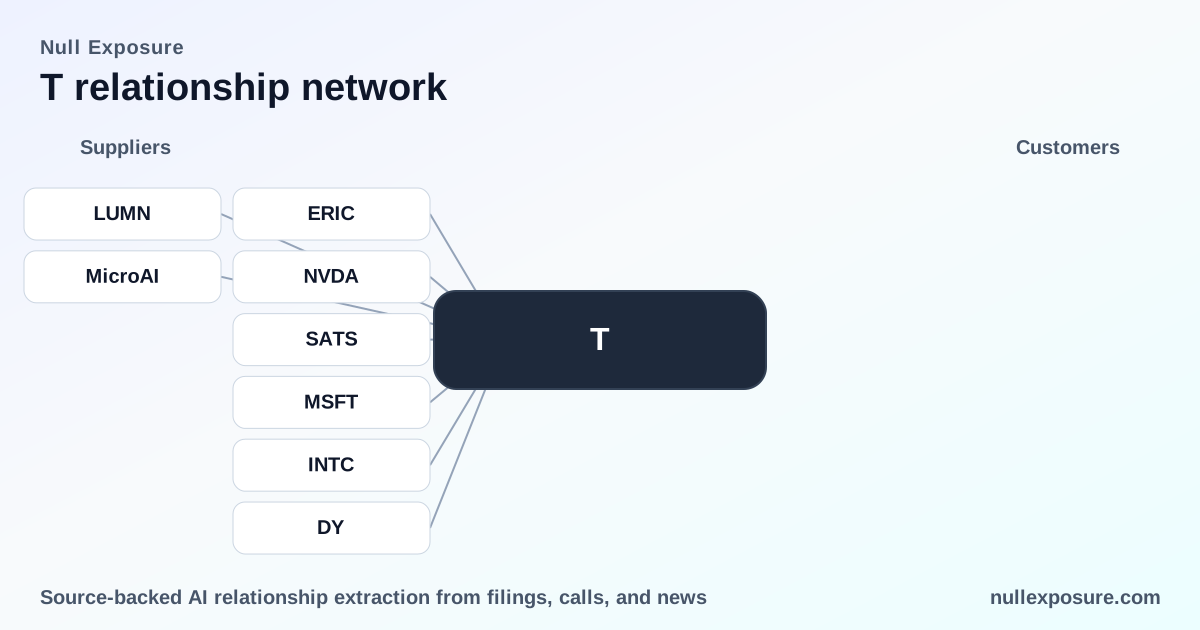
This section lists every supplier relationship in the source set with a concise, plain‑English summary and source reference.
Ericsson
AT&T and Ericsson demonstrated a working prototype of an AI‑driven 5G Cloud RAN feature that improves radio efficiency and aligns with AT&T’s cloud‑native radio plans. According to Bitget coverage and multiple news outlets in March 2026, Ericsson tested its AI‑native Link Adaptation software on a Cloud RAN setup that matches AT&T’s planned deployment. (Bitget, March 2026; InsiderMonkey and Finviz reporting, March 2026)
NVIDIA
NVIDIA supplies fast video analytics and conversational AI capabilities that underpin AT&T’s edge and smart‑manufacturing initiatives; these AI components power analytics and inference workloads at the network edge. (TradingView/Zacks, March 2026)
Microsoft
Microsoft’s Azure OpenAI services power generative AI at the edge for AT&T’s enterprise and manufacturing solutions, providing cloud and model hosting that AT&T integrates into customer offerings. (TradingView/Zacks, March 2026)
Intel
Intel’s Xeon 6 SoC served as the compute platform when Ericsson ran its AI‑native Link Adaptation software in a Cloud RAN test environment tailored to AT&T’s design, indicating Intel hardware is part of AT&T’s future cloud RAN compute stack. (Bitget, March 2026)
EchoStar
EchoStar sold spectrum licenses that AT&T acquired, a transaction that realizes value for EchoStar shareholders and transfers spectrum assets into AT&T’s network footprint to accelerate capacity and coverage. Morningstar noted the sale as a strategic monetization for EchoStar and a spectrum acquisition for buyers including AT&T and SpaceX. (Morningstar, March 2026)
Dycom Industries
Dycom reported that major customers—including AT&T—account for over 10% of contract revenues in a recent quarter, demonstrating that Dycom’s field services and construction work are materially tied to AT&T’s network buildouts. (Bitget coverage of Dycom results, March 2026)
Lumen Technologies (Lumen)
AT&T closed a deal to acquire mass‑market fiber locations from Lumen, adding more than 1 million fiber locations and accelerating AT&T’s shift to higher‑ARPU fixed services; Lumen, in turn, is repositioning toward enterprise AI infrastructure. (MarketBeat instant alert and BroadbandBreakfast reporting, March 2026)
MicroAI
AT&T’s smart‑manufacturing push includes collaboration with MicroAI alongside larger partners; MicroAI contributes embedded AI inferencing capabilities used in AT&T’s industrial and edge solutions. (TradingView/Zacks, March 2026)
What the supplier map implies for investors and operators
The supplier list reflects a deliberate strategy: AT&T pairs global systems integrators (Ericsson, Intel) and hyperscale cloud providers (Microsoft, NVIDIA) with specialized field and construction contractors (Dycom, Lumen) to execute a cloud‑native 5G and fiber expansion. This hybrid approach reduces direct capex while concentrating operational dependence on a small number of strategic vendors.
Key operational signals to price into risk and valuation:
- Payment posture is supplier‑friendly but cash‑optimized. Public notes confirm supplier financing payments are due within one year and AT&T actively manages timing to exploit 90‑day+ terms, which improves near‑term free cash flow but places liquidity pressure on key suppliers.
- Licensing is material and multi‑year. AT&T uses multi‑year software licenses (two to five years) to lock in capabilities while converting upfront costs into amortized payments—this creates predictable operating expense but also longer‑term vendor lock‑in.
- Spend concentration is significant. Company disclosures reference confirmed obligations in the billions, indicating that a small set of suppliers account for meaningful spend and counterparty risk.
Operationally, these characteristics produce both upside and exposures: faster technology deployment and ARPU uplift on one hand; single‑vendor execution risk and payment timing stress on the other.
Explore a supplier risk baseline for AT&T and comparable peers at https://nullexposure.com/ to understand concentration and payment dynamics.
Investment implications and what to watch next
For investors, AT&T’s supplier relationships are strategic levers for growth and cost control. Positive catalysts include successful Cloud RAN deployment with Ericsson and expanded fiber scale from the Lumen deal, both of which should drive higher‑margin fixed services. Key risks are execution dependency on a few core suppliers, supplier liquidity strain if payment terms compress, and licensing cost escalation if software initiatives require rapid scaling.
Monitor these specific indicators:
- Rollout cadence and commercial trials of Ericsson’s Cloud RAN and AI features.
- Hardware and compute commitments to Intel and NVIDIA that affect deployment economics.
- Execution metrics from Dycom and other field vendors tied to fiber rollout timelines.
- Licensing renewals and the accounting cadence of multi‑year software contracts.
For an operational view that ties these supplier relationships to liquidity and counterparty risk, visit https://nullexposure.com/ and review supplier‑level exposure benchmarks.
Conclusion: AT&T’s supplier strategy accelerates network modernization and ARPU mix improvement while concentrating execution risk. Investors should value the upside from cloud‑native 5G and fiber scale against supplier concentration and payment‑term mechanics that materially influence near‑term cash flow and vendor stability.