TACO supplier profile: outsourced CFO relationship and what it means for investors
Berto Acquisition Corp. (ticker: TACO) is a publicly traded acquisition vehicle listed on NASDAQ whose public filings and market data show the company is operating with an outsourced senior finance function rather than a fully staffed in-house finance department. The company monetizes shareholder capital principally through execution of a business combination or other corporate transaction; meanwhile its near-term operating expenditures include contracted executive services. For investors evaluating supplier counterparty risk, the single disclosed supplier relationship — an ongoing CFO services agreement — is the most material vendor exposure reported in the available record. Learn more about supplier intelligence and third-party risk at https://nullexposure.com/.
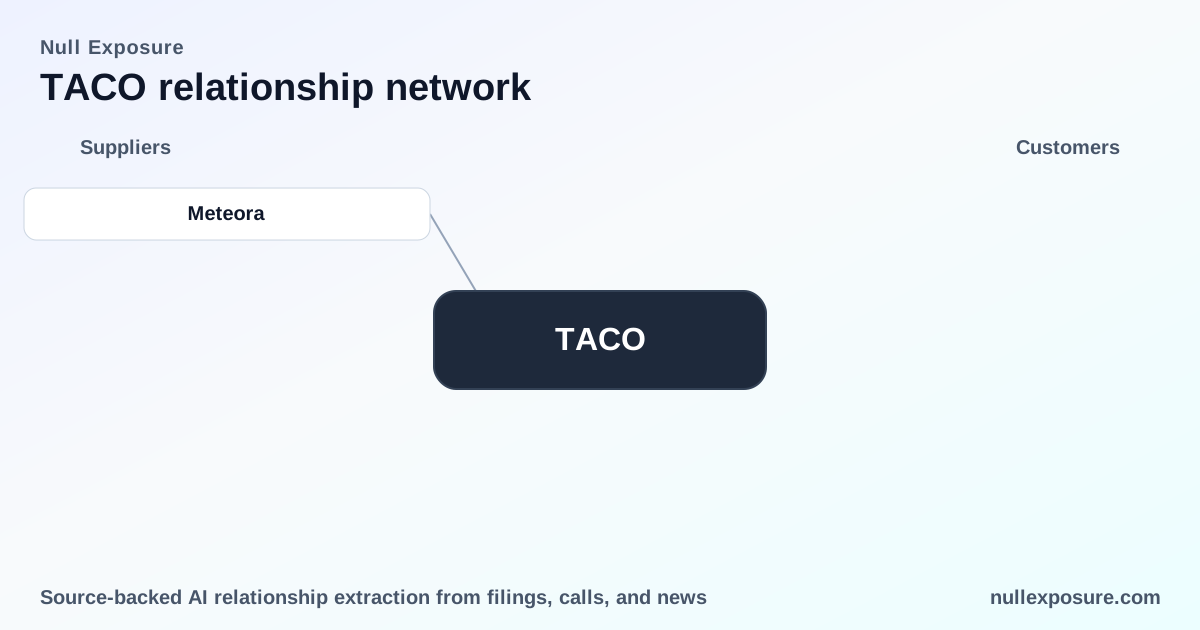
One clear supplier: Meteora provides CFO services
Meteora is disclosed in Berto’s public reporting as the counterparty to a CFO Services Agreement that pays a quarterly fee to make Vikas Mittal available as Chief Financial Officer. The engagement is structured as a contracted executive-services arrangement rather than a traditional full-time hire. According to TradingView’s summary of the company’s SEC 10-Q filing for FY2025, the fee is paid quarterly in exchange for the availability of Mr. Mittal as CFO (TradingView coverage of Berto’s FY2025 10-Q, reported March 2026: https://www.tradingview.com/news/tradingview:a5dbd8a32b04f:0-berto-acquisition-corp-sec-10-q-report/).
This single relationship is the only supplier engagement disclosed in the provided supplier scope, and it is both operationally and reputationally significant: a contracted CFO is central to financial reporting, regulatory compliance, and transaction execution.
Relationship snapshot
- Meteora provides outsourced CFO services to Berto Acquisition Corp., with a quarterly fee for access to Vikas Mittal as CFO. Source: TradingView summary of Berto’s FY2025 SEC 10-Q (reported March 2026): https://www.tradingview.com/news/tradingview:a5dbd8a32b04f:0-berto-acquisition-corp-sec-10-q-report/.
What this supplier exposure signals about Berto’s operating model
The Meteora arrangement reveals several corporate-level operating characteristics that investors should treat as active signals when assessing counterparty and execution risk.
- Contracting posture — outsourced and transactional. The CFO role is fulfilled through an external services agreement rather than an employee contract, indicating a deliberate preference for flexible, vendor-delivered executive capability. This posture reduces fixed payroll obligations but increases reliance on a counterparty for continuity of senior finance functions.
- Concentration risk — single-provider dependency. With only one supplier reported for the CFO function, the company carries high concentration risk in its finance leadership. If Meteora’s availability changes, Berto will need a rapid replacement mechanism to avoid disruptions to reporting and transaction timelines.
- Criticality — strategic and mission-critical. The CFO function is inherently critical for a public acquisition vehicle; therefore this supplier relationship is operationally critical and directly tied to the company’s ability to complete a business combination and meet SEC reporting obligations.
- Maturity and formality — contractually formal but operationally lean. The quarterly fee structure documented in the filing signals a formalized contract, but the arrangement remains lean compared to a full in-house finance team — typical for acquisition vehicles or early post-spac combinations that prioritize capital deployment over building large internal functions.
These are company-level signals derived from the contractual nature of the disclosed engagement, rather than isolated metrics.
Financial and shareholder context that amplifies supplier importance
Berto’s market position and ownership structure make supplier reliability especially important to investors. Market capitalization is reported at $382.7 million, with 37.52 million shares outstanding and institutions holding roughly 72.9% of the float, according to the company overview. Insider ownership is meaningful at about 19.2%, which concentrates governance incentives alongside institutional scrutiny. Given this profile, any interruption to financial leadership has outsized implications for valuation and transaction execution timelines.
Risk implications for investors and operators
- Execution risk on corporate combinations. A contracted CFO sits at the center of deal diligence, financial disclosure, and post-transaction integration planning; any vendor disruption increases the probability of timeline slippage or disclosure errors.
- Vendor replacement and transition risk. Outsourced executive roles compress the timeline to identify and onboard successors; the company’s current contracting posture implies limited internal redundancy.
- Cost vs. control trade-off. Outsourcing reduces fixed costs and preserves capital flexibility, but it transfers a level of control to an external provider — a trade-off investors should quantify when valuing the company’s execution capability.
For operators assessing counterparty resilience, these are actionable risk dimensions: document vendor SLAs, require contingency staffing clauses for critical roles, and assess the vendor’s own capacity and continuity plans.
Learn how to map supplier criticality and build contingency scoring for executive services at https://nullexposure.com/.
Practical due diligence checklist for this relationship
- Confirm the term, renewal mechanics, and termination triggers of the CFO services agreement to assess transition risk.
- Validate the scope of services — which responsibilities remain with Berto versus Meteora — to determine residual internal control exposures.
- Review disclosure and audit trails tied to financial reporting during the vendor’s tenure to confirm clear auditability and segregation of duties.
Closing takeaways and action items
Berto Acquisition’s single disclosed supplier relationship — Meteora’s outsourced CFO services — is a concentrated, critical dependency that materially affects execution risk for investors. The arrangement reflects a deliberate lean operating posture that trades internal control for capital flexibility. Given the company’s market capitalization and substantial institutional ownership, suppliers that touch finance and reporting warrant elevated scrutiny.
For investors and operators seeking deeper supplier intelligence or to commission a tailored risk assessment, visit https://nullexposure.com/ to request a focused supplier report or to begin a third-party risk engagement.