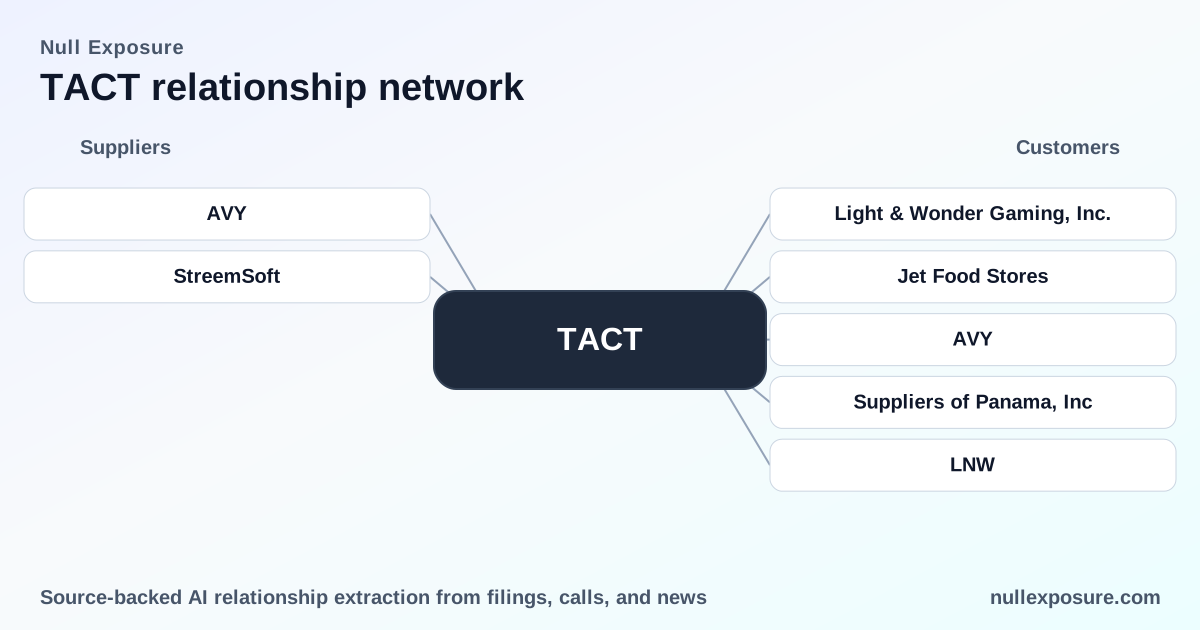
TransAct (TACT) — supplier map and operational constraints investors must price
TransAct Technologies designs and sells specialized transaction printers and terminals and monetizes through hardware sales, software licensing (including revenue-sharing licenses), and service/support contracts for its EPICENTRAL and BOHA! product lines. The company’s economics combine gross-margin support from proprietary software royalties with capital-light manufacturing via third‑party contract manufacturers, creating a supplier profile that is simultaneously cost-efficient and concentration-sensitive. For active investors and operators evaluating supplier counterparty risk, the tradeoff is clear: low fixed manufacturing capital but high outsourcing and licensing concentration that can affect availability and IP control.
Explore more supplier intelligence at https://nullexposure.com/ to inform diligence and contract negotiation.
How TransAct’s commercial model translates into supplier exposure
TransAct sells hardware (thermal printers and food service terminals) and licenses software that drives recurring revenue. Hardware manufacturing and assembly are outsourced, and certain food-service software components are licensed under revenue-sharing arrangements. This structure produces several operational characteristics:
- Contracting posture: heavy reliance on licensing agreements for software and long-term purchase relationships with contract manufacturers for hardware components.
- Concentration risk: material sourcing concentrated in Thailand for print mechanisms and assembly; a limited number of third‑party licensors for critical software components.
- Criticality: supplied components and licensed software are mission‑critical — disruptions directly reduce product availability and recurring service revenue.
- Maturity and optionality: ownership of a perpetual copy of BOHA! source code (recently acquired) changes the balance of control over a key software asset, improving long‑term optionality versus prior licensing-only posture.
These are company-level operating signals derived from TransAct filings and public disclosures; they are not assigned to any single relationship unless the underlying text explicitly names that counterparty.
Supplier relationships investors should track
Below I cover every supplier relationship surfaced in the public results and explain the operational and investment significance in plain language.
Avery Dennison — BOHA! software licensor and source-code license
TransAct announced that it acquired a perpetual license to a copy of the BOHA! source code that it historically licensed from Avery Dennison, transferring a formerly dependent software relationship into one with greater internal control over a core product. According to a company press release in August 2025, TransAct completed the license acquisition for BOHA! that underpins parts of its food-service offerings (press release, Aug 2025).
Takeaway: acquisition of the BOHA! source-code license materially reduces software dependency risk and strengthens TransAct’s long-term operating leverage.
StreemSoft — terminated master development and license agreement
A March 2026 report documented that TransAct terminated a Master Development and License Agreement with StreemSoft, indicating a cessation of a development/licensing relationship (TradingView report, Mar 2026).
Takeaway: the termination signals a reduction in external software reliance for the affected modules but also suggests contract churn and the potential near-term operational impact where StreemSoft deliverables had been integrated.
Operating constraints and what they imply for counterparty risk
TransAct’s public disclosures and recent announcements reveal several constraints that shape supplier risk. These are presented as company-level signals unless the excerpt names a partner.
- Licensing-centric software model: TransAct licenses web-based food-service application software and selected downloadable components on a non-exclusive, revenue-sharing basis through 2031, per company disclosures. This creates ongoing royalty obligations and multi-year vendor dependences for product functions and margins.
- Geographic manufacturing concentration (APAC): Almost all printers and terminals are produced by a third‑party manufacturer in Thailand. This concentration increases exposure to regional supply-chain disruption, logistics cost volatility, and geopolitical risk.
- Manufacturing outsourcing as a primary role: TransAct buys a majority of thermal print mechanisms and fully assembled printers from its Thailand contract manufacturer. That structure delivers manufacturing scale without fixed capital but centralizes single‑point operational risk.
- Third‑party service provisioning for software: The company relies on unrelated third parties to develop, maintain and host portions of its food service technology software, which makes operational continuity and software quality dependent on external providers.
- Royalty and licensee obligations: Gross margins explicitly account for royalty payments to third-party licensors of the food-service software products, embedding recurring cash‑flow obligations into the cost base.
Each of these constraints increases the importance of contractual protections (minimum supply commitments, IP transfer or escrow, SLAs, and multi-source qualification) and should influence valuation multiples applied to TransAct.
What this means for valuation and operational due diligence
Investors and operators should treat TransAct as a software-enabled hardware vendor with concentrated supplier vectors. Key implications:
- Upside: Full or perpetual control of BOHA! code significantly improves defensibility and long-term margin capture for the food-service stack — a positive for long-term revenue retention and product roadmap independence.
- Downside: Thailand-centric manufacturing and outsized reliance on third-party software development create single‑region and single‑vendor execution risk that compresses free cash flow during disruptions.
- Valuation sensitivity: Given current negative EPS and modest market cap, upside from software consolidation is meaningful, but downside from supply shocks could be immediate and disproportionate. Price-to-sales and EV metrics should be stress-tested for component shortages or accelerated royalty expense scenarios.
Actionable operator items include negotiating inventory buffers, demanding source-code escrow or perpetual transfers in future licensing, and qualifying secondary manufacturers outside of Thailand to reduce concentration.
Explore supplier risk scores and tailored counterparty reports at https://nullexposure.com/ to support M&A, portfolio monitoring, or procurement strategy.
Practical next steps for investors and procurement teams
- Confirm the scope and transfer terms of the BOHA! perpetual license in diligence materials to quantify cost savings and margin impact.
- Require supplier SLAs and multi-year commitments from the Thailand contract manufacturer, and evaluate secondary sourcing options to mitigate single-region concentration.
- Review the StreemSoft termination for any unfinished deliverables, warranty exposure, or transition costs and quantify ongoing development needs now that that agreement is closed.
- Re-run downside sensitivity on revenue and gross margin incorporating temporary production outages and royalty payment escalators.
For deeper supplier profiles, historical contract excerpts, and scenario modeling templates, visit https://nullexposure.com/ to order a focused supplier diligence package.
Bottom line
TransAct’s supplier picture is a mix of outsourced manufacturing concentration and evolving software independence. The shifted balance toward owning BOHA! source code lowers future licensing risk and improves strategic optionality, while the Thailand manufacturing concentration and reliance on external software service providers remain material operational risk factors that investors and operators must price and mitigate. Act on IP-transfer details, supplier SLAs, and secondary sourcing to capture upside and limit downside.
Access curated supplier intelligence and contract-level analysis at https://nullexposure.com/ to convert these findings into investment or operational actions.