Takeda’s 2026 supplier map: AI partnerships, selective licensing, and pipeline pruning
Takeda operates as a research-driven global pharmaceutical company that monetizes through a mix of internal R&D, strategic licensing and acquisitions, and partnerships that convert early-stage science into late-stage assets and commercial rights. Recent activity shows Takeda paying for near-term rights and outsourcing discovery capabilities—translating cash and milestone risk into a replenished pipeline and optionality for its therapeutic franchises. For investors, the company’s supplier relationships are direct levers on R&D productivity, capital allocation, and time-to-market.
If you want a concise index of these partner dynamics and how they affect supplier risk and upside, start here: https://nullexposure.com/
Directional strategy: what the new deals reveal about how Takeda organizes R&D
Takeda’s publicized supplier relationships from FY2025–FY2026 signal a clear operating posture: externalize early discovery to AI-enabled and computational biology specialists, then selectively pay for or license late preclinical/clinical assets. This two-track approach compresses discovery timelines while preserving optionality through paid licensing or acquisitions when assets demonstrate differentiated clinical readthrough.
- Contracting posture: outward-facing and modular—Takeda signs multi-year tech and discovery collaborations rather than exclusively building in-house machine-learning platforms.
- Concentration and criticality: relationships are diversified across multiple boutique biotech partners, lowering supplier concentration risk while making each partner strategically important for early-stage throughput.
- Maturity: most partnerships are early-stage (discovery/design) or rights purchases for clinical-stage assets, indicating Takeda focuses on accelerating entry points to clinically de-risked programs rather than building commoditized platforms internally.
Explore the underlying relationship signals in more detail at https://nullexposure.com/
The relationships that matter — one-by-one
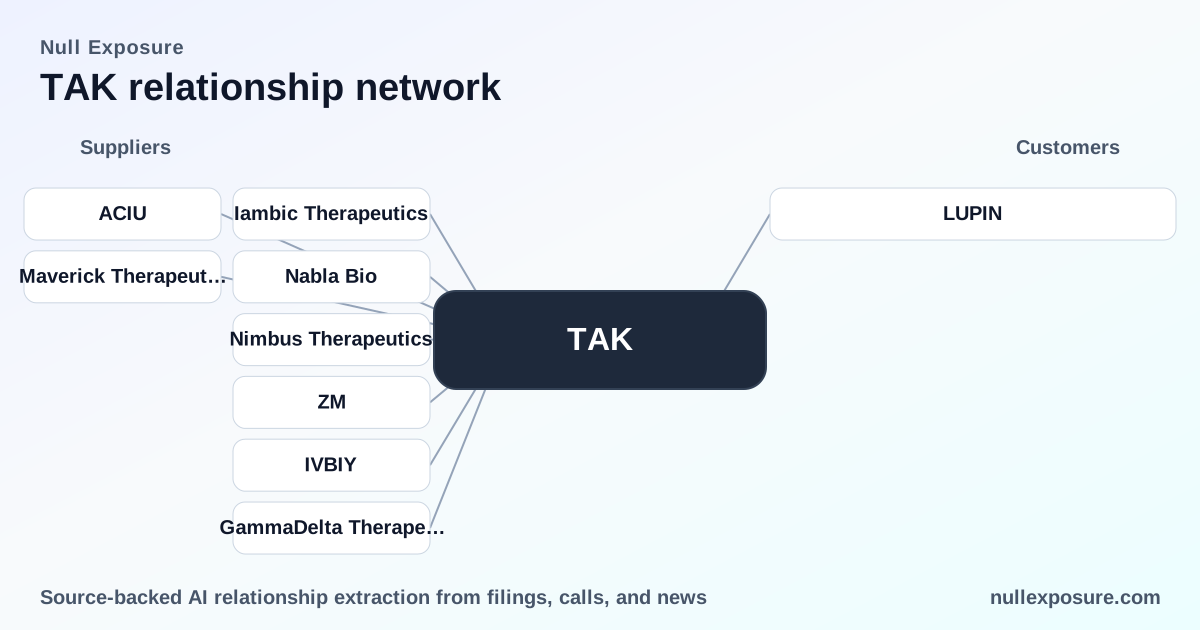
Iambic Therapeutics — Takeda signed a multi-year technology and discovery collaboration to apply Iambic’s AI models to small-molecule drug discovery across oncology, inflammation, and gastrointestinal disease, in a deal that could total as much as $1.7 billion in potential payments. This is a strategically large bet on external AI discovery to feed Takeda’s pipelines (GenEngNews, 2026: https://www.genengnews.com/topics/artificial-intelligence/takeda-iambic-launch-up-to-1-7b-ai-collaboration/).
Nabla Bio — Takeda deployed Nabla Bio’s Joint Atomic Model (JAM) computational platform across early-stage programs and extended a pact potentially worth up to $1 billion to generate antibodies, multispecifics, and other protein therapeutics for Takeda’s pipeline (Benzinga and GeneOnline reporting, FY2025–FY2026: https://www.benzinga.com/news/health-care/25/10/48209315/takeda-taps-nabla-bios-generative-ai-platform-for-antibody-design-in-1-billion-pact; https://www.geneonline.com/nabla-bio-and-takeda-announce-1-billion-collaboration-to-develop-ai-driven-protein-therapeutics/).
Nimbus Therapeutics — Takeda acquired the rights to zasocitinib from Nimbus for approximately $4 billion at the end of 2022, a transaction that has shown clinical payoff with strong Phase III data for plaque psoriasis and underpins Takeda’s strategy of buying differentiated clinical assets (BioSpace coverage, FY2025: https://www.biospace.com/drug-development/takedas-4b-nimbus-bet-pays-off-with-best-in-class-phase-iii-plaque-psoriasis-data).
Zoom — Takeda uses Zoom’s webcast and simultaneous interpretation services for investor and earnings communications, reflecting standard corporate IR tooling rather than a strategic R&D supplier relationship (MarketScreener FY2025 announcement of webcasting method: https://www.marketscreener.com/news/takeda-pharmaceutical-to-hold-earnings-call-for-fiscal-year-2025-2nd-quarter-on-october-30-ce7d5adcd881f32d).
Innovent Biologics (IVBIY) — Takeda paid $1.2 billion in cash for rights to two Innovent oncology candidates (now TAK-928 and TAK-921), a transaction that accelerates Takeda’s oncology portfolio with clinical-stage assets and reflects a willingness to deploy near-term capital to secure optionality (MedCityNews and FierceBiotech reporting, FY2026: https://medcitynews.com/2026/01/takeda-andy-plump-innovent-bispecific-antibody-cancer-oncology-adc-tak/).
GammaDelta Therapeutics — Takeda discontinued a cell-therapy research program that had included assets from its 2021 GammaDelta acquisition, signaling a strategic reallocation away from certain cell therapy modalities to other priorities within oncology (MedCityNews coverage, FY2026: https://medcitynews.com/2026/01/takeda-andy-plump-innovent-bispecific-antibody-cancer-oncology-adc-tak/).
AC Immune (ACIU) — Takeda’s commentary on partnering progress indicates ongoing collaboration with AC Immune in areas relevant to neurodegeneration and other programs where AC Immune contributes specific expertise to joint efforts (Earnings-call transcript reporting, FY2026: https://www.insidermonkey.com/blog/takeda-pharmaceutical-company-limited-nysetak-q3-2026-earnings-call-transcript-1685236/).
Maverick Therapeutics — Assets from Takeda’s 2021 Maverick acquisition informed earlier bispecific antibody efforts; inclusion in the narrative shows Takeda’s historical pattern of buying capabilities and later integrating or pruning them as strategy evolves (MedCityNews referencing the acquisition, FY2026: https://medcitynews.com/2026/01/takeda-andy-plump-innovent-bispecific-antibody-cancer-oncology-adc-tak/).
What investors should watch: capital allocation and program-level readthrough
Takeda’s mix of AI discovery deals plus high-value licensing and asset purchases creates three observable investment vectors:
- Near-term spend for optionality: multi-hundred-million to billion-dollar collaborations and one-off buys (e.g., Innovent $1.2B) are cash-intensive but convert scientific promise into owned or co-developed assets.
- Pipeline velocity: partnering with Iambic and Nabla increases the rate of candidate generation, reducing time spent in early discovery and potentially lowering per-program spend—but the commercial payoff remains tied to clinical outcomes.
- Portfolio pruning and focus: discontinuing cell-therapy research and consolidating efforts shows disciplined reallocation, which preserves capital for high-conviction buys and partnerships.
Key financial context: Takeda’s market capitalization and valuation multiples imply the market prices in a high expectation for successful pipeline replenishment; monitor announced milestones, R&D spend cadence, and how much of the procurement budget flows into upfront payments versus contingent milestones.
For a structured supplier-risk profile and to map these relationships against comparable peers, visit https://nullexposure.com/
Final takeaways and next steps
Takeda’s supplier relationships in 2025–2026 show a deliberate playbook: buy or partner for differentiated capabilities and clinical-stage assets while cutting underperforming internal lines. That strategy accelerates potential upside but concentrates downside in clinical execution and milestone realization—areas investors should monitor quarter-to-quarter.
If you are evaluating Takeda for allocation or counterparty exposure, use the company’s partner announcements, milestone schedules, and cash deployment as primary signals. For an actionable index of these supplier interactions and ongoing monitoring tools, go to https://nullexposure.com/
Bold positions: Takeda is actively externalizing discovery and paying for clinical optionality; the practical outcomes for shareholders will be determined by milestone realization and the company’s ability to convert AI-driven discovery into late-stage candidates.