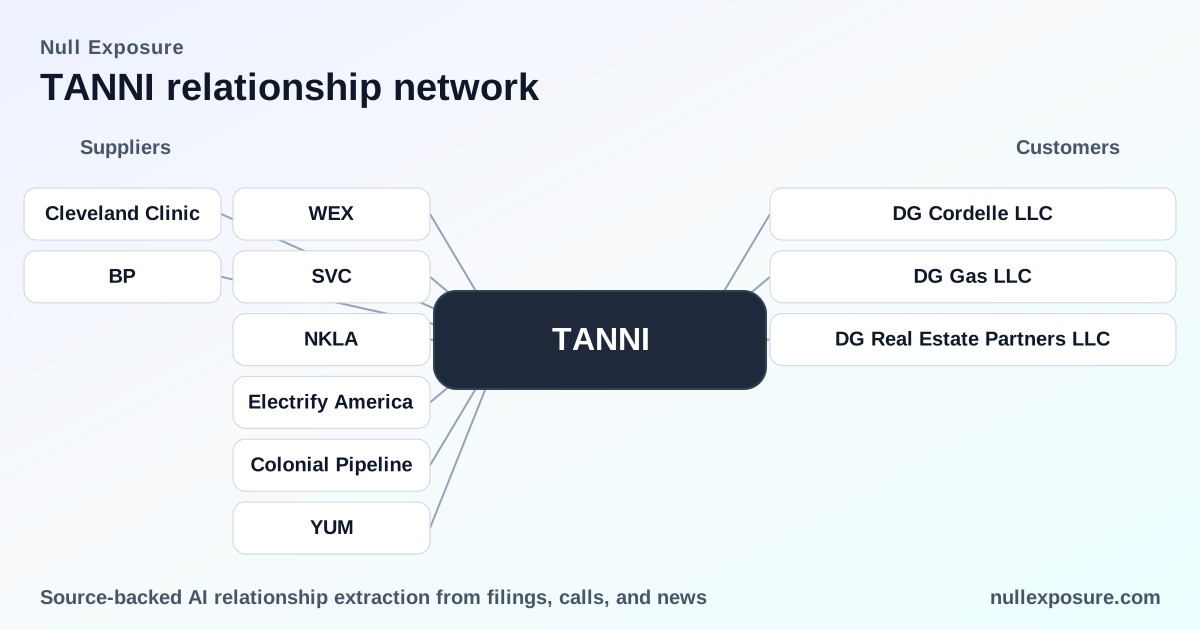
How TravelCenters of America (TANNI) monetizes via strategic supplier partnerships
TravelCenters of America operates a nationwide network of travel plazas and truck stops and monetizes through fuel retailing, convenience store sales, restaurant franchises, fleet payment services, and site-level energy services (EV, hydrogen, biodiesel). The company leverages third-party partners for payments, fuel supply, foodservice brands, and emerging energy infrastructure to scale capital-light while preserving site-level revenue capture. For a concise supplier-risk scorecard and ongoing alerts, visit the NullExposure homepage: https://nullexposure.com/.
Market thesis in one line: TravelCenters of America positions itself as the downstream operator that captures high-margin retail, food and service revenue while outsourcing specialized capabilities (payments, EV/hydrogen tech, branded food) to majors that accelerate network modernization and reduce execution risk.
Why these partnerships matter for investors
TravelCenters’ partner selection reveals its operating posture: asset-heavy retail operations paired with strategic outsourcing of technology and fuel supply. That combination delivers steady cash flow from site operations and variable capital needs tied to energy upgrades. Investors should focus on three vectors:
- Revenue capture: TA retains high-margin in-store, service bay, and restaurant upside while sharing specialized income streams (fuel brand premiums, EV/hydrogen concessions) with partners.
- Capital intensity and maturity: Fuel supply and convenience retail are mature, low-margin segments; EV and hydrogen are emerging and require partner technology and capital.
- Supplier criticality: Payment and fuel suppliers are functionally critical to operations; branding and health-partnerships are important for differentiation and customer retention.
For an institutional supplier-analysis and intelligence feed, see NullExposure: https://nullexposure.com/.
Operating-model signals and contracting posture
No explicit supplier contract constraints were provided in the public summary for TANNI, which is itself an informative company-level signal: TA discloses partner relationships through commercial announcements rather than exhaustive contract filings, suggesting negotiated commercial agreements and public joint-press releases as the primary communication method. From the partner mix, the following operating characteristics are evident:
- Contracting posture: Collaboration-focused deals with strategic co-investment for site electrification and branded programs rather than wholesale divestiture of core retail assets.
- Concentration: Supplier concentration is moderate; multiple large suppliers (energy majors, payments, foodservice brands) reduce single-counterparty exposure but create strategic dependencies for major network rollouts.
- Criticality: Fuel suppliers and payment-platform providers are operationally critical; energy infrastructure partners (EV, hydrogen) are strategically critical for medium-term growth.
- Maturity: Legacy fuel and retail operations are mature; electrification and hydrogen partnerships are early-stage but high-impact for long-term capital allocation.
Supplier map: what each relationship contributes
WEX Inc. — TA has launched a fleet payment product powered by WEX’s commerce platform, giving TA an expanded fleet-pay offering that drives recurring payment revenues and tighter fleet customer relationships. According to Fleet Equipment magazine (March 2026), the TA Fleet Universal program is powered by WEX’s global commerce platform.
Service Properties Trust (SVC) — As part of TA’s strategic real estate posture, TA will enter into amended long-term lease agreements with Service Properties Trust to secure site-level real estate access, reducing location risk and aligning landlord incentives for network stability. TruckingInfo reported on the amended lease arrangements in connection with BP’s acquisition reporting (March 2026).
Nikola (NKLA) — TravelCenters is working with Nikola’s energy division to install hydrogen fueling stations for heavy-duty trucks at two California TA-Petro locations, positioning TA to serve heavy-duty hydrogen demand and diversify its alternative-fuel portfolio. TruckingInfo described the Nikola hydrogen installations as part of site upgrades (March 2026).
Electrify America — TA has formal agreements to deploy EV charging across select TA/Petro locations, including plans to build approximately 1,000 DC fast chargers at 200 sites and earlier agreements to begin station deployment in 2023; this partnership accelerates TA’s EV-capacity rollout without bearing full infrastructure costs. Autoweek and other outlets reported the multi-site Electrify America program (coverage spans reports referencing 2023 deployments and broader 2026 discussions).
Colonial Pipeline — TA sources fuel through major pipeline suppliers and has explored increased purchases from Colonial Pipeline to support fuel inventory and logistics, strengthening wholesale supply flexibility for retail fuel operations. Transport Topics coverage documented TA’s consideration of expanded Colonial Pipeline purchases (FY2022 reporting).
KFC (YUM) — TA’s new builds and remodeled travel plazas include co-branded foodservice options such as KFC, integrating national quick-service brands to boost foodservice revenue per site and improve customer draw at high-volume locations. CSP Daily News covered the 300th-location opening highlighting KFC as a tenant (FY2024).
Cleveland Clinic — TA partners with Cleveland Clinic to curate healthier menu options across its Country Pride and Iron Skillet restaurants and select grab-and-go offerings, a differentiator aimed at professional drivers’ wellness and repeat patronage. Landline and FuelsMarketNews covered the Cleveland Clinic collaboration and menu initiatives (FY2022 reports).
bp — BP’s relationship involves installation of biodiesel blending infrastructure and bp Pulse EV charging at select TA sites, and strategic transactions that include real estate and branding alignment; this ties TA’s fuel and EV strategy closely to a major energy brand. CSP Daily News and TruckingInfo described the bp infrastructure initiatives and transaction context (FY2024–FY2026 reporting).
Key investment takeaways and risk checklist
- Strategic diversification: TA’s mix of payments, fuel suppliers, foodservice brands, and energy partners underwrites a diversified revenue base while concentrating execution risk on site modernization.
- Capital-light energy rollout: Partner-funded EV and hydrogen deployments limit TA’s near-term capital exposure while transferring technology risk to specialists.
- Operational criticalities: Payment platforms and fuel supply remain core to daily operations; any disruption would have immediate cash-flow consequences.
- Disclosure gap: The absence of formal supplier constraint disclosures in public summaries signals that investors must rely on partnership announcements and deal press releases for counterparty risk assessment.
For a tailored supplier-risk scorecard and monitoring solution that tracks these counterparties and contract events, visit NullExposure: https://nullexposure.com/.
Conclusion: what investors should watch next
Follow three levers for near-term conviction changes: (1) pace and ownership model of EV/hydrogen rollouts (partner-funded vs. TA-funded), (2) any long-term fuel supply agreements or concentration shifts, and (3) changes to lease structures or real-estate arrangements that affect store economics. The partner list demonstrates TA’s deliberate strategy to monetize core retail and outsource specialized energy and payments capabilities — a structure that supports predictable site-level cash flows while exposing the company to execution risk during energy transitions.
For ongoing alerts on these counterparties and to convert this supplier intelligence into actionable investment signals, visit NullExposure: https://nullexposure.com/.