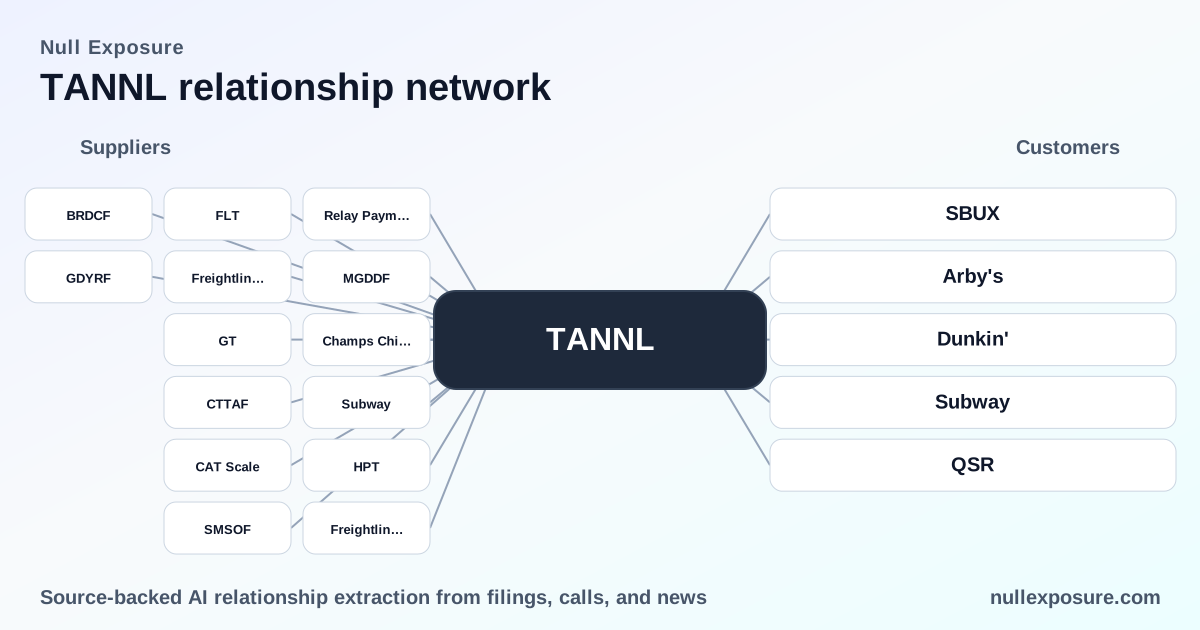
TANNL Supplier Map: Who Supplies TravelCenters of America and Why It Matters to Investors
TravelCenters of America (TANNL) operates a national network of travel centers and truck service facilities that monetize through fuel sales, convenience retail, food and restaurant concessions, and truck maintenance services; value flows from transaction volume at forecourts and ancillary service revenue, supplemented by property-lease economics. Supplier relationships drive both topline throughput (payment and fleet networks, fuel lanes) and margin capture (tire, parts and service partners, branded food outlets). For an investor evaluating operational resilience and revenue durability, the supplier roster is a direct window into diversification, vendor bargaining leverage, and exposure to downstream demand cycles.
Explore more supplier intelligence at https://nullexposure.com/.
Snapshot: what the partner list reveals about TANNL’s operating rhythm
TANNL’s suppliers fall into three clear functional buckets: payments and fleet card networks, truck service and tire vendors, and food & amenity concessionaires. The supplier mix emphasizes high-frequency, low-margin fuel transactions supported by higher-margin service and convenience sales. Multiple national tire and parts brands supply service centers, while payment acceptance partnerships expand usable customer bases and reduce friction at the pump—both core to sustaining same-store fuel volumes.
Vendor-by-vendor: the supplier ledger investors need
-
Relay Payments — Relay has been accepted across TA, Petro Stopping Centers and TA Express locations, expanding electronic/fraud-free digital fuel payment options for customers and potentially improving transaction security and speed (PR Newswire release, FY2025; https://www.prnewswire.com/news-releases/ta-and-relay-payments-partner-to-launch-fraudfree-digital-fuel-payments-in-the-us-302625942.html).
-
Michelin (MGDDF) — TA Truck Service centers carry Michelin tires among their full tire lines, indicating a multi-brand sourcing approach for replacement tires and maintenance services that keeps trucks on the road (TruckingInfo article, FY2026; https://www.truckinginfo.com/news/travelcenters-of-america-opens-alabama-service-center).
-
Champs Chicken — TA Express locations include Champs Chicken as a food amenity, reflecting TA’s concession strategy to offer quick-serve options that increase on-site dwell time and ancillary sales per visit (Truckers News, FY2021; https://www.truckersnews.com/life/article/15066202/new-ta-express-opens-in-pennsylvania-tourist-area-near-lancaster).
-
Subway — Subway outlets appear among TA amenities, representing a branded-food partnership that contributes predictable rent or revenue-share income and helps drive convenience-store foot traffic (Truckers News, FY2021; https://www.truckersnews.com/life/article/15066202/new-ta-express-opens-in-pennsylvania-tourist-area-near-lancaster).
-
Hospitality Properties Trust (HPT) — TA’s operating results reflect the impact of a lease amendment with HPT that reduced rent and interest expense, demonstrating how landlord relationships materially affect TA’s operating margins (TruckingInfo earnings coverage, FY2026; https://www.truckinginfo.com/news/travelcenters-of-america-q3-profit-soars-on-rising-fuel-sales-lower-costs).
-
Freightliner — TA partners with Freightliner to recruit technicians and to grant access to parts distribution and technical systems, aligning TA’s service capability with a major OEM to support heavy-duty truck maintenance revenue (TruckingInfo articles, FY2026; https://www.truckinginfo.com/news/travelcenters-of-america-searching-for-qualified-technicians- and https://www.truckinginfo.com/news/ta-to-offer-freightliner-service).
-
FleetCor Technologies / Fuelman Network (FLT) — TA accepted Fuelman and CFN FleetWide fleet cards systemwide, expanding fleet payment acceptance and likely increasing commercial fuel throughput from large fleet customers (TruckingInfo coverage on fleet cards, FY2026; https://www.truckinginfo.com/news/tapetro-to-accept-fuelman-cfn-fleetwide-cards).
-
Freightliner Service Point — The inclusion of Freightliner Service Point locations inside TA facilities (e.g., Wapakoneta) highlights TA’s strategy to co-locate OEM-backed maintenance shops for professional drivers, strengthening non-fuel service revenue (TruckingInfo coverage, FY2026; https://www.truckinginfo.com/news/travelcenters-of-america-adds-ohio-facility).
-
Goodyear (GT / GDYRF) — TA’s Retread Center is part of the Goodyear Authorized Retread Network, enabling retreading services that lower fleet casing costs and create an additional service revenue stream for TA (TruckingInfo report on retread center, FY2026; https://www.truckinginfo.com/news/travelcenters-of-america-opens-first-retread-center).
-
Continental (CTTAF) — Continental is one of the tire brands carried at TA Truck Service centers, reinforcing the multi-supplier tire strategy that mitigates single-vendor concentration risk (TruckingInfo, FY2026; https://www.truckinginfo.com/news/travelcenters-of-america-opens-alabama-service-center).
-
CAT Scale — Certified CAT Scale installation at TA sites supports professional drivers and generates ancillary customer utility that keeps long-haul drivers choosing TA locations for refueling and service (TruckingInfo, FY2026; https://www.truckinginfo.com/news/travelcenters-of-america-adds-ohio-facility).
-
Samson (SMSOF) — Samson is listed among the tire suppliers at TA service centers, contributing to the diversified tire supply pool serving heavy-duty customers (TruckingInfo, FY2026; https://www.truckinginfo.com/news/travelcenters-of-america-opens-alabama-service-center).
-
Bridgestone (BRDCF) — Bridgestone is included in the tire mix at TA service centers, reinforcing relationships with global tire OEMs to serve a wide range of fleet needs (TruckingInfo, FY2026; https://www.truckinginfo.com/news/travelcenters-of-america-opens-alabama-service-center).
Note: several items appear as repeated mentions across related stories (Freightliner, Goodyear), underscoring sustained operational ties rather than one-off mentions.
Operating model constraints and company-level signals
There are no discrete constraint excerpts extracted for TANNL in the supplied records; that absence itself is a signal: no immediate supplier contract disputes or restrictive covenants surfaced in the public results provided. Beyond that, the relationship set produces clear operating-model inferences:
-
Contracting posture: TA leverages a mix of merchant acceptance agreements (fleet card and digital payments), franchise/concession leases for branded food, and OEM service partnerships—indicating a hybrid contracting model that balances capital-light concession revenue with more integrated service operations.
-
Supplier concentration: Tire and parts sourcing is intentionally diversified across Bridgestone, Michelin, Goodyear, Continental and Samson, which reduces single-vendor dependency for critical truck services.
-
Criticality: Payment networks (Relay, FleetCor/Fuelman) and OEM service access (Freightliner) are operationally critical because they directly affect transaction throughput and uptime for professional drivers; disruptions here would have outsized revenue impact.
-
Maturity and counterparty quality: Partners are established industry names, suggesting mature contracting terms and predictable service continuity—this supports margin stability but limits abrupt supplier-driven upside.
Explore tailored supplier risk reports at https://nullexposure.com/ to translate partner maps into portfolio actions.
Investment implications: risks, opportunities, and what to watch
-
Risk — payment acceptance is strategic: Wider acceptance of FleetCor/Fuelman and Relay Payments improves customer convenience and capture, but also increases TA’s reliance on third-party processing economics and network terms; monitor interchange and acceptance cost trends.
-
Opportunity — service revenue layer: Freightliner service points, Goodyear retread centers and multi-brand tire offerings create higher-margin service revenue that offsets fuel volatility; expansion or densification of these services materially lifts per-site profitability.
-
Operational resilience through diversification: Multi-brand tire sourcing and a mix of branded food concessionaires reduce single-point supplier risk and allow TA to tailor offers to local demand.
For more on how supplier exposure translates into financial sensitivity and practical counterparty diligence, visit https://nullexposure.com/.
Bottom line
TANNL’s supplier roster is a deliberate assembly of payment platforms, OEM service partners and national tire and food brands that collectively support its core fuel-and-service business. The supplier mix reduces concentration risk, anchors fleet demand through card acceptance, and creates meaningful non-fuel revenue streams—while exposing TA to payment network economics that require ongoing monitoring. For investors and operators, the critical next step is continuous tracking of payment acceptance terms and service-center rollouts, which will determine whether supplier relationships stay a source of margin resilience or become a cost pressure.