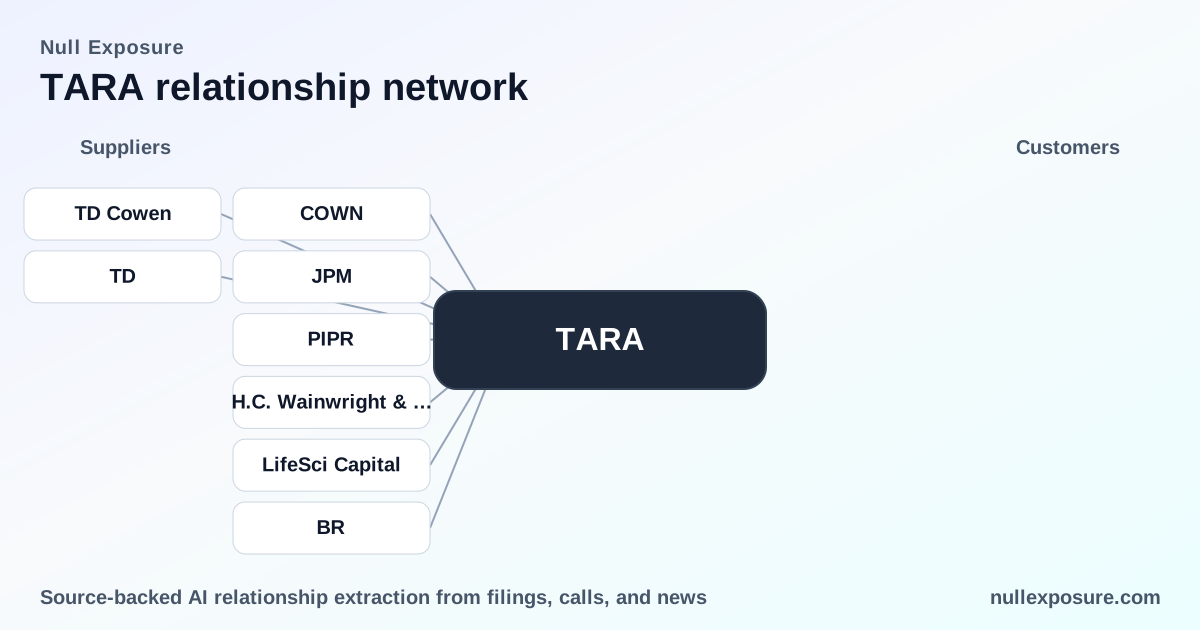
Protara Therapeutics (TARA): the supplier and placement network that funds a clinical-stage pipeline
Protara Therapeutics operates as a clinical-stage biopharmaceutical developer of oncology and rare-disease assets, relying on third-party contract manufacturers, contract research organizations and capital markets to fund development. The company generates value by advancing clinical candidates (notably TARA‑002) through trials and by raising equity to fund operations; recent financing activity highlights how external financial and manufacturing partners are integral to the company’s operating model and cash runway. For a concise view of supplier and capital markets partners, see Null Exposure’s dossier: https://nullexposure.com/.
How Protara monetizes and why suppliers matter to investors
Protara has no commercial product revenue and depends on capital raises to fund R&D and trials; the company monetizes long-term only if regulatory approval yields product sales or licensing deals. Because Protara outsources manufacturing and trial execution, manufacturing CDMOs, CROs and underwriting banks effectively control throughput, timing and funding, making supplier strength and underwriting relationships investment‑critical.
If you need an investor-ready supplier map and primary source links, visit https://nullexposure.com/ for the full tracker.
The financing syndicate that supplied capital in FY2025
Protara closed a $75 million public offering in December 2025. The placement and distribution network for that offering provides the clearest, disclosed picture of the company’s external dependency on capital markets.
- J.P. Morgan — J.P. Morgan acted as one of the joint book‑running managers on Protara’s $75 million offering announced in December 2025, coordinating investor allocation and prospectus distribution. According to the GlobeNewswire press release dated December 8, 2025, J.P. Morgan was named among the joint book‑runners for the offering.
- TD Cowen — TD Cowen served as a joint book‑running manager on the same offering, participating in underwriting and placement functions alongside the lead banks. This role is documented in the company’s December 2025 press materials and syndicate disclosures on Yahoo Finance and StocksToTrade.
- Piper Sandler — Piper Sandler acted as a joint book‑running manager for the $75 million offering and handled prospectus requests and distribution channels through its prospectus department, as described in the prospectus distribution notes from December 2025.
- H.C. Wainwright & Co. — H.C. Wainwright was listed as a manager of the offering, indicating participation in the underwriting syndicate though not as a lead book‑runner; this detail appears in Protara’s GlobeNewswire announcement (Dec 2025).
- LifeSci Capital — LifeSci Capital was identified as a lead manager on the transaction, signaling a specialist life‑science placement role in the deal, per the December 2025 transaction disclosure.
- Broadridge Financial Solutions — Broadridge is referenced as the agent handling physical and electronic prospectus distribution for syndicate members, a back‑office supplier for regulatory and investor materials noted in the prospectus access information published in December 2025.
- TD Securities (USA) LLC — TD Securities (USA) LLC is named in the prospectus distribution instructions as a point of contact for obtaining offering materials, reflecting its role in supporting the syndicate’s disclosure logistics (December 2025 filings).
Each of these partners is visible in Protara’s December 2025 public filing and press materials covering the $75 million offering (GlobeNewswire; Yahoo Finance; StocksToTrade). Collectively, the syndicate demonstrates conventional capital-market dependency: Protara sources operating capital through well‑known equity underwriters rather than strategic pharma partners.
What the supplier constraints tell investors about operational posture
Protara’s disclosed supplier constraints and contract excerpts signal several structural characteristics of its operating model:
- Long-term supplier commitments: Protara amended a CDMO agreement to establish an eight‑year term from the amendment date, indicating multi‑year manufacturing commitments and a contracting posture oriented toward continuity and supply security rather than short, ad‑hoc procurement.
- Geographic footprint: Clinical activity and leased manufacturing/office locations are concentrated in North America (United States and Canada) with trial sites spanning Argentina and Ukraine; this produces a North America‑centric operational base with selective LATAM and EMEA clinical exposure.
- Outsourced manufacturing concentration: The company states it is “completely dependent on CDMOs” for clinical and commercial supply of TARA‑002 and conducts end‑to‑end manufacturing of IV Choline Chloride through a U.S. cGMP CDMO; this is a concentration risk—single-source CDMO relationships are critical to batch availability and regulatory compliance.
- Service reliance for trials: Protara relies on CROs to run and oversee clinical trials and faces ongoing fees for CRO services; this establishes operational criticality where trial timelines hinge on third‑party capabilities.
- Segment focus: The constraints emphasize the manufacturing segment—Protara has formalized manufacturing arrangements and long-term CDMO terms, reflecting a transition from purely preclinical outsourcing to structured manufacturing relationships.
These constraints are company-level signals derived from Protara’s disclosures; no specific CDMO or CRO names are provided in the constraint excerpts.
Risk and operational implications for investors
- Capital dependence: The December 2025 $75 million equity raise shows Protara’s ongoing reliance on equity markets for operability; underwriting partners and distribution logistics therefore determine funding velocity and dilution cadence.
- Supply chain concentration: Long-term CDMO commitments reduce short‑term supply risk but increase counterparty concentration; operational hiccups at a single CDMO would have outsized impact given the company’s declared dependence.
- Regulatory and geographic exposure: Trials spanning North America, LATAM and EMEA introduce regulatory complexity and geopolitical risk, particularly where clinical sites (e.g., Ukraine) have elevated operational risk.
- Maturity mismatch: Protara is clinical stage with structured, long-duration manufacturing contracts—this indicates a hybrid posture: early‑stage product risk paired with investment in longer-term manufacturing continuity.
Key investor takeaways:
- Underwriters are conventional and deep‑market players; funding access is executed through established equity syndicates rather than strategic pharma partnerships.
- Manufacturing and CRO relationships are critical single points of failure; the company’s operating continuity depends on these third parties.
- Long-term CDMO contracts suggest operational planning beyond immediate trials, which is constructive for eventual commercialization planning but concentrates counterparty risk.
For investors and operators who need the primary‑document trail and an actionable supplier map, Null Exposure’s platform maintains the linked filings and news items: https://nullexposure.com/.
Next steps for due diligence
For governance, counterparty and operational diligence focus on:
- Contractual counterparty names and termination/change provisions for CDMOs and CROs.
- Prospectus and offering documents for underwriter execution terms and any placement or stabilization arrangements.
- Clinical site lists and country‑specific regulatory timelines tied to the ADVANCED‑2 program.
Access the registry and connected filings at Null Exposure to review the primary materials referenced in this note: https://nullexposure.com/.
Final verdict: Protara’s external supplier and underwriting network is conventional for a clinical‑stage biotech—capital markets relationships are robust and traditional, while manufacturing and trial execution remain concentrated and critical to valuation outcomes.