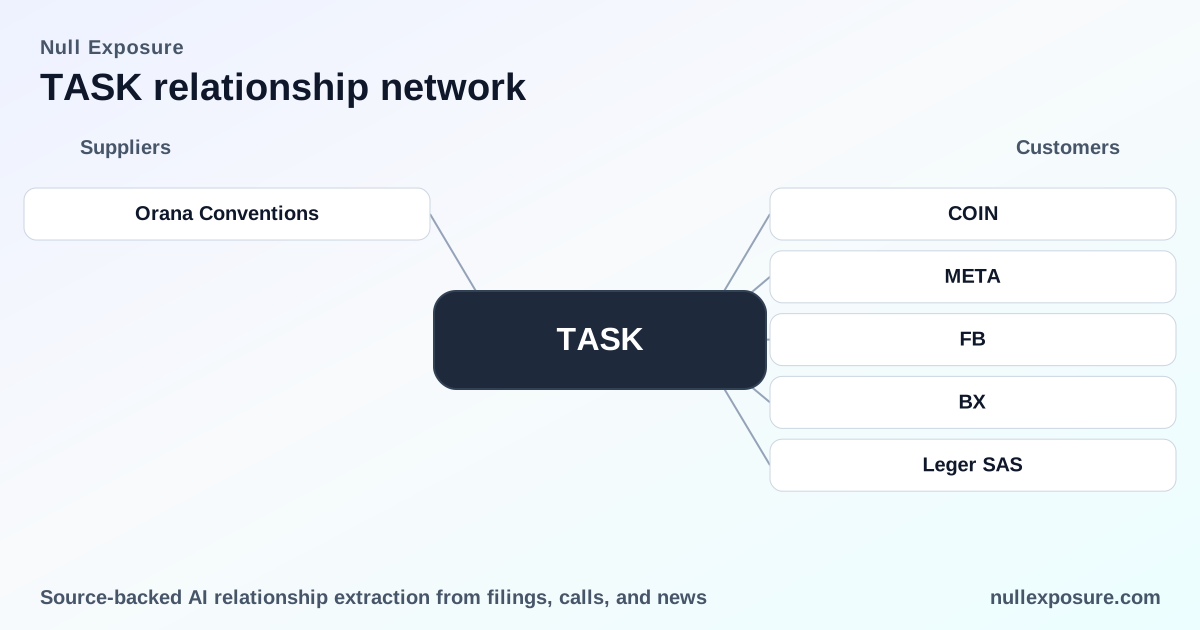
TaskUs (TASK) — Supplier relationships, operating posture, and what investors should price in
TaskUs is a publicly traded business-process outsourcing (BPO) provider that sells high-touch operational services to internet and technology companies, monetizing through fee-for-service contracts that scale with client headcount and complexity. Revenue derives from recurring labor and technology-enabled support services rather than one-off product sales, producing predictable gross margins and operating leverage as client volumes grow. For investors and procurement operators evaluating supplier relationships, the relevant signal set is focused: facility and event vendors and local service providers support a people-centric delivery model. Visit the NullExposure homepage for ongoing supplier intelligence: https://nullexposure.com/
Company snapshot: margins, scale and where supplier risk lives
TaskUs is a mid-cap BPO with Revenue TTM of $1.183 billion and Gross Profit TTM of $472 million, translating into a Profit Margin of 8.64% and an Operating Margin of 12% on the latest quarter (2025-12-31). Market participants value the company at about $940 million market cap with EV/EBITDA of 4.74 and a Trailing P/E of 9.44, signals consistent with a value-oriented valuation for a high-growth services firm. High institutional ownership (~82%) and meaningful insider ownership (~25%) indicate both public investor interest and founder/executive alignment with long-term value creation.
These financials identify where supplier risk is concentrated: the business is labor- and facilities-intensive, so vendor categories that matter are workforce sourcing, local facilities and event vendors, and third-party technology partners that augment delivery. Volatility is material — Beta ~2.1 — which amplifies operational missteps into share-price moves.
What the supplier signal set shows (every relationship in the available results)
There is one supplier-related relationship surfaced in the available signals:
- TaskUs used Orana Conventions as the venue for a themed office event in Gurugram called “Bollywood Bash with Us.” According to a news report dated March 10, 2026, the event was held at Orana Conventions in Gurugram, indicating local event/venue procurement for employee or marketing activities (BW People, March 10, 2026). Source: https://www.bwpeople.in/article/taskus-unveils-theme-based-office-in-gurugram-426150
This entry lists a single local vendor engagement tied to corporate events, rather than core delivery capability. The signal is operationally useful as a tracer of local vendor relationships in markets where TaskUs runs delivery centers.
Orana Conventions — a vendor-level read and relevance to procurement
Orana Conventions provided venue services for a TaskUs office event in Gurugram, India; the engagement is evidence of local facilities and event procurement rather than delivery-critical outsourcing. The March 2026 news item confirms the company engages third-party vendors for employee-facing events in major delivery markets, which is consistent with a global facilities footprint requiring local procurement channels. Source: BW People, March 10, 2026 — https://www.bwpeople.in/article/taskus-unveils-theme-based-office-in-gurugram-426150
Key takeaway: this is a non-core supplier relationship in the context of delivery operations, but it corroborates that TaskUs relies on third-party vendors for local services across international locations.
Company-level constraints and what they imply for supplier risk
No supplier-level constraints were reported in the available feed; that absence is itself a signal. From a company-level perspective, the following characteristics define TaskUs’s contracting posture and supplier risk profile:
- Contracting posture: Predominantly operational vendor relationships driven by scale and local execution. Contracts will tend to be service agreements with variable-cost elements (labor, venues, local vendors) rather than large fixed-capex supplier commitments.
- Concentration: The public signals do not disclose customer concentration here, but the business model implies dependence on a set of large internet clients; supplier concentration is lower because the company sources local services across many geographies.
- Criticality: Suppliers tied to workforce availability, local facilities, and IT platforms are operationally critical; by contrast, event vendors like Orana Conventions are support-level criticality with limited revenue impact if swapped.
- Maturity: TaskUs operates as a mature public BPO with positive EBITDA ($216.9 million reported) and stable operating margins, suggesting an evolved procurement function with standardized supplier sourcing and vendor management.
These company-level signals imply procurement teams should prioritize continuity and labor-sourcing vendors, while treating event and marketing vendors as lower criticality but useful for monitoring brand and employee experience.
What investors and operators should do differently
For investors assessing supplier risk and for operators managing vendor relationships, prioritize three practical actions:
- Validate continuity plans for labor and facilities across high-volatility markets. With high Beta and a people-centric model, disruptions in local supplier networks translate quickly to delivery interruptions.
- Ensure supplier diversification in key markets. The Orana Conventions signal confirms TaskUs uses local vendors for events; apply the same logic to recruiter networks, payroll vendors and co-location agreements to avoid single points of failure.
- Monitor procurement maturity as a signal for margin resilience. EV/EBITDA of 4.74 and Operating Margin of 12% provide cushion, but margin expansion depends on controlling variable supplier costs and scaling higher-margin services.
For a concise supplier intelligence baseline and ongoing monitoring, see the NullExposure homepage: https://nullexposure.com/
Risk factors that change valuation and what to watch next
- Operational concentration in labor markets — wage inflation, local regulation, and turnover will materially compress margins if not offset by pricing. Track regional labor market indicators in the Philippines, India and Eastern Europe where TaskUs runs centers.
- Client demand cyclicality — a BPO like TaskUs will see revenue sensitivity to tech sector hiring and marketing spend; supplier commitments should be flexible to match that cyclicality.
- Execution on higher-margin services — margin expansion depends on moving beyond commoditized task processing into analytics and tech-enabled offerings; supplier partnerships with software providers will matter.
Bottom line and next steps
TaskUs monetizes scale in labor-intensive service delivery, with supplier risk concentrated in workforce and facility sourcing rather than event/vendor spending. The single supplier signal (Orana Conventions) validates the presence of local vendors for employee-facing activities but does not alter the core supplier risk thesis: manage labor and facilities first. For practitioners building a procurement playbook or investors stress-testing downside, focus on contingency planning for labor markets, supplier diversification, and monitoring procurement maturity as a proxy for margin durability.
To track supplier relationships and get continuous updates on TaskUs and comparable service providers, visit NullExposure: https://nullexposure.com/