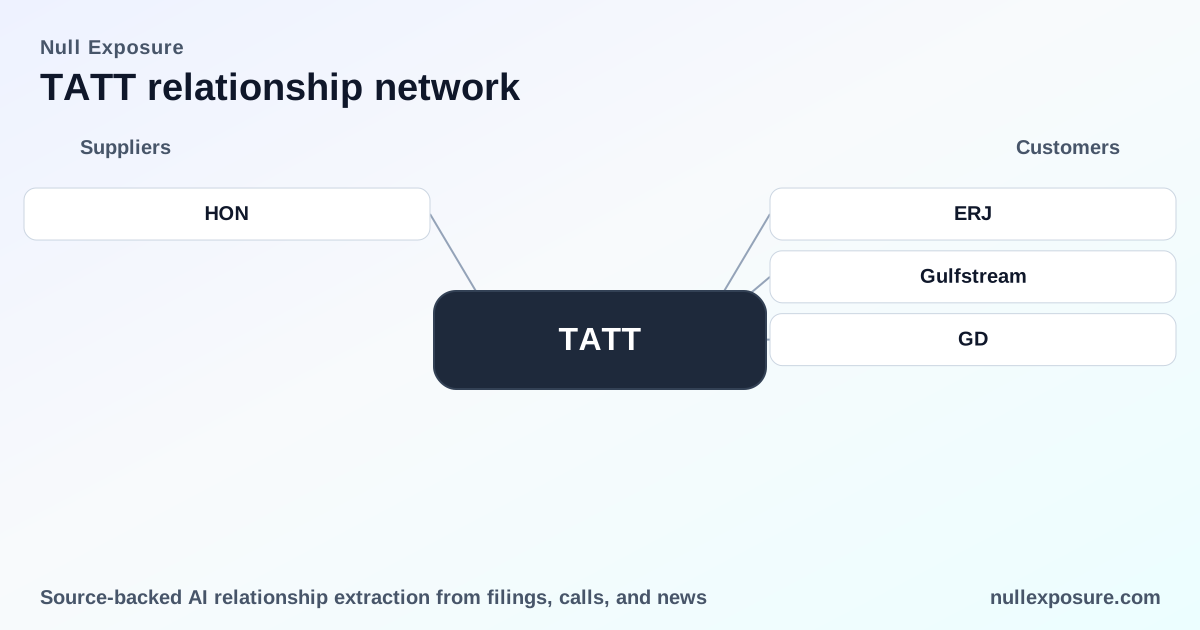
TAT Technologies (TATT): Supplier relationships and what they mean for investors
TAT Technologies is an aerospace and defense supplier that monetizes through licensed aftermarket services, component sales and maintenance, repair and overhaul (MRO) contracts for commercial and military platforms. The company combines OEM licensing, approved-service-provider status and a product-engineering base to capture lifecycle revenue from airframe and auxiliary power unit (APU) operators, converting engineering IP into recurring service and parts income. For investors, TAT’s valuation reflects that mix of higher-margin aftermarket services and capital-light licensing, supported by stable institutional ownership and recent revenue growth. Learn more on the firm through a focused supplier lens at https://nullexposure.com/.
Why the Honeywell connection matters to the business model
TAT’s public disclosures and press coverage highlight a licensing and approval relationship with Honeywell for APUs. OEM authorization is a strategic lever: it creates a de facto commercial moat for aftermarket work, raises switching costs for customers, and enables TAT to bid on authorized service work that non‑licensed competitors cannot win at scale. According to an InsiderMonkey write-up on March 10, 2026, TAT holds a license agreement with Honeywell and is positioned as an approved provider of aftermarket service and support for Honeywell power units. A Finviz news summary the same day reiterated that TAT “becomes Honeywell’s approved provider of aftermarket service and support.”
Relationship inventory — everything surfaced in the research
Honeywell — OEM license and approved aftermarket provider
TAT is reported to have a license agreement with Honeywell that positions the company as an approved provider of aftermarket service and support for Honeywell APUs, which elevates TAT’s addressable aftermarket and service margin opportunity. This point is documented in a March 10, 2026 InsiderMonkey write-up discussing the licensing arrangement and in a Finviz news item the same day that summarized the approval status.
(InsiderMonkey, March 10, 2026; Finviz news item, March 10, 2026)
Note: both sources reference the same business relationship; the coverage strengthens confidence that the Honeywell tie is public and meaningful.
Company-level signals and operating constraints
With no relationship-specific constraints disclosed in the collected materials, the operational and commercial constraints are best interpreted at the company level:
- Contracting posture: TAT’s business model favors contractual licensing and approved-service-provider agreements rather than speculative OEM replacement programs. That posture reduces capital intensity and transfers some certification and performance risk onto the licensing framework.
- Concentration and governance: Institutional ownership stands at 69.6%, with insiders at ~7.3%, signaling professional investor oversight combined with founder/insider alignment on execution. These ownership patterns support disciplined capital allocation and oversight of strategic supplier deals.
- Criticality of services: The aftermarket services for APUs and related systems are mission-critical for operators because downtime and parts availability directly affect flight operations; OEM approval therefore translates into pricing power and customer stickiness.
- Maturity and financial profile: Through the September 30, 2025 quarter, TAT reported TTM revenue of $172.5M, gross profit of $41.9M, and operating margin around 11.4%, indicating a mature small-cap industrial profile with positive margins and double-digit returns on equity (ROE ~11.2%). The company trades at a forward P/E of about 9.05, contrasting with a trailing P/E of 43.38, which reflects accelerated earnings expectations embedded in near-term projections.
These company-level signals shape supplier risk: licensing reduces some competitive vulnerability, high institutional ownership raises execution expectations, and the critical nature of services supports recurring revenue.
Operational implications for investors and operators
The Honeywell relationship elevates TAT’s role in the APU aftermarket and positions the company to capture higher-margin, recurring service revenues rather than one-off repair jobs. For operators and procurement teams, an approved-service-provider designation simplifies vendor qualification and reduces certification overhead. For investors, the key operational takeaways are clear:
- Revenue durability: Approved-service-provider status supports recurring MRO contracts and parts sales, improving revenue visibility.
- Margin enhancement potential: Licensing and authorized support generate better gross and operating margins than commodity repair work.
- Execution sensitivity: Value depends on TAT’s ability to execute on service delivery, certification compliance, and supply-chain reliability; any breakdown in these areas would directly affect revenue conversion.
Want a concise supplier risk score and relationship map for TAT? Visit https://nullexposure.com/ for a streamlined investor brief and sourcing intelligence.
Risk profile and valuation context
TAT’s market capitalization (~$747M) and positive operating metrics position it as a scaled small-cap in aerospace & defense, but the valuation hinges on continued conversion of OEM licensing into market share and margin expansion. Key risk vectors include concentration of OEM ties, the potential for competitive authorized providers, and operational disruptions in parts supply or certifications. The stock’s forward P/E of 9.05 vs trailing P/E of 43.38 indicates that analysts expect near-term earnings acceleration—execution is the determinant of whether that re-rating is sustainable.
Practical takeaway for portfolio managers and supply-chain operators
- For investors: The Honeywell-approved relationship is a strategic differentiator that supports recurring revenue and margin expansion; evaluate TAT based on execution against service growth targets and maintenance-of-certification costs. Monitor quarterly service-book growth and contract awards.
- For operators and procurement teams: TAT’s OEM authorization reduces onboarding friction and provides an authorized supply route for APUs; include TAT in approved vendor lists where Honeywell-sourced APUs require certified aftermarket providers.
- For both groups: Institutional investor concentration and positive operating profitability are supportive signals, but execution on converting approvals into long-term service agreements is the primary value driver.
For a tailored supplier relationship report and procurement playbook, see the resources at https://nullexposure.com/.
Overall, TAT’s publicly documented Honeywell license and approved-service-provider status are material commercial assets that align the company with recurring aftermarket economics and improved margin potential. Investors should weigh those structural advantages against execution risk and the company’s need to scale service volumes to justify its valuation.