TAVIR supplier relationships: what investors need to know now
Tavia Acquisition Corp. Right (TAVIR) operates as a SPAC vehicle positioned to monetize through a successful initial business combination; its near-term economics are driven not by operating revenue but by sponsor funding, short-term financing instruments and contingent advisory fees tied to a completed merger. Investors should evaluate TAVIR as a finance-first vehicle whose supplier and service provider arrangements directly affect liquidity, timing of a deal and the dilution or cost profile of any business combination. For detailed supplier-mapping and ongoing monitoring, visit the research hub at https://nullexposure.com/.
One active supplier relationship dominates the public record
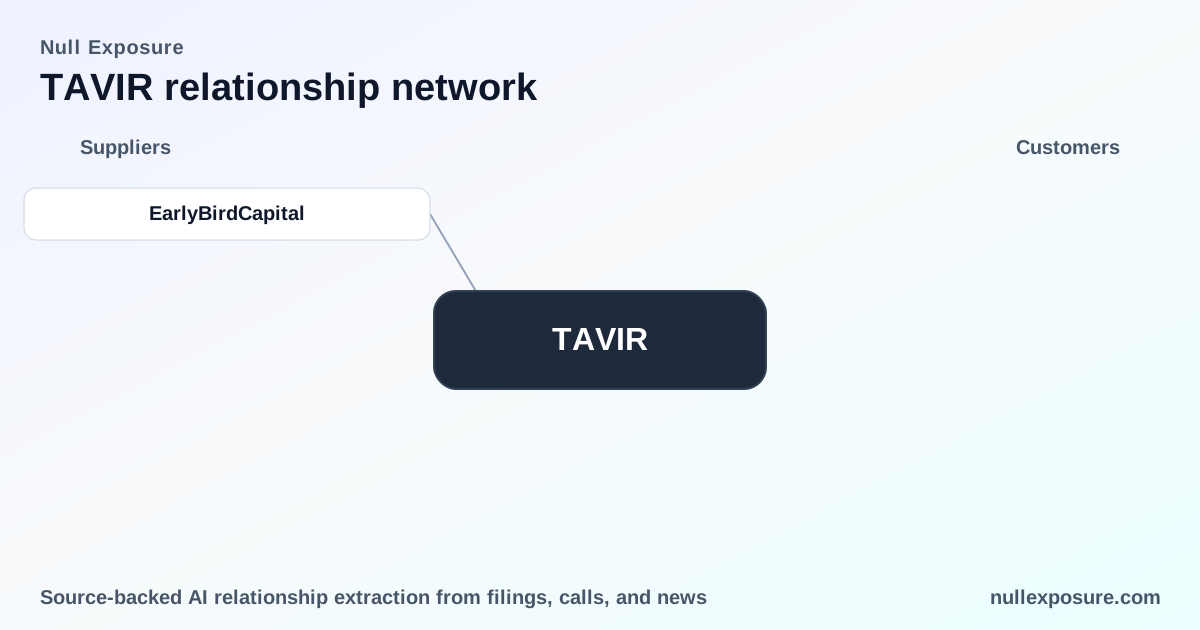
EarlyBirdCapital — short-term, non‑interest note in FY2026
Tavia executed a non‑interest bearing promissory note to access up to $300,000 from EarlyBirdCapital in FY2026, providing immediate liquidity without interest expense but with a contractual repayment obligation. A TradingView news item reported this arrangement on March 10, 2026, describing the up-to-$300,000 facility as a short-duration cash bridge to support SPAC operations leading up to a business combination (TradingView, March 10, 2026).
The underlying contracts and company-level signals investors should prioritize
TAVIR’s public disclosures and excerpted contract provisions reveal a small set of recurring commercial dynamics that define its supplier posture and operational risk profile:
-
Service‑provider posture: Tavia has engaged multiple external parties for administrative, secretarial and business‑combination marketing services. The filings identify an ongoing Administrative Services Agreement and marketing/advisory arrangements. These agreements position external suppliers as active service providers to the SPAC’s lifecycle activities, not passive vendors.
-
Recurring small-dollar operating spend: The company pays $10,000 per month to its Sponsor for secretarial and administrative services, recorded as an accrued expense through year‑end 2024. This creates a predictable monthly cash outflow that reduces available cash for transaction activity.
-
Sponsor funding and concentrated counterparty exposure: The Sponsor issued an unsecured promissory note that allows borrowing up to $500,000, with $500,000 outstanding as of December 31, 2024. This establishes the Sponsor as a primary source of working capital and creates concentration risk around a single counterparty for near-term liquidity.
-
Contingent advisory economics on deal close: The Business Combination Marketing Agreement engages an advisor (referred to in the excerpts as EBC) to market the proposed combination and introduce potential investors, with a contingent cash fee equal to 3.5% of the gross proceeds of the IPO payable upon consummation. This fee allocates meaningful variable cost to advisory partners at deal close and reduces net proceeds available to targets or for post-merger operations.
-
Active relationship stage and moderate spend bands: Excerpts describe these arrangements as active and quantify spend exposure across bands: one set of instruments places spend in the $100k–$1m band (promissory note capacity), while monthly administrative fees fall in the sub‑$100k band. Together, they indicate a modest but material level of supplier spend for a SPAC at this stage.
These contractual characteristics translate to a clear operating model: early-stage, sponsor-funded, high counterparty concentration with predictable administrative spend and contingent marketing fees that crystallize on a business combination.
What this means for investors: risks, levers, and monitoring priorities
-
Liquidity and sponsor dependence: The combination of a $500k sponsor note outstanding and the $300k EarlyBirdCapital facility shows primary reliance on promissory financing rather than operating cash flow or public market issuance; this elevates counterparty and execution risk if a business combination stalls.
-
Predictable expense drag: The $10,000 monthly fee to the Sponsor is a persistent cash outflow that reduces runway; investors should treat this as an operational burn rate for SPAC lifecycle planning.
-
Contingent transaction economics: The 3.5% marketing/advisory fee is an economically significant contingent liability that scales with IPO proceeds and will reduce the net benefit to shareholders and the target on consummation. Track fee triggers tied to the business combination timetable.
-
Concentration of suppliers: With a small set of named counterparties providing both cash and services, counterparty failure or strategic resistance from the Sponsor or key advisors would be economically meaningful.
For ongoing monitoring, prioritize updates to: (1) outstanding promissory note balances and repayment terms, (2) any amendments to administrative service fees, and (3) material changes to the Business Combination Marketing Agreement.
Relationship ledger: every named counterparty in the public results
- EarlyBirdCapital — Tavia entered into a non‑interest bearing promissory note to access up to $300,000, providing a short-term liquidity bridge in FY2026. (TradingView news report, March 10, 2026)
The public results list a single external financing relationship; the other contractual items in filings are described above as company-level signals tied to the Sponsor and an advisor referenced as EBC in the company disclosures.
Strategic read for operators and potential counterparties
-
Operators evaluating a tie-up with a SPAC like TAVIR must price the 3.5% marketing/advisory drag into transaction modeling, and account for the SPAC’s current cash commitments and sponsor lending profile when negotiating deal funding and escrow structures.
-
Counterparties should assess sponsor concentration: entering supplier or advisor relationships with TAVIR effectively ties your commercial exposure to the Sponsor’s capital support and to the timing of the business combination.
For a consolidated view of counterparties, contracts and active supplier signals across SPACs and acquisition vehicles, explore our analysis suite at https://nullexposure.com/ — it’s tailored for investors who need a quick read on supplier-driven execution risk.
Bottom line and next steps
TAVIR is a classic SPAC in execution mode: short-term financing from related parties, recurring administrative fees to the Sponsor, and a contingent marketing fee structure that activates on deal close. These are the levers that determine runway, counterparty risk and net economics for any merger. Monitor changes in outstanding promissory notes, amendments to administrative or marketing agreements, and any new external financing that alters concentration dynamics.
If you’re evaluating exposure or considering a commercial relationship with TAVIR, use our platform to track contract changes and supplier concentration signals in real time: https://nullexposure.com/.