Taylor Devices (TAYD): Supplier intelligence and strategic takeaways for partners and investors
Taylor Devices designs, manufactures, and sells industrial shock absorption, speed control, and energy storage devices—monetizing through product sales and engineering services to equipment OEMs and structural partners. The company captures margins via proprietary mechanical solutions, modest scale manufacturing, and niche intellectual property, positioning it as a specialized supplier to infrastructure and machinery markets rather than a volume commodity play.
If you are evaluating supplier relationships or counterparty risk with Taylor Devices, start with a concise supplier-risk profile at this link: NullExposure homepage.
Operational profile and where Taylor Devices earns its economic rent
Taylor Devices operates a focused manufacturing business based in North Tonawanda, NY, selling engineered mechanical absorbers and related components across North America and internationally. Key financial signals: Market capitalization roughly $142M, trailing revenue of $44.6M, gross margin near 46% (Gross Profit $20.4M), operating margin roughly 22.6%, and trailing EPS of $2.72. These metrics reflect a profitable, niche industrial supplier with moderate operating leverage and stable unit economics.
The company’s monetization is straightforward: product sales to OEMs and structural engineering partners plus custom integration services. Profitability is driven by proprietary designs and application-specific value rather than scale manufacturing cost advantages. Taylor’s 52-week trading range (low $29.50, high $90.37) and a forward P/E of about 11.36 indicate the market prices in growth optionality against cyclical industrial demand.
Supplier constraints and what they signal about business resilience
Taylor Devices’ public disclosures and filings yield two company-level constraints that inform contracting and supplier-risk posture:
- Geography: Global supplier footprint for raw materials and components. The company’s manufacturing inputs come from numerous U.S. and foreign suppliers, which implies a dispersed sourcing strategy that reduces single-supplier dependency but exposes the business to global supply-chain dynamics and freight cost volatility.
- Materiality: Loss of any single supplier is immaterial. Management states that the loss of any one supplier would not have a material adverse effect, signaling low supplier concentration and a mature sourcing posture appropriate for a specialized industrial manufacturer.
Taken together, these constraints point to a low concentration, resilient procurement model: contracting is transactional and repeatable, supplier substitution is feasible, and supplier relationships are unlikely to be single points of systemic failure. For counterparties, that equates to lower criticality but continued exposure to commodity and logistics cycles rather than contract fragility.
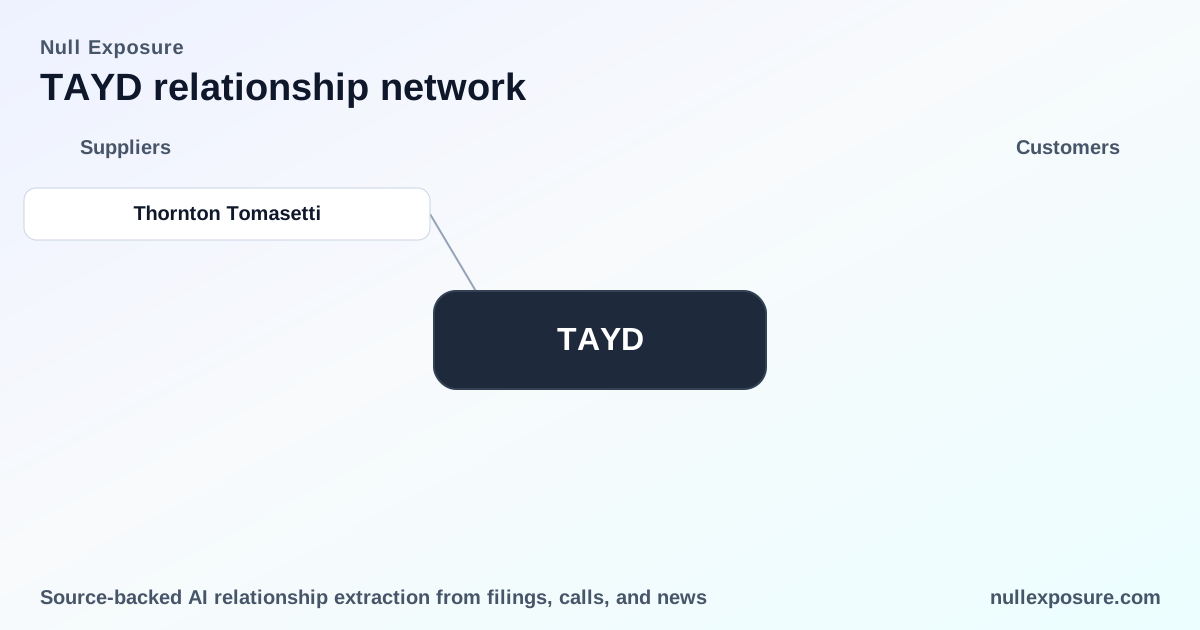
Relationships that matter: Thornton Tomasetti
Taylor Devices announced a partnership with Thornton Tomasetti to manufacture and distribute the Pumpkin™ Mounts absorber—an engineered seismic and vibration isolation product—representing a strategic channel into structural engineering and infrastructure projects. According to a PR Newswire release (March 2026), Taylor Devices and Thornton Tomasetti teamed to launch the Pumpkin™ Mounts globally, combining Taylor’s manufacturing with Thornton Tomasetti’s distribution and engineering reach. (PR Newswire, March 10, 2026)
This relationship is a classic example of Taylor leveraging partner distribution and engineering credibility to scale niche product adoption: Taylor supplies precision mechanical absorbers; Thornton Tomasetti brings structural-engineering validation and global market access. The arrangement expands Taylor’s addressable market for infrastructure and building-retrofit applications and mitigates sales-channel concentration risk by adding an engineering-led distribution avenue. (PR Newswire coverage, FY2021 disclosure context.)
How individual relationships and constraints shape commercial risk
The Thornton Tomasetti alliance illustrates how Taylor uses partnerships to commercialize product innovations beyond its core OEM base. From a counterparty perspective:
- Contracting posture is partner-oriented and non-exclusive, focused on co-marketing and manufacturing supply rather than joint equity or deep vertical integration.
- Concentration risk declines when partners like Thornton Tomasetti extend distribution into new verticals, reducing reliance on existing OEM channels.
- Criticality remains moderate: Taylor’s manufacturing is essential to product supply, but the partner brings sales and engineering validation rather than production dependency.
- Maturity of the relationship looks early-growth focused, consistent with press announcement timing rather than long-term public milestones.
Investors and operators should track adoption metrics for the Pumpkin™ Mounts channel and any product certifications that translate into recurring project pipelines.
Financial context and strategic positioning in the market
Taylor Devices combines attractive margins with modest scale: operating margin over 22% and return on equity near 15%, pointing to a well-run niche manufacturer. Revenue growth has shown near-term headwinds (quarterly revenue growth YOY at -14.6% and earnings decline YOY at -18.6%), which frames partnerships and new distribution channels as crucial levers for reaccelerating top-line expansion.
Balance-sheet and valuation signals matter for counterparties: EV/EBITDA around 16.2 and EV/Revenue about 4.11 indicate a valuation that prices both current profitability and future growth expectations. For procurement teams and contracting partners, that translates into a supplier with solid financial footing and performance-driven pricing power, but also one sensitive to cyclical demand in industrial capex.
Mid-report action item: explore contract terms and performance metrics with Taylor Devices via this portal: NullExposure homepage.
Risk factors that should shape negotiation and oversight
- Supply-chain exposure to global inputs introduces cost and lead-time variability; contracts should include clear lead-time SLAs and escalation clauses.
- Product adoption risk for new channel launches like Pumpkin™ Mounts requires milestone-based commitments for marketing, certifications, and revenue targets.
- Concentration of intellectual property and manufacturing know-how remains company-critical; protective IP and quality-assurance clauses are essential in supplier agreements.
For investors, a useful covenant to monitor is the extent to which partnership revenue converts into recurring project pipelines rather than one-off sales.
Actionable takeaways for investors and operational partners
- Taylor Devices is a profitable, niche industrial supplier with low supplier concentration and global sourcing exposure. Its economic model is built on engineered product margins and partner-led distribution expansion.
- The Thornton Tomasetti relationship is strategically meaningful: it opens infrastructure channels and reduces channel concentration while leaving manufacturing control with Taylor.
- Contracts should emphasize lead-time guarantees, quality standards, and measurable channel-adoption milestones to convert partnership announcements into predictable revenue.
For a holistic supplier-risk review or to benchmark Taylor Devices against peer suppliers, start here: NullExposure homepage.
Final verdict: Taylor Devices is a defensible industrial supplier with focused product economics and an active partnership strategy to broaden market reach. For investors, the company combines attractive margins and a credible valuation with the need for renewed revenue growth—partnerships like the one with Thornton Tomasetti are the most direct pathway to that next stage. For counterparties, the supplier’s low single-vendor materiality and global sourcing should enable pragmatic contracting, provided agreements lock in delivery and adoption milestones.