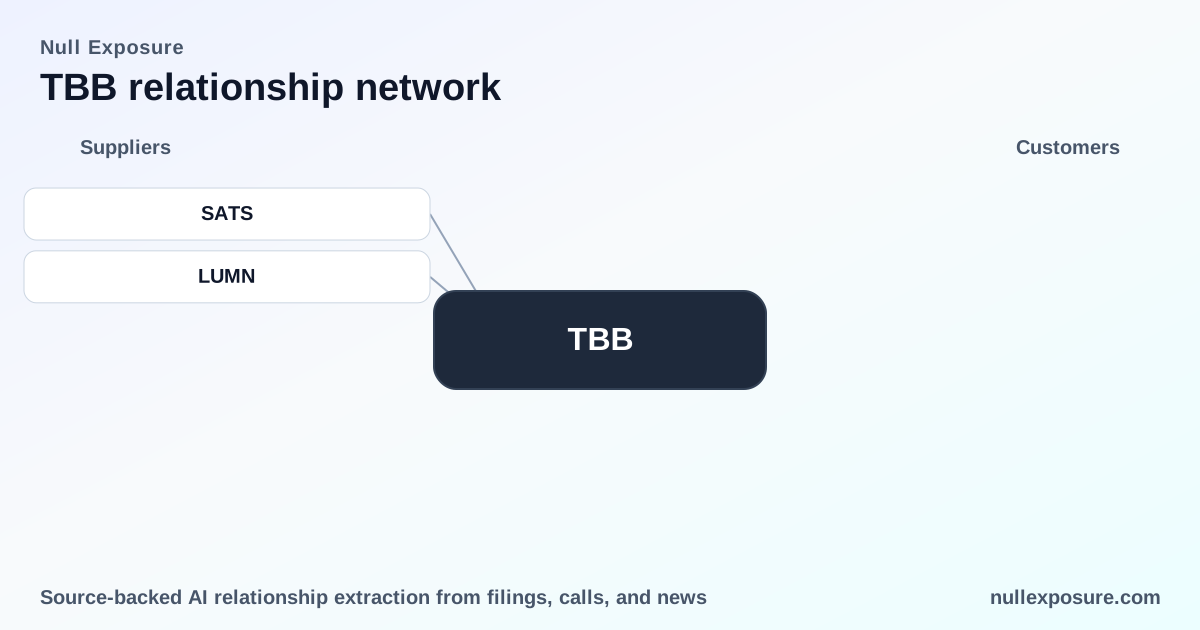
AT&T (TBB) — Supplier Relationships That Drive Scale and Cash Flow
Thesis: AT&T operates as a vertically integrated communications and entertainment provider, monetizing through subscription services, device sales and multi-year licensing arrangements while actively managing supplier payment terms and vendor financing to optimize cash flow. The company's supplier strategy blends short-term payment leverage with selective multi-year licensing commitments and high-dollar purchase obligations, creating both working-capital advantages and counterparty concentration risks for counterparties and investors. For a deeper supplier-exposure view, visit https://nullexposure.com/.
How AT&T runs its supplier playbook and why it matters to investors
AT&T funds operations and service scale by pushing payment timing against suppliers and using vendor financing where beneficial. Supplier financing payments are treated as short-term liabilities and are due within one year, while the company also enters into multi-year software licensing contracts paid over two-to-five year terms. This dual posture lets AT&T extract immediate working-capital relief while keeping strategic, longer-dated vendor relationships in place for critical software and network capabilities.
- Cash-management orientation: AT&T explicitly targets payment terms of 90 days or greater while offering suppliers early-pay bank facilities at the suppliers’ cost, which preserves AT&T liquidity while leaving suppliers’ financing choices open.
- Mixed contract maturity: Hardware supply and handset inventory arrangements are managed with short-term extensions and variable-rate fees, while software licenses are multi-year.
- Scale and spend concentration: Contractual purchase obligations are reported as approximately 8,545 for 2026 and 10,698 in total for 2027–2028, with vendor financing payments of 1,181 in 2025 versus 1,792 in 2024—figures that underline high absolute spend and material supplier exposure.
For a consolidated supplier analysis and screening tools relevant to these dynamics, see https://nullexposure.com/.
Contracting and cash-management: what the constraints reveal
AT&T’s disclosed constraints reveal a company that uses supplier terms as a lever on cash flow and capital allocation:
- Short-term payables dominate: The filing language that “All supplier financing payments are due within one year” (Note 22) confirms a clear one-year working-capital cycle for supplier debt.
- 90+-day payment target: Management states an aim to make payments on 90-day or greater terms while providing suppliers with access to bank facilities for earlier payment at the supplier’s cost—this is an explicit contracting posture that transfers financing cost to vendors while preserving AT&T cash.
- Segmented supplier types: The company treats hardware suppliers (handsets and inventory) and software licensors differently: hardware arrangements include 90-day extensions at variable fees, while software commonly runs two-to-five year licensing terms.
- Material spend scale: Reporting of sizable purchase obligations and vendor financing flows signals high criticality and maturity across supplier relationships—these are not immaterial or sporadic contracts.
Taken together, these constraints indicate an operating model that balances short-term leverage with selective long-term commitments, an important distinction when evaluating counterparty credit and operational resilience.
Two supplier relationships to watch (explicitly disclosed)
AT&T disclosed two supplier relationships in its 2025 Q4 earnings commentary that are material to network and asset strategy.
EchoStar — spectrum acquisitions
AT&T disclosed agreements to acquire spectrum licenses from EchoStar, emphasizing strategic expansion of radio assets to support wireless capacity and coverage. According to AT&T’s 2025 Q4 earnings call (reported March 7, 2026), the company explicitly cited its agreements to acquire spectrum licenses from EchoStar. (Earnings call, 2025 Q4)
Lumen — fiber asset purchases
AT&T confirmed agreements to acquire fiber assets from Lumen, signaling continued investment in fixed-network capacity and backhaul. According to the same 2025 Q4 earnings call, AT&T referenced agreements to acquire fiber assets from Lumen. (Earnings call, 2025 Q4)
Both relationships are cited in the company’s 2025 Q4 earnings commentary and are strategically aligned with AT&T’s network expansion and capacity goals; EchoStar for spectrum and Lumen for fiber infrastructure. These are asset acquisitions rather than routine supplier coverage and therefore carry different commercial and integration risk profiles.
What this profile means for investors and operator partners
Investors and operator partners should focus on several actionable takeaways:
- Liquidity optimization is a primary driver. AT&T’s 90-day-plus payment target and the use of supplier-financing facilities transfer financing costs off the balance sheet of the company and onto suppliers who opt for early-pay options.
- Counterparty financing risk is elevated for suppliers. Suppliers that accept accelerated payments via provided bank facilities incur financing cost and reliance on their own credit access—this elevates supplier-side credit sensitivity to market funding conditions.
- High-dollar purchase obligations create concentration risk. The reported purchase obligations (8,545 in 2026; 10,698 across 2027–28) and vendor financing flows demonstrate meaningful scale that makes a small set of suppliers strategically important.
- Mixed maturity profile reduces rollover risk for core software, increases it for hardware. Multi-year software licenses provide continuity for critical platforms, while handset and inventory arrangements rely on short-term extensions and variable fees that require active liquidity management.
Investors should price AT&T’s supplier strategy as a source of recurring working-capital benefit that also introduces vendor concentration and financing-transfer dynamics into cash-flow forecasts and supplier-credit assessments.
For tools that help decompose supplier exposures and payment-term impacts across portfolios, visit https://nullexposure.com/.
Risk factors that affect valuation and operational resilience
- Market funding shocks increase supplier friction: If supplier financing markets tighten, vendors are less likely to accept delayed payments or early-pay facilities on favorable terms, which could pressure AT&T’s operating cadence.
- Integration and execution risk on asset purchases: The EchoStar spectrum and Lumen fiber acquisitions shift risk into execution and integration; asset deals change the supplier-versus-owner relationship and require capital deployment.
- Supplier concentration: Large purchase obligations concentrate operational risk in a limited supplier set, creating outsized operational impact if a key supplier encounters stress.
Bottom line — what investors should do next
AT&T operates with a deliberate supplier-financing strategy that optimizes cash at scale while maintaining multi-year contracts where continuity is critical. The net effect is improved liquidity for AT&T but elevated financing and concentration risk on the supplier side, which investors should incorporate into credit and operational risk models.
For a practical assessment of how these supplier dynamics affect valuation and counterparty risk, start here: https://nullexposure.com/.