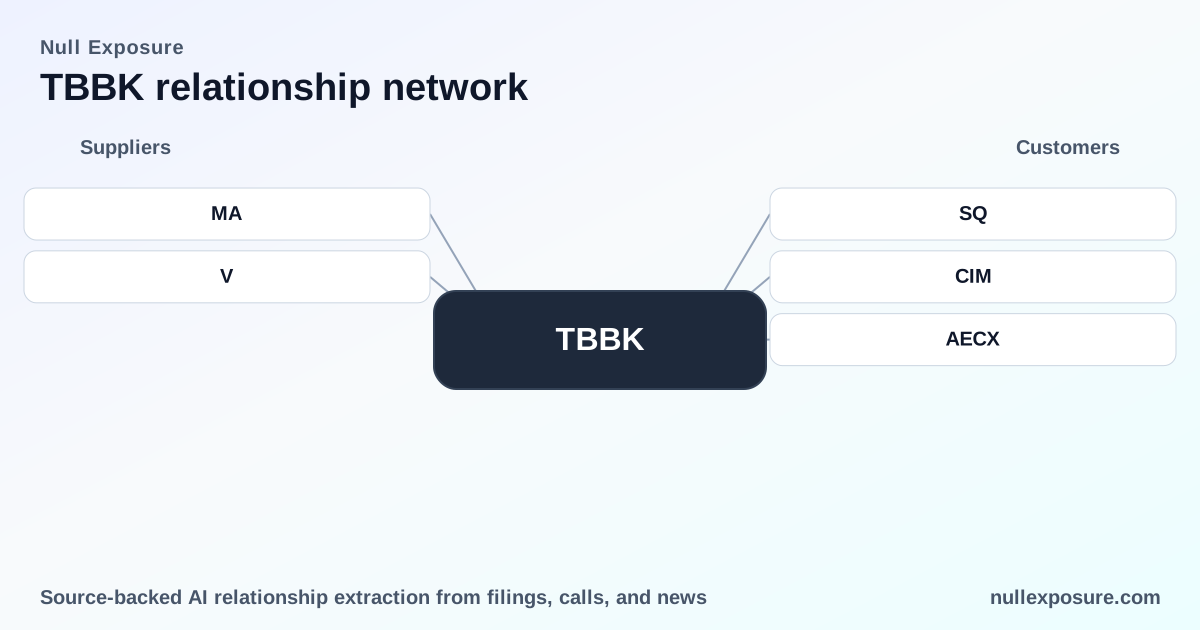
The Bancorp, Inc. (TBBK): How supplier relationships shape the payments franchise
The Bancorp, Inc. operates as a specialist bank and payments issuer, monetizing through interest income on loan and investment portfolios and fee and interchange revenue from card and prepaid programs. Its balance sheet scale and payments distribution make third-party network and processing relationships a structural input to revenue stability and margin capture. If you are evaluating TBBK as a supplier counterparty or judging counterparty risk in a portfolio, focus on its payments network dependencies and the size of its contractual exposures. Learn more about supplier signals at https://nullexposure.com/.
Why suppliers matter to a payments-focused regional bank
The Bancorp is a payments-first banking franchise: it is recognized as one of the largest issuers of Visa- and Mastercard-branded prepaid cards in the U.S., a top debit issuer by purchase volume, and a material ACH originator — all of which convert network and processing access into recurring fee streams. Financial metrics underline the business model: Revenue TTM of $526m, profit margin of 43.4% and return on equity of 30.8%, indicating that non-interest income and platform economics are material contributors to profitability. The company therefore operates with a contracting posture that leans on specialized third parties for transaction processing and card network access; those relationships are operationally critical to revenue delivery.
Key commercial facts to keep in mind:
- Payments network access (Visa, Mastercard) drives interchange and program distribution.
- Third-party transaction processors handle high-volume flows and settlement; their reliability maps directly to operational risk and customer retention.
- Large secured funding lines and overnight capacity position The Bancorp to underwrite program liquidity at scale.
If you evaluate supplier concentration or counterparty risk for Treasury or vendor oversight, start with the network and processor pairings outlined below. For a systematic supplier audit and exposure map, visit https://nullexposure.com/ to request a tailored review.
What public reporting and press coverage say about partners
The following relationships show the two network partners surfaced in recent coverage. Each relationship is a contributor to card issuance, program branding, and the payment rails The Bancorp uses to monetize prepaid and debit programs.
MasterCard
The Bancorp is identified as a major issuer of MasterCard-branded prepaid cards in the U.S., implying an active issuer-network relationship that allows the bank to distribute MasterCard-branded products and capture associated interchange and program fees. A Sioux Falls Business report covering The Bancorp’s corporate move referenced this position in March 2026 (reporting on the bank’s scale as an issuer and ACH originator). Source: SiouxFalls.Business, March 10, 2026 — https://siouxfalls.business/the-bancorp-bank-completes-hq-move-to-sioux-falls/.
Visa
The Bancorp is likewise recognized as a leading issuer of Visa-branded prepaid cards and a high-volume debit card issuer, indicating parallel network access to Visa’s rails and settlement services for those products. The same March 2026 reporting highlighted the bank’s position across both Visa and Mastercard programs. Source: SiouxFalls.Business, March 10, 2026 — https://siouxfalls.business/the-bancorp-bank-completes-hq-move-to-sioux-falls/.
Operational constraints that determine bargaining power and risk
Company-level disclosures and filings surface two constraints that shape supplier dynamics:
- Service-provider dependence: The Bancorp states in regulatory disclosures that it “relies upon third parties for transaction processing services,” which creates direct exposure to processor vulnerabilities and service continuity risks. This is a structural operational constraint that makes processor contracts and SLAs critical to service delivery and regulatory compliance.
- Large secured funding and scale of operations: Filings show the Bank had $1.02 billion FHLB overnight borrowing capacity and a $1.99 billion line with the Federal Reserve as of December 31, 2024, both collateralized by loans. That scale signals high transaction volumes and capitalized program scale, producing significant counterparty spend and bargaining weight, but also concentration of exposure in a few critical relationships.
These are company-level signals: the first affects the criticality and maturity of processing relationships (service continuity and compliance), while the second reflects spend band and the scale of program commitments that suppliers must support.
What investors and operators should prioritize
Operational and commercial implications flow from the supplier picture above:
- Concentration and criticality: The Bancorp’s business is materially dependent on card networks and processors; any disruption in processing or network access would impede fee generation and customer-facing services. Prioritize verification of multi-vendor failover, SLA penalties, and liability allocations in contracts.
- Contracting posture: The bank’s scale (multi-hundred-million dollar funding lines and market cap around $2.33bn) gives it negotiating leverage, but processor specialization narrows vendor choices; examine renewal cadence and exclusivity terms.
- Maturity and integration risk: Longstanding program ties to branded networks reduce onboarding risk but increase coupling; confirm roadmap alignment for tokenization, dispute management, and fraud controls.
- Counterparty spend and operational concentration: The disclosed credit lines indicate program scale that produces high recurring spend with a small set of suppliers; operators should stress-test supplier failure scenarios against liquidity and settlement windows.
A short checklist for counterparties and asset managers:
- Confirm network and processor redundancy and tested failover paths.
- Validate contractual indemnities and outage recovery obligations.
- Review vintage and patch cycles for processing software and fraud engines.
- Monitor funding-line usage as an indirect signal of program throughput.
For a deeper supplier risk profile and exposure mapping, request a focused supplier intelligence pack at https://nullexposure.com/.
Closing view — read-through for investment and vendor risk
The Bancorp’s payments-first model converts network access and processing relationships into durable margins, but that conversion is only as robust as its supplier ecosystem. MasterCard and Visa are strategic network partners that provide brand and rails for core revenue; third-party processors are mission-critical service providers whose operational health determines day-to-day settlement and fee capture. Company disclosures on reliance upon third parties and the scale of secured funding are the clearest signals that supplier management is a first-order investment risk and an operational priority.
For senior investors, treasury officers, or vendor-risk teams, the immediate action is to validate contractual rights, redundancy plans, and the counterparty performance history that underpin TBBK’s payments revenues. If you want a tailored analysis linking these supplier signals to credit exposure or counterparty limits, visit https://nullexposure.com/ to start a review.