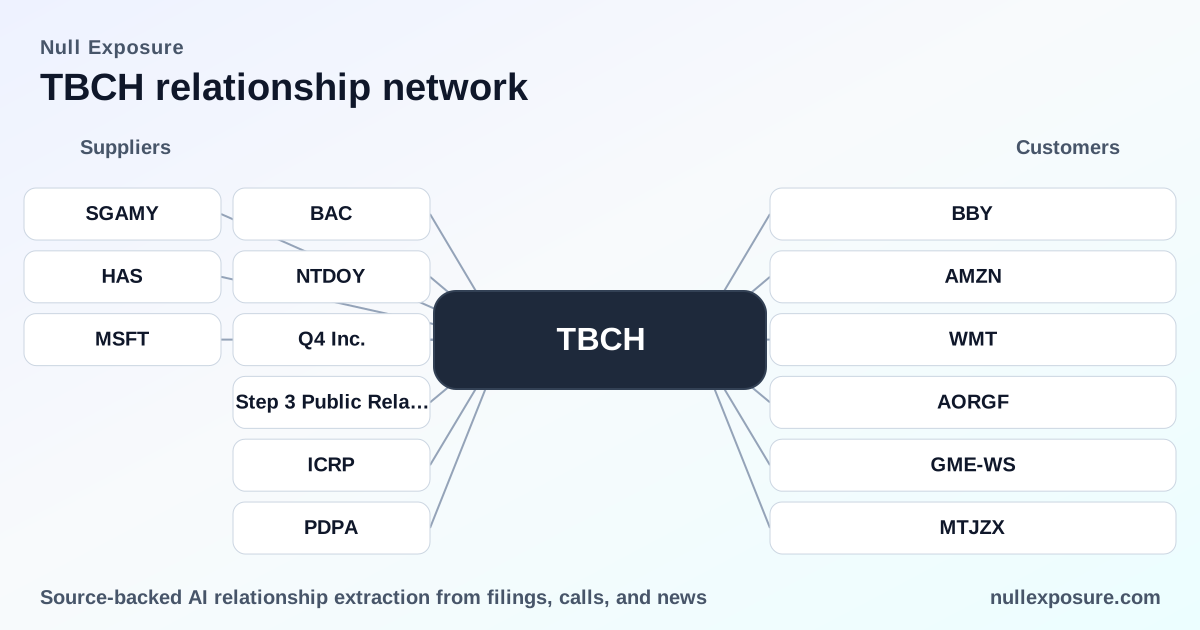
Turtle Beach (TBCH) — Supplier and partner map investors must price in
Turtle Beach monetizes primarily by designing, licensing and selling gaming audio and controller peripherals across retail and direct channels, augmented by targeted acquisitions (notably PDP) and licensed-branded product programs with platform owners such as Nintendo; balance-sheet flexibility comes from a senior secured credit facility that funds working capital, product development and M&A. Revenue is generated from hardware sales and license relationships; the company funds growth through a mix of operating cash flow and secured debt. For an investor or operator evaluating supplier risk, the interplay between manufacturing concentration, third‑party logistics controls, and strategic platform relationships is determinative for margins and resilience.
For more structured supplier intelligence on TBCH, visit https://nullexposure.com/.
Why the supplier and partner map drives valuation and execution risk
Turtle Beach is a product-centric consumer-electronics business that outsources much of its manufacturing and logistics. That operating posture produces a set of persistent, measurable constraints:
- Contracting posture: TBCH relies on third‑party manufacturers in APAC and multiple outsourced logistics providers rather than captive manufacturing; this is a strategic choice to keep fixed costs low and scale SKUs quickly. The company’s filings explicitly state exposure to trade, tariff and currency movements tied to China-based production (FY2024–FY2025 disclosures).
- Concentration and criticality: Platform and license relationships (Nintendo and acquired PDP product lines) are revenue‑critical because branded, officially licensed SKUs command shelf space and higher ASPs; losing a major license or experiencing supply interruptions would be materially adverse.
- Operational maturity and controls: Public disclosures identify a material weakness in monitoring controls over third‑party logistics providers during order fulfillment, a governance signal that affects delivery performance and potential chargebacks.
- Liquidity posture: The $150 million senior secured facility and subsequent covenant amendment provide working capital flexibility but also create a lender relationship that constrains capital returns and levered actions in the medium term.
These characteristics should be treated as company-level signals when modeling supplier risk, cost of goods sold volatility, and working-capital scenarios.
Supplier & partner relationships — quick reference rollcall
Below are every counterpart referenced in public TBCH supplier/partner results, with concise plain‑English summaries and the source context.
Bank of America (BAC)
Turtle Beach executed a new $150 million senior secured credit facility that includes a $90 million revolver and a $60 million term loan to secure liquidity for operations and growth. This was reported in the company’s press release summarized by The Globe and Mail (FY2025 / reported March 2026).
BAC (alternate reference)
Media coverage repeated the Bank of America financing details; the market treats BAC as the administrative lender on the new facility. Coverage reflected the same TBCH press release (FY2025 / March 2026).
BAC-P-M
A First Amendment to the credit agreement—reported in TradingView—granted covenant flexibility around excluded restricted payments for two trailing twelve‑month periods ending March 31 and June 30, 2026, which eases near‑term capital return constraints while leaving the facility term unchanged (Effective Dec 29, 2025 / reported FY2025).
Nintendo (NTDOY)
Turtle Beach expanded its officially licensed product portfolio for Nintendo Switch and Nintendo Switch 2, launching themed controllers and licensed headsets that leverage Nintendo IP and distribution channels. This comes from Turtle Beach corporate press releases and consumer gaming press (company release FY2025; GamingTrend and GoNintendo coverage, FY2025).
NTDOY (alternate reference)
Multiple trade outlets echoed the same licensing relationship: TBCH is working closely with Nintendo to design Switch 2 accessories targeted at holiday and ongoing retail windows (GamingTrend and GoNintendo reporting, FY2025).
PDP / PDPA
Following TBCH’s acquisition of PDP, the company integrated PDP gaming accessories—controllers, gamepads and related SKUs—under the Turtle Beach brand to broaden its product set and channel reach. This integration is discussed in TBCH SEC disclosures and TradingView summaries of the 10‑Q (FY2025).
ICR / ICRP
ICR is named repeatedly as the investor-relations / PR contact for Turtle Beach product announcements, indicating outsourced investor-communications support rather than a commercial supplier. The corporate press pages list ICR contact information on multiple FY2025 releases (Turtle Beach press releases, FY2025).
Q4 Inc.
Turtle Beach’s press pages show being “Powered by Q4 Inc.” for investor relations web functionality, which signals outsourced IR/web services supporting earnings and product announcements (company press content, FY2025).
Step 3 Public Relations
Step 3 Public Relations is cited as a PR contact for North America on product releases, representing a supplier relationship for earned-media and launch communications in FY2025 press materials (company press releases, FY2025).
Sega / SGAMY
Acquired PDP’s product lines and partnerships include relationships (or channel familiarity) with console and IP partners such as Sega; coverage of the PDP acquisition noted PDP’s good relations with Sega and others, which can facilitate licensed product strategies (TechRadar reporting on the PDP acquisition, FY2024).
Hasbro (HAS)
Industry reporting on PDP’s catalog and pre‑existing business lines indicates established ties with consumer brands such as Hasbro, which supports cross‑brand product opportunities for Turtle Beach following the PDP acquisition (TechRadar, FY2024).
Microsoft (MSFT)
TBCH’s SEC filings reference Microsoft in context of platform and software experiences—e.g., titles that drive accessory demand such as Microsoft Flight Simulator—highlighting how major software/platform releases influence accessory purchasing cycles (TBCH 10‑K, FY2024).
MSFT (alternate reference)
The 10‑K text repeats Microsoft references when describing market drivers for peripherals; treat this as a demand-side relationship rather than a contract supplier (TBCH 10‑K, FY2024).
How these relationships translate into credit and operational risk
Liquidity profile improved: The $150 million facility and the December 2025 covenant amendment increase near-term liquidity flexibility and preserve investment-grade vendor access to working capital; lenders now explicitly limit certain restricted payments, which constrains capital returns while supporting operations (Globe and Mail; TradingView, FY2025).
Supply-side concentration is material: Manufacturing exposure to APAC—particularly China—creates cost volatility from tariffs, trade restrictions and currency swings; this is a company‑level risk flagged in SEC disclosures and should be modeled into COGS and lead‑time stress tests (company filings, FY2024–FY2025).
Operational control gaps raise execution risk: The disclosed material weakness in monitoring third‑party logistics providers raises the probability of fulfillment errors, chargebacks or customer claims that can compress margins—recovery requires investment in controls and vendor oversight.
Strategic upside from platform and IP relationships: Official licensing with Nintendo and the PDP product integration improve SKU attractiveness, distribution access, and pricing power for branded accessories; these relationships are revenue multipliers that support higher gross margins on licensed SKUs (company press releases and industry coverage, FY2025).
Investment takeaway and action points
- Buy-side thesis: TBCH is a product-driven consumer-electronics operator with stabilized EBITDA and meaningful upside from licensed portfolio expansion, but valuation must price supply‑chain concentration and logistics control weakness.
- Operational monitoring: Investors should insist on quarterly updates tying reorder lead times and logistics KPIs to liquidity covenants and margin drivers.
- For supplier evaluation: Treat TBCH as a fast‑moving, contract-manufactured client that will prioritize cost, flexibility and IP-compliance in vendor contracts.
For a deeper supplier-risk scorecard and live relationship tracking on TBCH, see our coverage at https://nullexposure.com/.