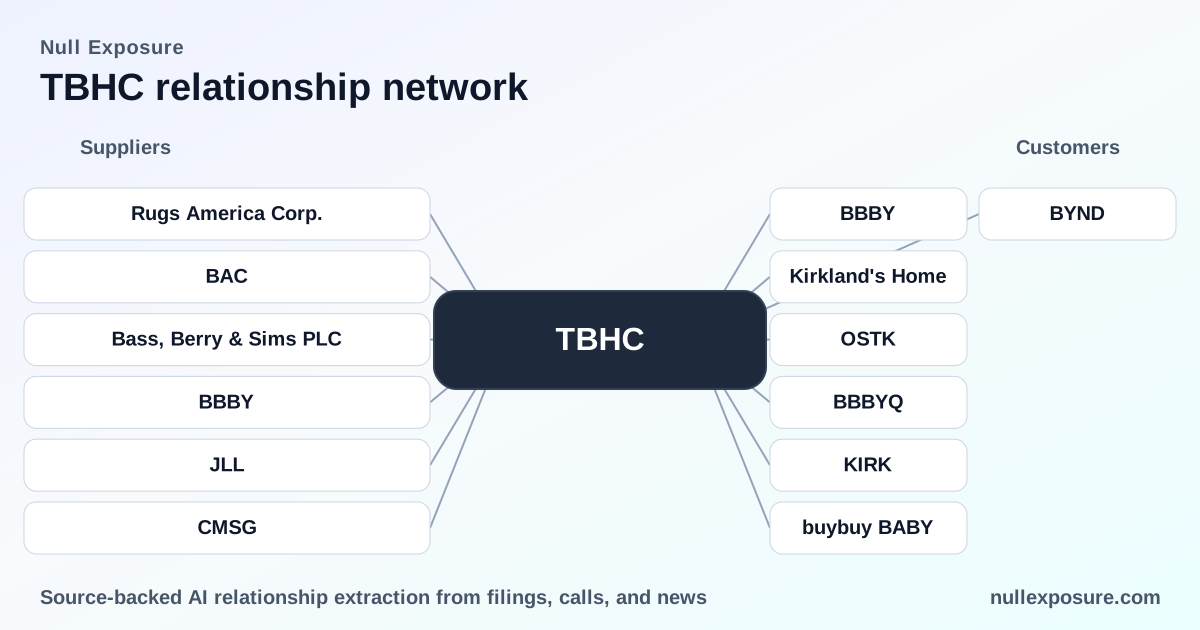
The Brand House Collective (TBHC): Supplier and Strategic Relationship Map for Investors
The Brand House Collective is a U.S. specialty home‑decor retailer that monetizes through brick‑and‑mortar sales, omnichannel retailing and selective licensing/brand conversions; its near‑term value catalysts are store conversions and a proposed Bed Bath & Beyond transaction that restructures the company’s capital and product mix. TBHC generates revenue from inventory turnover across its Kirkland’s and related banners while relying on external financing and strategic partners to execute store conversions and assortment expansions. For a deeper look at institutional supplier risk and counterparty exposure, visit https://nullexposure.com/.
Why counterparty mapping matters for investors
TBHC’s operating picture combines modest scale (Revenue TTM $409.65M) with negative EBITDA and concentrated sourcing. The company’s near‑term strategy depends on third‑party capital and brand deals to convert store footprints and to replenish omnichannel inventory. That creates concentrated operational exposure to financing counterparties and inventory suppliers, and makes legal disputes capable of causing outsized P&L drag.
- TBHC reported negative EBITDA (-$21.5M) and a market cap roughly $22.7M, emphasizing capital sensitivity.
- Management disclosed inventory sourcing concentration with a large share of purchases coming from China, which influences supply chain, tariff and FX risk.
This combination of capital tightness, concentrated sourcing and reliance on partner execution defines the company’s contracting posture: high dependency on a small set of financial and service providers, elevated supplier concentration risk, and transactional relationship maturity tied to an ongoing M&A process.
What the constraint signal means operationally
TBHC reported that approximately 71% of inventory purchases in fiscal 2024 were from China; this is a company‑level signal that creates supplier concentration and execution risk across multiple dimensions:
- Concentration: Heavy procurement from a single region increases vendor leverage and amplifies disruption risk from tariffs, shipping delays, or geopolitical developments.
- Contracting posture: Given TBHC’s capital profile, supplier negotiation power tilts in favor of larger vendors and financing counterparties; TBHC will need to use financing and conversion programs to maintain inventory flow.
- Criticality & maturity: Inventory sourcing is critical to revenue; the sourcing pattern is operationally mature (longstanding supplier relationships), but strategically brittle due to concentration.
Investors should price in supply concentration as a persistent company‑level constraint rather than as an isolated vendor issue.
Supplier and strategic relationships that matter
Rugs America Corp.
Rugs America has initiated a claim alleging TBHC displayed non‑Rugs America rugs on fixtures and is seeking $5.0 million in damages. This lawsuit creates a direct legal exposure that could be material relative to TBHC’s capital base. According to TBHC’s FY2025 10‑K, Rugs America is pursuing that claim.
Bank of America
Bank of America is the lender under TBHC’s existing credit facility and is a condition precedent for the Bed Bath & Beyond transaction; the parties agreed to use commercially reasonable efforts to amend or refinance the facility prior to closing. That refinancing requirement makes Bank of America a gatekeeper for the deal closing. The merger press release on the Beyond investors site (2025) documents this condition.
Bass, Berry & Sims PLC
Bass, Berry & Sims is serving as TBHC’s legal advisor in connection with strategic transactions. Engagement of an experienced law firm signals that TBHC is formalizing M&A and financing documentation with external counsel. The Bed Bath & Beyond transaction announcement referenced the firm’s advisory role.
Bed Bath & Beyond (Beyond Inc. / BBBY)
Bed Bath & Beyond (now operating under Beyond Inc. / BBBY branding) is the acquirer and strategic partner in TBHC’s announced merger; the buyer advanced $10 million under an existing delayed‑draw term loan to support store conversions and inventory procurement, and management has described the ADL and loan as part of the company’s liquidity (alongside total liquidity disclosure). Press releases and earnings commentary in late 2025 and early 2026 describe the $10M draw and the role of the Bed Bath & Beyond arrangement in supporting the conversion program.
JLL
JLL is acting as a design partner as TBHC sets the vision for its brands and store conversions, indicating a vendor relationship focused on store layout and experience rather than inventory supply. Management referenced this ongoing collaboration in the Q4 2025 earnings call.
Consensus (Consensus Advisors)
Consensus (Consensus Advisors) is the investment bank serving as TBHC’s financial advisor on the transaction with Bed Bath & Beyond, which positions Consensus as the primary strategic adviser coordinating valuation, fairness and deal execution. The assignment is noted in transaction announcements and industry press covering the merger agreement.
Risk and contract profile — what investors should price in
Legal exposure, financing dependency, and sourcing concentration are the dominant risk vectors. Specific implications:
- The Rugs America claim is a discrete legal risk that can cause cash outflows or settlement costs; the $5M claim is meaningful relative to TBHC’s liquidity profile (management cited total liquidity around $30M including the ADL and loan in public commentary).
- Financing is mission‑critical: the Bank of America facility amendment/refinance is a closing condition for the Bed Bath & Beyond deal, so credit negotiations directly affect strategic execution.
- Operational concentration in China (≈71% of purchases) elevates tariff, FX, and logistics exposure and reduces bargaining flexibility with suppliers.
- Advisory relationships (Consensus, Bass Berry & Sims) and service vendors (JLL) are structurally important for transaction completion and the conversion program but are not primary cash suppliers.
Investment implications and actionable takeaways
- Monitor the Bank of America credit amendment process: failure to secure acceptable terms would derail the merger and could force alternative, more expensive financings.
- Track the Rugs America litigation for any settlement or judgment that would reduce TBHC’s operating runway.
- Stress test inventory sourcing: hedge scenarios for supply disruption given 71% China sourcing, and evaluate whether management is diversifying vendors.
- Assess liquidity runway against conversion costs: the $10M ADL from Bed Bath & Beyond supports conversions today, but TBHC’s negative EBITDA and limited market cap leave little margin for execution error.
Recommended investor actions:
- Watch filings and press releases for Bank of America credit amendments and for any legal pleadings in the Rugs America matter.
- Revisit assumptions around gross margin and working capital if China sourcing tightens or freight costs rise.
- Consider counterparty risk in valuation: financing counterparties and the acquirer’s commitment materially change downside outcomes.
For a structured counterparty risk review and to explore how these relationships affect TBHC’s exposure across credit and supply chains, visit https://nullexposure.com/ for curated supplier intelligence.
Bottom line
TBHC’s near‑term upside is tied to completing the Bed Bath & Beyond transaction and executing store conversions that expand assortments and traffic; the company’s downside is driven by financing fragility, a material legal claim, and concentrated China sourcing. Investors should treat counterparties—Bank of America, Bed Bath & Beyond, Rugs America, JLL, Consensus, and Bass Berry & Sims—not as peripheral vendors but as determinative actors in TBHC’s path to stabilization and growth. For ongoing monitoring of these relationships and how they affect investment risk, see https://nullexposure.com/.