TrueBlue (TBI): Lender and Advisor Map — what operators and investors need to know
TrueBlue is a specialized workforce and staffing services company that monetizes through hourly placements, managed workforce solutions, and contract staffing fees across the United States, Canada, and Puerto Rico. The firm generates recurring revenue from client payroll pass-through and margin on placements, while financing and advisory relationships are central to near-term liquidity and strategic repositioning. For investors and vendor partners, the key read is that TrueBlue’s operating cash flow profile is seasonal and capital-intensive, and its bank and advisor relationships directly influence flexibility and execution.
Explore deeper coverage at https://nullexposure.com/.
Why TrueBlue’s bank group matters more than ever
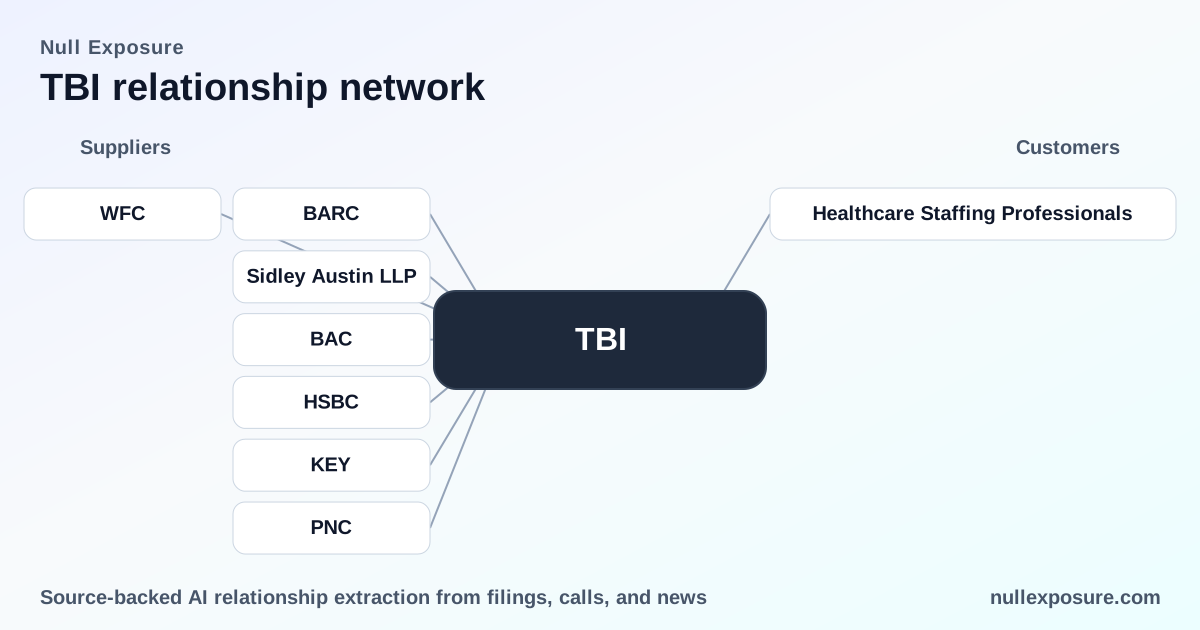
TrueBlue reported roughly $1.616 billion in trailing revenue but is operating with negative margins and a negative EBITDA in the latest reported periods, signaling tight operating leverage. In that context, the composition and posture of the credit facility are core risk factors: the company executed a credit agreement amendment with a syndicate led by Bank of America acting as Administrative Agent and co-lenders including Wells Fargo, PNC, KeyBank, and HSBC. That amendment is a de facto signal that management is actively managing covenant headroom and liquidity options with relationship banks, rather than relying solely on capital markets given a market capitalization of approximately $108.8 million. (TradingView coverage, March 2026).
Legal and financial advisors reflect a strategic reset
TrueBlue has engaged Barclays as financial advisor and Sidley Austin LLP as legal counsel during FY2026, a combination that signals either a strategic review, potential capital transaction, or board-level governance work. High-quality advisors are an explicit indicator that management is preparing for material corporate actions—whether restructuring, sale, or capital raising—making these relationships operationally and strategically critical. (AIjourn report, March 10, 2026).
Operating model signals investors should treat as constraints
- Contracting posture: TrueBlue relies on a bank-led credit facility for working capital; the recent amendment underscores dependence on committed bank lines rather than unsecured market financing. This is a company-level signal rather than a relationship-specific constraint.
- Concentration: A small group of large banks lines up as lenders, concentrating counterparty risk and negotiation leverage in the syndicate.
- Criticality: Credit availability is critical for payroll-heavy staffing operations; any material tightening or covenant stress would directly impair the business’s ability to place and pay hourly workers.
- Maturity: The business is mature as a staffing operator with stable revenue run-rate, but profitability and cash conversion have lagged, elevating the importance of financial and legal advisors to execute re-rating actions.
What these relationships mean for suppliers and operators
For vendors and channel partners, the implications are straightforward: service continuity depends on the company’s liquidity position and its ability to preserve bank covenants. Suppliers should evaluate payment terms against TrueBlue’s seasonal cash flow patterns and the presence of an active bank syndicate.
If you’re evaluating counterparty risk or bid/award exposure to TrueBlue, our platform offers tailored supplier risk insights—visit https://nullexposure.com/ to request a profile.
Relationship catalogue — every named partner in the reporting
- Barclays — Barclays is serving as financial advisor to TrueBlue in FY2026, signaling active strategic advisory engagement for potential corporate actions. Source: AIjourn coverage of TrueBlue corporate developments (March 10, 2026).
- Sidley Austin LLP — Sidley Austin is acting as legal counsel to TrueBlue during FY2026, supporting transactional and governance work tied to the company’s strategic initiatives. Source: AIjourn coverage (March 10, 2026).
- Bank of America — Bank of America is the Administrative Agent on TrueBlue’s credit facility; the company signed a credit agreement amendment in FY2026 that lists Bank of America as Administrative Agent. Source: TradingView report on the credit amendment (March 2026).
- Wells Fargo — Wells Fargo is a co‑lender in the syndicated facility that participated in the FY2026 credit agreement amendment, indicating ongoing lending exposure to TrueBlue’s working capital needs. Source: TradingView report (March 2026).
- PNC Bank — PNC Bank is named among the co‑lenders in the credit amendment, reflecting syndicated support for TrueBlue’s operational financing. Source: TradingView report (March 2026).
- KeyBank — KeyBank participates as a co‑lender in the amended credit agreement for FY2026, contributing to the concentrated bank syndicate supporting TrueBlue. Source: TradingView report (March 2026).
- HSBC — HSBC is listed as a co‑lender on the FY2026 credit agreement amendment, adding an international bank to the syndicate backing TrueBlue’s facility. Source: TradingView report (March 2026).
Balance-sheet and governance takeaways for investors
TrueBlue’s public metrics show a thin equity market value relative to revenue, negative profitability metrics (negative EBITDA and negative EPS), and high institutional ownership (~96%), indicating a shareholder base focused on active oversight. The combination of a concentrated bank syndicate, high institutional ownership, and external advisors engaged in FY2026 creates a dynamic where creditors and large investors will drive near-term outcomes. That dynamic compresses the window for operational fixes and makes execution risk the primary valuation driver.
Practical guidance for operators and suppliers
- For suppliers: tighten payment terms and prioritize contracts with clear payment mechanics—the company’s payroll-centric model makes bank liquidity the fulcrum for on-time payments.
- For vendors considering strategic partnerships or deferred payment arrangements: get lender consents or credit support language where practical, since the bank group has visibility into material commitments.
- For investors: monitor covenant language and any filings or press releases about the bank amendment and advisor engagement; those items will move credit and equity sentiment faster than organic top-line signals.
If you want a supplier-risk deep dive or a counterparty monitoring feed for TrueBlue, start here: https://nullexposure.com/.
Bottom line
TrueBlue operates a high-volume, low-margin staffing business whose near-term valuation and operational continuity are tightly coupled to a small group of bank lenders and professional advisors. The credit amendment and the engagement of Barclays and Sidley Austin in FY2026 are decisive facts that shift focus from organic recovery to financial and strategic execution. For suppliers, creditors, and investors, the immediate priority is tracking covenant mechanics and any advisor-driven transaction outcomes that will reconfigure capital structure or ownership.
Learn more about our coverage and monitoring capabilities at https://nullexposure.com/.