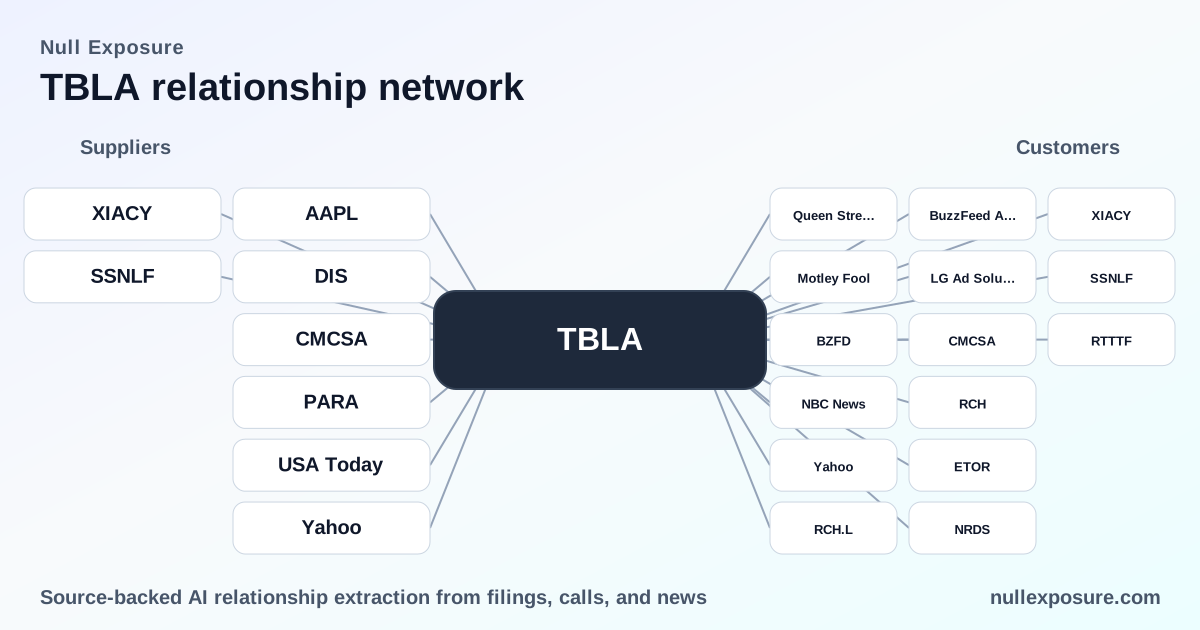
Taboola (TBLA) supplier map: where Taboola places its chips and why it matters to investors
Taboola operates a content-discovery and native-advertising platform that monetizes by placing recommendation units and performance ads across a global roster of publisher and device partners, sharing revenue through traffic-acquisition economics and multi-year integrations. The company sells audience reach and conversion outcomes to advertisers while remunerating digital properties and platforms that host its code, creating a two-sided monetization structure where publisher integrations and partner distribution drive recurring revenue.
If you are evaluating supplier risk or partnership opportunity for Taboola, review the partner list and operating constraints below and then check out our deeper coverage at https://nullexposure.com/ for model-level supplier risk analytics.
The partner list investors should read once, twice, then model
Taboola’s FY2025 commentary and earnings call transcript describe a set of high-profile publisher and platform relationships that underpin its Realize product and broader monetization channels. Below are the relationships identified in public reporting and what each partnership contributes to Taboola’s business.
Apple News
Taboola cites Apple News as one of the platforms across which its Realize product engages audiences, contributing to open-web distribution and scale for content recommendations. Source: Taboola Q3 2025 earnings call transcript summarized in InsiderMonkey (March 10, 2026).
ESPN
ESPN is named among major publisher partners driving daily engagement in Taboola’s open-web distribution, supporting sports-leaning inventory and highly engaged audiences that feed performance advertising. Source: Taboola Q3 2025 earnings call transcript summarized in InsiderMonkey (March 10, 2026).
NBC
Taboola lists NBC as part of its publisher mix that helps reach broad news and entertainment audiences, delivering scale for content-discovery monetization. Source: Taboola Q3 2025 earnings call transcript summarized in InsiderMonkey (March 10, 2026).
Paramount
Taboola has an announced commercial relationship with Paramount to combine TV and performance advertising, integrating CTV and digital channels to sell coordinated inventory and measurement across Paramount properties. Source: Taboola Q3 2025 earnings call transcript summarized in InsiderMonkey (March 10, 2026).
USA Today
USA Today appears on Taboola’s roster of large national publishers used to drive Realize engagement and open-web audience distribution for advertisers. Source: Taboola Q3 2025 earnings call transcript summarized in InsiderMonkey (March 10, 2026).
Yahoo
Yahoo is identified by Taboola as a core partner within its open-web monetization footprint, representing significant placement opportunities for recommendation units and performance buys. Source: Taboola Q3 2025 earnings call transcript summarized in InsiderMonkey (March 10, 2026).
Xiaomi
Taboola calls out device partners such as Xiaomi among the channels that deliver Realize engagement, indicating device-level distribution beyond traditional publishers. Source: Taboola Q3 2025 earnings call transcript summarized in InsiderMonkey (March 10, 2026).
Samsung
Samsung is listed alongside other device and platform partners used by Taboola to extend reach on embedded device surfaces, broadening inventory beyond desktop and mobile browsers. Source: Taboola Q3 2025 earnings call transcript summarized in InsiderMonkey (March 10, 2026).
For more context on how partner footprints translate to commercial exposure and supplier risk, see our platform supplier dashboards at https://nullexposure.com/.
How the relationship list maps to Taboola’s operating model
The partnership roster and company disclosures establish several company-level operating characteristics that investors must fold into valuation and operational risk analysis:
- Contracting posture: multi-year, exclusive digital-property agreements. Company disclosures specify that certain agreements provide exclusivity and span multiple years while requiring Taboola’s code to be integrated on partner pages. This indicates a deliberate strategy to secure durable placements and predictable revenue streams through embedded integrations.
- Role orientation: both service provider and distributor. Taboola self-identifies as a third-party service provider in operations while also operating as a distributor where traffic acquisition cost (TAC) is paid to digital properties and exchanges—this dual posture places Taboola between advertiser demand and publisher supply, with both client-service obligations and channel economics to manage.
- Commercial concentration and criticality: high-touch publishers and platforms. The roster contains major national publishers and device OEMs, which suggests concentration risk if a small set of partners accounts for outsized placement or TAC exposure and also implies operational criticality since code integrations are embedded directly into partner pages and devices.
- Maturity and revenue visibility: programmatic scale with contractual anchors. The mix of open-web programmatic reach (scale) and multi-year exclusivity clauses (visibility) creates a hybrid business model that supports predictable revenue while still exposing the company to market-rate advertising cycles.
What this means for revenue quality and supplier risk
- Revenue durability is reinforced by long-term integrations, which lock in placement and amortize incentives; that improves predictability versus purely auction-driven revenue. Company disclosures confirm multi-year digital property contracts and amortized incentive payments.
- Margin pressure resides in TAC and distributor economics. Since TAC includes up-front payments and bonuses to partners, profitability is sensitive to partner terms and competitive bidding for placements.
- Concentration risk is non-trivial. Large publishers and device OEMs are valuable but also create single-point vulnerabilities if commercial terms reset or technical integrations change.
Midway through your diligence, revisit the partnership signaling and contract language at https://nullexposure.com/ for a quantified supplier-risk view and modeled downside scenarios.
Investment implications and tactical takeaways
- Positive: predictable embedded placements increase revenue visibility. Multi-year, exclusive integrations reduce churn and support forward revenue modeling.
- Negative: TAC and distribution economics limit upside to gross revenue growth. Investors should model a margin-neutral TAC elasticity where higher scale drives more absolute TAC outflows.
- Catalyst watch: terms renegotiation and platform policy changes. Device and publisher platform policy or tooling changes (e.g., changes to embedded code rules) create immediate execution risk given Taboola’s integration dependency.
Final recommendation and next steps
For investors and operators, Taboola is best evaluated as a channel-centric ad technology company whose value hinges on partner contracts, device distribution, and TAC management. Focus diligence on contract duration and exclusivity clauses, partner concentration metrics, and the company’s ability to defend or expand placement economics with major publishers and OEMs.
Explore our supplier risk scoring and partner-concentration analysis at https://nullexposure.com/ for the detailed inputs that matter most when sizing TBLA exposure.