TBLAW (Taboola.com Ltd. Warrant): Supplier Exposure, Traffic Costs, and What Investors Need to Know
Taboola operates a content-discovery and native advertising platform that monetizes by selling placements to advertisers and sharing revenue with digital properties that host its widgets. The company’s economics are driven by gross advertising sales less traffic acquisition costs (TAC) paid to publishers and third-party exchanges; that split determines gross margin and the effective take-rate Taboola realizes on advertiser spend. For investors evaluating TBLAW as a supplier exposure, the key dynamic is how variable TAC flows through Taboola’s P&L and how large partner relationships influence cash payments and negotiating leverage.
Learn more on the homepage: https://nullexposure.com/
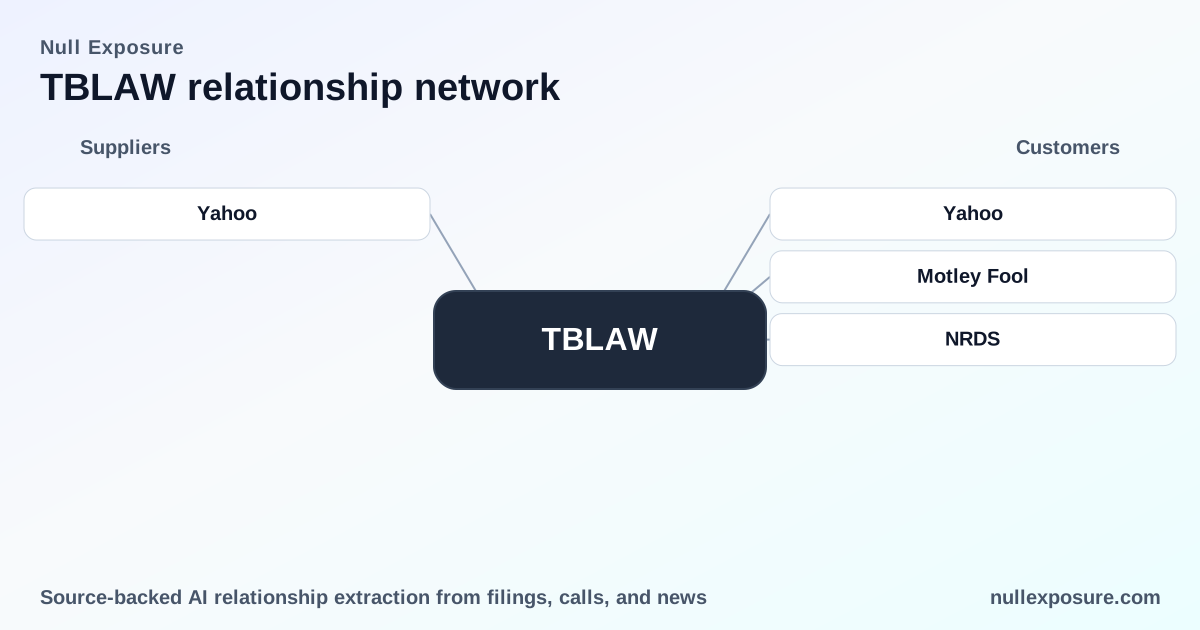
What the raw relationship data shows: a single, quantified connection to Yahoo
Taboola’s FY2024 Form 10‑K discloses explicit TAC payments related to Yahoo: the company recorded traffic acquisition costs related to Yahoo of $275,539 for the year ended December 31, 2024 and $45,183 for 2023, reflecting an increase in payments year-over-year (FY2024 filing). This direct disclosure confirms Yahoo is a compensable traffic supplier to Taboola’s business (Taboola FY2024 10‑K).
Why that Yahoo line matters to investors and operators
The disclosed TAC amounts tied to Yahoo are a concrete indicator that Taboola routes budget to major digital publishers and partners rather than retaining all advertising gross margin. For investors, the magnitude and trajectory of TAC payments to named platforms like Yahoo translate into two material considerations: margin dilution and counterparty concentration. According to Taboola’s FY2024 filing, the company increased TAC payments associated with Yahoo significantly in 2024 relative to 2023, which directly reduces gross margin on incremental revenue (Taboola FY2024 10‑K).
Supplier relationships: every relationship disclosed in the review
- Yahoo — Taboola recorded traffic acquisition costs related to Yahoo of $275,539 in FY2024 and $45,183 in FY2023, per Taboola’s FY2024 10‑K filing. This line-item confirms Yahoo functions as a paid digital property or inventory supplier to Taboola’s platform (Taboola FY2024 10‑K).
Operating constraints and what they reveal about the business model
Taboola’s constraint data identifies the core nature of TAC: “Traffic acquisition cost, or TAC, consists primarily of cost related to digital property compensation for placing Taboola’s platform on their digital property and cost for advertising impressions purchased from real-time advertising exchanges and other third parties.” This is a company-level signal about how Taboola contracts and spends:
- Contracting posture: TAC is inherently variable and transactional — payments flow to digital properties and programmatic exchanges based on placement and impression metrics. That structure gives Taboola flexibility to scale spend with revenue but also constrains pricing power when large publishers demand higher compensation.
- Cost concentration and criticality: Named supplier payments (Yahoo) confirm that Taboola routes meaningful spend to individual publishers; concentration to a handful of large properties would increase supplier bargaining power and operational risk. The single disclosure here identifies Yahoo as material enough to be called out in the 10‑K.
- Maturity of supplier relationships: The explicit accounting for TAC and a historical comparison (2023 versus 2024) implies mature, contractual flows rather than one‑off ad hoc purchases — Taboola books these costs consistently and reports them on an annual basis.
- Profitability mechanics: Because TAC is the principal offset to gross advertising revenue, variations in TAC percentages drive Taboola’s gross profit and operating margin performance directly; investors should view revenue growth through the lens of net take-rate after TAC.
Risk and opportunity implications for investors
Taboola’s model creates a handful of clear risk/return tradeoffs investors should monitor:
- Margin volatility: Increases in TAC payments to large partners compress gross margins; the FY2024 splice to Yahoo demonstrates how partner economics can swing year-over-year.
- Concentration risk: Payments to named publishers increase counterparty exposure. A strategic shift by a large digital property or repricing request would have immediate earnings impact.
- Operational leverage: The variable-cost structure of TAC lets Taboola scale without equivalent fixed-cost expansion, providing upside when the company can negotiate stable or declining TAC percentages against rising advertiser demand.
- Negotiating dynamics: Taboola’s bargaining power depends on the value of its distribution to publishers and the competitiveness of ad exchanges; the prominence of TAC suggests nontrivial dependency on publisher compensation.
Key takeaway: TAC is the single most important supplier-driven lever on Taboola’s profitability; large, disclosed payments to publishers like Yahoo are both a necessary cost of scale and a potential point of margin risk.
Practical action items for investors and procurement teams
- Monitor subsequent quarterly and annual filings for TAC by named supplier and TAC as a percentage of gross revenue; rising absolute TAC or rising TAC percentage is an early-warning indicator of margin pressure.
- Assess concentration by looking for repeat mentions of specific publishers across filings and disclosures; diversification of supply reduces counterparty risk.
- Engage management on long-term pricing strategy with publishers and programmatic counterparties; favorable contract terms with large properties materially raise free cash flow potential.
Explore further supplier intelligence and filings at the Null Exposure homepage: https://nullexposure.com/
Final read: what to watch next
Taboola’s FY2024 disclosure of TAC payments to Yahoo is a targeted signal — the company pays sizable compensation to digital properties, and those payments can swing margins materially. Investors evaluating TBLAW exposure should prioritize tracking TAC dynamics, concentration metrics, and the evolution of relationships with large publishers. Management commentary and future 10‑K/10‑Q notes that detail changes in TAC composition or named partners will be the most actionable inputs for forecasting Taboola’s net take-rate and margin trajectory. For ongoing monitoring and supplier-level intelligence, visit https://nullexposure.com/ for updates and deeper filings coverage.