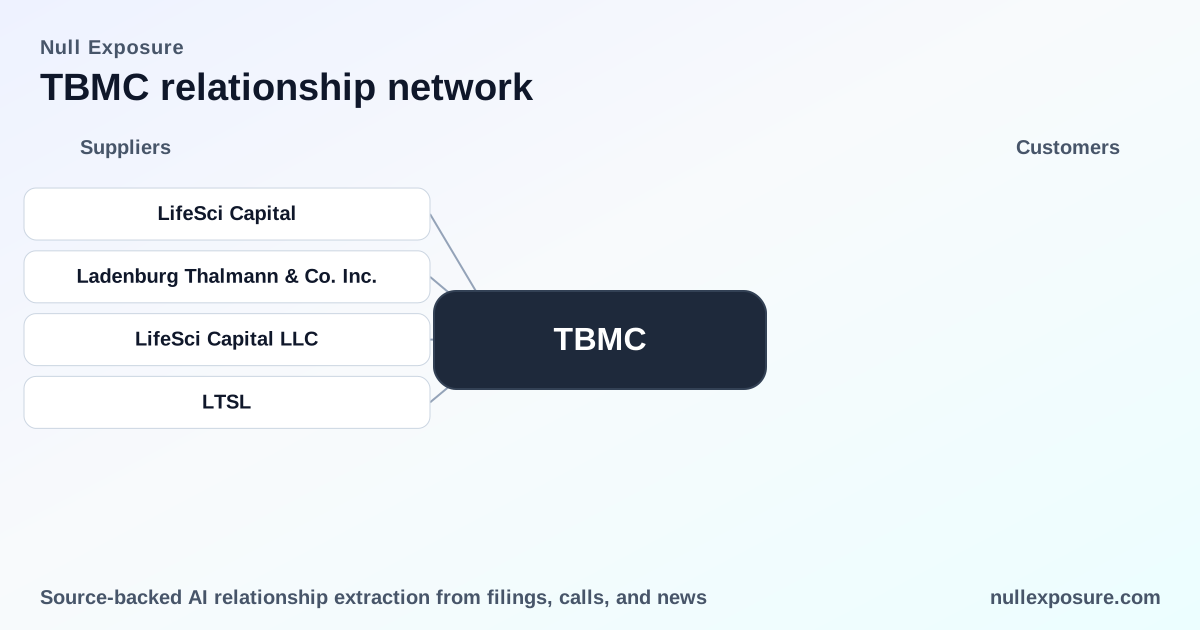
TBMC: Supplier relationships that matter to an SPAC investor
Trailblazer Merger Corporation I (TBMC) is a traditional SPAC: it monetizes by raising capital through an IPO, parking proceeds in a trust account, and collecting sponsor and underwriting economics tied to completing a business combination. TBMC’s revenue profile is effectively zero today; its economic value derives from the trust account, its sponsor/insider stake, and the success or failure of a target merger. For investors and operators assessing counterparty risk, the supplier roster around a SPAC—underwriters, trustees, and transactional lawyers—directly shapes deal execution risk and cash flow timing.
Explore the supplier map for TBMC at NullExposure: https://nullexposure.com/
Underwriters and bookrunners: who stood behind the IPO
The filings and press coverage identify LifeSci Capital and Ladenburg Thalmann as the joint book-running managers on TBMC’s IPO. That underwriting relationship is the primary commercial tie between TBMC and the capital markets that funded its trust account, and it carries both immediate payables and deferred economics linked to a completed business combination.
LifeSci Capital
LifeSci Capital is cited as a joint bookrunner on the IPO and therefore part of the underwriting syndicate that executed TBMC’s offering in 2026. According to a Renaissance Capital note (March 2026), LifeSci Capital was named alongside Ladenburg as a joint bookrunner for the deal.
Source: Renaissance Capital report on the SPAC filing, March 2026.
LifeSci Capital LLC (duplicate listing)
A Yahoo Finance press release covering the offering pricing also lists LifeSci Capital LLC as a joint book-running manager, reiterating its underwriting role in calendar 2026 coverage of the offering. This confirms public distribution and syndicate disclosure across multiple outlets.
Source: Yahoo Finance press release on offering pricing, March 2026.
Ladenburg Thalmann & Co. Inc.
Ladenburg Thalmann & Co. Inc. is named consistently with LifeSci as a joint book-running manager and received underwriting economics at closing. A Yahoo Finance release (March 2026) describes Ladenburg’s position as co-bookrunner on the offering.
Source: Yahoo Finance press release on offering pricing, March 2026.
Ladenburg Thalmann (LTSL) — RenaissanceCapital mention
Renaissance Capital’s coverage also registers Ladenburg Thalmann in the syndicate listing tied to TBMC’s IPO in their March 2026 write-up, reinforcing that Ladenburg was a material execution partner for the transaction.
Source: Renaissance Capital SPAC filing note, March 2026.
What the supplier footprints imply about TBMC’s operating posture
TBMC’s supplier evidence and constraints reveal a standard SPAC operating model with a few strategic implications for counterparties and investors:
- Contracting posture: The company’s underwriting terms include both an immediate cash underwriting discount and a deferred fee that is payable only from trust funds if a business combination closes. This structure aligns underwriter incentives with deal completion and preserves trust-account liquidity pre-close, per the company disclosure describing a $0.15 per Unit cash underwriting discount (paid at IPO close) and a $0.30 per Unit deferred fee. The deferred-pay structure is a common SPAC design that ties a portion of fees to successful transaction execution (company filings cited in constraints).
- Concentration and criticality: A small SPAC dependent on a single upcoming business combination places high operational criticality on a handful of suppliers—underwriters, the trustee that holds the trust account, and legal counsel for target jurisdictions. TBMC’s supplier spend bands show material upfront underwriting cash outflows (>$1m) and legal/vendor caps in the six‑figure range, indicating concentrated spend with high operational leverage to those counterparties.
- Maturity and stage: The constraints tag the relationship stage as active, with underwriting discounts already paid and legal vendor fees partially disbursed as of December 31, 2024. That payment history signals an executed IPO and an ongoing transactional lifecycle rather than a dormant shell.
- Geographic reach: A disclosed legal-services engagement for Israeli transactional matters around a potential combination involving Cyabra points to EMEA/Israel legal exposure, implying cross-border counsel requirements and attendant regulatory complexity for closing a target in that jurisdiction.
These operating signals are company-level. They frame TBMC as a live SPAC with active supplier commitments, concentrated counterparty reliance, and cross-border legal exposure.
Explore TBMC supplier detail and supplier risk scoring at NullExposure: https://nullexposure.com/
Dollars and incentives: spend bands and fee mechanics
The company disclosures enumerate two material spend bands:
- A cash underwriting discount of $0.15 per Unit paid at IPO close, aggregating approximately $1,035,000—an immediate cash outflow reflecting underwriter compensation.
- A deferred underwriter fee of $0.30 per Unit (aggregating ~$2,070,000) payable only from trust proceeds if a business combination closes—this defers a sizable portion of underwriting economics to deal completion.
- A legal vendor fee cap tied to the potential Cyabra transaction of $117,000 if the business combination does not close, and $210,600 if it does, with $117,000 already paid as of December 31, 2024.
These figures signal moderate absolute spend (six-figure legal engagements, low‑to‑mid seven‑figure underwriting economics) consistent with a small SPAC capitalization and a concentrated supplier roster.
Risk implications for investors and operators
- Execution risk is concentrated. TBMC depends on a small number of financial and professional services suppliers to execute a business combination; failure or dispute with any one of them could delay or derail a closing.
- Cash alignment reduces pre-close dilution but increases post-close payments. The deferred underwriting fee model conserves trust liquidity pre-close but guarantees larger fee outflow on successful consummation, compressing post-close economics.
- Cross-border legal complexity. The disclosed Israeli transactional counsel engagement imposes additional closing risk and cost variability when target jurisdictions expand execution complexity.
Closing takeaways and recommended next steps
- TBMC is an active SPAC with engaged underwriters and legal counsel; underwriting economics are split between immediate cash and deferred fees tied to deal success, and the company has already paid material legal fees. That profile creates a binary outcome sensitivity: successful combination unlocks deferred payments and sponsor upside; failure results in sunk costs and trust-account return mechanics for public investors.
- Supplier concentration and international legal exposure raise execution risk. Investors should treat underwriter and counsel relationships as strategic counterparties whose performance materially affects deal timing and economics.
For investors and procurement teams wanting deeper supplier-level intelligence and contract-level signals on SPAC counterparties, visit NullExposure to drill into TBMC supplier relationships: https://nullexposure.com/
If you are evaluating ongoing counterparty risk or planning to participate in SPAC transactions, prioritize verification of underwriting and trustee arrangements and request confirmation of deferred-fee obligations and legal fee caps in deal disclosures. Further supplier-due-diligence resources and relationship summaries are available at NullExposure: https://nullexposure.com/