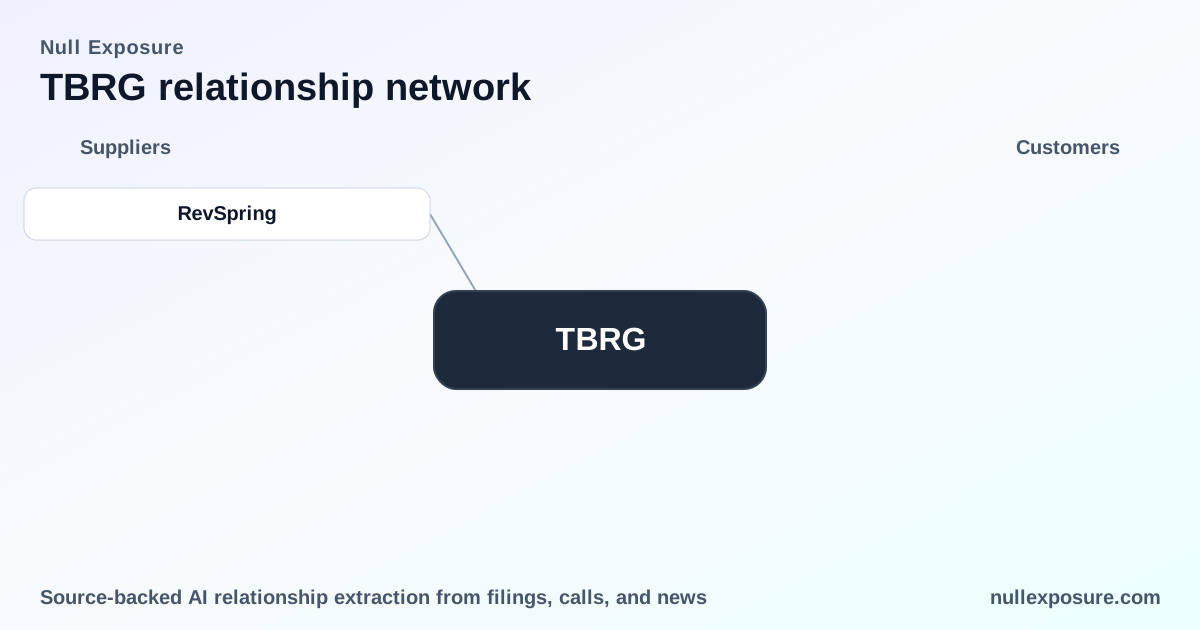
TruBridge (TBRG): Supplier relationships and what RevSpring means for investors
TruBridge monetizes by selling healthcare IT services and outsourced revenue cycle solutions into community and rural hospitals, collecting recurring software and services fees and incremental revenue from integrated patient financial engagement tools. The company drives cash flow through long-term customer contracts and platform integrations that expand product stickiness; partnerships with third-party vendors are a deliberate lever to extend functionality without building internally. For a full supplier coverage view, visit https://nullexposure.com/.
How TruBridge makes money and why supplier strategy matters
TruBridge generates roughly $347 million in trailing revenue with a gross profit of about $183 million, producing a modest operating margin (around 9% TTM) and thin net profit margin (about 1%), which underscores the reliance on scale and recurring revenue to improve profitability. The market currently values the business at roughly $264 million market cap and shows a wide valuation gap between trailing and forward multiples (trailing P/E ~73x vs forward P/E ~7.4x), indicating earnings seasonality or one-off items in recent reported periods. Institutional holders control over 70% of the stock, signaling professional investor interest in execution and margin expansion.
Supplier and integration partners are material to TruBridge’s product roadmap because they allow the company to offer broader capabilities to small, resource-constrained hospitals without heavy internal R&D investment. The RevSpring integration discussed below is a clear example of that strategy — it expands the company’s patient billing and engagement stack through a third-party partner, improving market competitiveness in rural care settings.
RevSpring: direct integration to strengthen the rural offering
Ad-hoc News reported on March 10, 2026 that TruBridge has confirmed a deal to directly integrate RevSpring’s patient financial engagement tools into TruBridge’s dedicated platform for rural and community hospitals. This integration embeds RevSpring functionality into TruBridge’s workflows to improve patient collections and engagement for its customers. (Source: Ad-hoc News, March 10, 2026 — https://www.ad-hoc-news.de/boerse/ueberblick/trubridge-strengthens-rural-healthcare-offering-through-revspring-alliance/68428871)
Why this matters: the RevSpring tie-in is a product strategy that broadens TruBridge’s addressable feature set with a vendor that specializes in patient financial communications, reducing time-to-market for enhanced billing engagement capabilities and likely improving churn and AR collection metrics for client hospitals.
All relationships disclosed in the supplier results
- RevSpring — TruBridge confirmed a direct integration of RevSpring’s patient financial engagement tools into its rural/community hospital platform; the deal was reported by Ad-hoc News on March 10, 2026 and centers on embedding RevSpring functionality into TruBridge’s offering. (Ad-hoc News, March 10, 2026)
This list reflects the complete set of supplier relationships captured in the supplied results.
Company-level constraints that shape supplier posture and risk
The firm-level constraints disclosed in public filings paint a clear operating backdrop that affects vendor negotiations, contract duration, and capital allocation:
- Long-term contracting posture. TruBridge carries leases and debt with multi-year profiles and identifiable extension options, which demonstrates a commitment to long-lived operational footprints and predictable overhead: company filings as of December 31, 2024 show leases with terms expiring from 2025 through 2030 and loan maturity schedules stretching into 2027. (Company filings, as of 2024 year-end)
- North America geographic concentration. Office leases and operations are concentrated in Alabama, Pennsylvania, and Mississippi, signaling that commercial focus and operational risk remain U.S.-centric rather than global. (Company filings, 2024)
- Third-party service provider model. TruBridge treats external vendors as service providers with contractual and cybersecurity controls, which means suppliers are integrated into compliance and data protection regimes rather than treated as simple commodity vendors. (Company policy disclosures and filings)
- Active, mid-maturity spending. Real-estate rent expense runs around $1.8 million annually, which puts recurring corporate infrastructure cost in the low single-digit millions range and suggests mid-sized, stable operating overhead that influences vendor budget bands. (Company filings, rent expense disclosure)
- Capital structure timing. As of Dec 31, 2024, anticipated debt maturities skew heavily to 2027 with roughly $165.8 million due in that year within a $172.79 million total maturity schedule, concentrating refinancing risk in a specific future period that will affect free cash flow and negotiating leverage with suppliers. (Company filings, 2024)
Those constraints combine to produce a supplier posture that favors long-duration, compliance-rich contracts with partners that can deliver enterprise-grade security and predictable support, and they compress discretionary spend during peak refinancing windows.
Operational and investment implications for operators and investors
- Supplier choice is strategic, not transactional. Given the company’s emphasis on integrated offerings for small hospitals, partners that provide turnkey patient engagement and collections technology accelerate adoption and reduce churn risk.
- Margin expansion requires integration success. TruBridge’s operating leverage depends on lifting utilization and AR efficiency for client hospitals; supplier integrations like RevSpring are one of the fastest levers to deliver those improvements without heavy capital investment.
- Refinancing risk constrains agility. The concentration of debt maturities around 2027 increases the importance of predictable cash flow from operations and makes supplier contracts more conservative in pricing and duration until refinancing is complete.
For operators evaluating partnerships, prioritize vendors that accept shared KPIs tied to patient collections and compliance certification. For investors, monitor integration rollouts, AR days, and any guidance on cost synergies from supplier tie-ups. Read more about supplier risk and coverage at https://nullexposure.com/.
Key takeaways and recommended next steps
- RevSpring integration is a targeted product extension that strengthens TruBridge’s proposition to rural and community hospitals by enhancing patient financial engagement.
- TruBridge’s operating model relies on recurring contracts, measured real-estate spend (~$1.8M annually), and a concentrated refinancing schedule in 2027, which together shape negotiation posture with suppliers.
- Institutional ownership is high, signaling market attention; execution on integrations and debt management will be the primary performance drivers over the next 12–18 months.
If you are evaluating TruBridge supplier risk or preparing a vendor strategy for a health IT roll-out, perform a focused review of integration timelines, compliance attestations, and collection uplift metrics tied to new partners. For continued supplier relationship intelligence and actionable research, visit https://nullexposure.com/.
Bottom line: TruBridge is executing a classic platform-extension strategy through targeted supplier integrations to increase product stickiness among community hospitals, while corporate lease and debt profiles set a cautious but structured contracting environment that rewards predictable service providers. For deeper supplier analytics and ongoing coverage, go to https://nullexposure.com/.