Texas Capital Bancshares (TCBI) — supplier posture and what the trustee relationship signals to investors
Texas Capital Bancshares operates as the banking holding company for Texas Capital Bank, generating revenue through lending net interest margin, fee income from treasury and commercial banking services, and capital markets activities. The company complements core banking with third-party providers for treasury management, information security, and administrative functions around capital instruments; those supplier relationships underpin day-to-day operations and the company’s ability to service clients and manage regulatory capital. For investors evaluating counterparty and operational risk, the supplier picture combines routine banking service providers with administrative partners for debt instruments — each with different criticality and contract profiles. Learn more about supplier risk and relationship intelligence at https://nullexposure.com/.
Financial snapshot for context
Texas Capital Bancshares is a mid-cap regional bank with Market Cap ≈ $4.2B and trailing revenues around $1.20B (TTM). Profitability metrics include Profit Margin ~27.5%, Return on Equity ~9.44%, and EPS $6.79; valuation sits at Trailing P/E ≈ 13.6 and Price/Book ≈ 1.23. The stock has traded between $59.37 and $108.92 over the last 52 weeks, reflecting a recovery from cyclical troughs. These numbers frame supplier risk: operational interruptions or capital-event administration failures can influence earnings and investor sentiment for a business operating at scale in commercial banking.
What the vendor disclosures reveal about operating posture
Texas Capital’s filings and disclosures describe an operating model that mixes in-house banking functions with a substantial roster of third-party service providers for operations, treasury management systems, IT security, and audit services. The company explicitly relies on managed security services (third-party MDR) and a variety of vendors to maintain day-to-day operations, which creates an operational dependency that is both routine and strategically significant. The firm’s 2025 annual report highlights that an external vendor failure could have a material adverse impact on results, including reputational damage, signaling a conservative vendor-risk framing in corporate governance.
- Contracting posture: The bank contracts specialized, enterprise-grade vendors for security monitoring, treasury systems, and audit services rather than attempting to own every capability internally. That creates operational efficiency and external dependency.
- Concentration and criticality: Disclosures state a “large number of vendors,” which implies dispersion of supplier concentration; however, the company also warns that failure by an external vendor could be material, underlining that some vendors — even if singular — have outsized criticality.
- Maturity of relationships: The company describes long-standing, active arrangements (audits, MDR, treasury systems) typical of a regulated regional bank that has formal vendor management and oversight processes.
These points are drawn from Texas Capital’s corporate disclosures in its Form 10‑K and related filings for the 2025 fiscal year, which list vendor reliance and the use of third‑party security monitoring services.
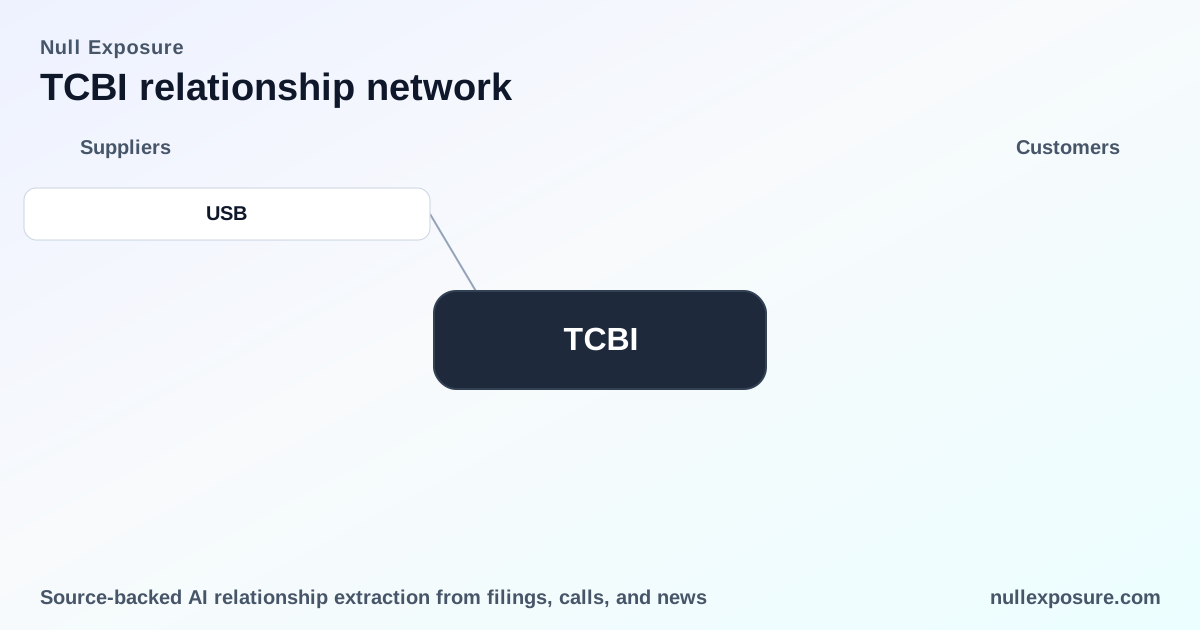
The explicit supplier relationship in the public results: U.S. Bank Trust Company
TradingView reported that U.S. Bank Trust Company acts as trustee for subordinated notes issued by Texas Capital Bancshares; the notes were issued under an indenture dated September 21, 2012, as supplemented May 6, 2021. The same report noted Texas Capital will redeem $375 million of 4.00% subordinated notes due 2031 on May 6, 2026, with U.S. Bank Trust Company named as trustee for the indenture (TradingView, March 10, 2026).
Why that matters for investors: a trustee relationship is administrative and legal — it governs payment mechanics, covenant enforcement, and redemption procedures for subordinated debt — and therefore is important to capital structure execution though not operationally critical in the way an IT or security vendor is.
Source: TradingView news item covering the redemption notice and indenture language (published March 10, 2026).
Other named service providers and their roles at the company level
The company’s filings explicitly name key service roles that shape vendor risk and control posture:
- Ernst & Young LLP — the independent registered public accounting firm that issued an audit report on the effectiveness of internal control over financial reporting as of December 31, 2025, reflecting reliance on an external audit partner for financial assurance (Texas Capital’s 2025 Form 10‑K).
- Managed Detection and Response (MDR) provider — Texas Capital uses a third‑party MDR to monitor information systems 24/7 for intrusions and alerts, signaling a defensive outsourcing model for cybersecurity operations (2025 Form 10‑K).
These references come from the company’s annual disclosures and reflect deliberate outsourcing of high-skill functions: external audit for SOX and controls assurance, and outsourced security operations for cyber defense.
Operational and investment implications — what to watch
- Operational risk is real and labeled material. The company’s filing warns explicitly that a vendor’s failure “could be disruptive” and have a material adverse impact, which raises the bar for vendor oversight and contingency planning.
- Trustee relationships are low-latency capital controls. Trustee partners like U.S. Bank Trust Company are critical at event times (redemption, covenant triggers), so monitor debt servicing notices and indenture amendments for signals on liquidity and capital management.
- Cybersecurity outsourcing is a double-edged sword. Outsourced MDR improves monitoring but transfers dependence; investors should monitor breach disclosures and vendor-control attestations.
- Audit and controls evidence: strong governance signals. An external auditor attestation on internal control effectiveness strengthens confidence in the company’s control environment.
If you are evaluating counterparty exposure or operational resilience, focus on vendor concentration, SLAs and escalation procedures, cybersecurity attestations, and the terms of debt indentures.
For deeper supplier intelligence and risk benchmarking, visit https://nullexposure.com/ to see structured supplier relationship profiles and control signals.
Practical due-diligence checklist for investors and operators
- Confirm whether any single vendor provides services that would halt critical banking functions if disrupted.
- Review SLAs, right-to-audit clauses, and termination/transition assistance in vendor contracts.
- Examine the most recent external audit opinion and any management letters on internal control weaknesses.
- Monitor MDR service coverage, incident response times, and tabletop exercise outcomes.
- Read indenture provisions and trustee notices for subordinated debt for redemption/acceleration language.
Bottom line and recommended actions
Texas Capital Bancshares operates a hybrid model that leverages third-party specialists for treasury systems, security, and audit while retaining core lending and client-facing capabilities. The explicit trustee relationship with U.S. Bank Trust Company is administrative but consequential during capital events; the broader vendor footprint is operationally critical by design and labeled material in filings. Investors and operators should treat vendor governance as a first‑order risk: verify vendor resilience, confirm continuity plans, and track capital instrument administration closely.
For ongoing monitoring and supplier relationship insight, subscribe or explore firm-level profiles at https://nullexposure.com/.