TriCo Bancshares (TCBK): Supplier relationships and what they mean for investors
TriCo Bancshares operates as the bank holding company for Tri Counties Bank, generating revenue through traditional commercial banking activities—net interest income on loans and securities, fee-based wealth-management and brokerage services, and deposit-driven funding—while selectively monetizing capital via dividends and share performance. Brokerage and wealth services are delivered through affiliated advisors and third-party broker-dealers, creating a revenue mix that combines interest margin with advisor-driven fee income. For a focused supplier-risk view and counterparty mapping, see https://nullexposure.com/.
A concise investor thesis: predictable margins, fee adjacency, and operational dependency
TriCo’s core economics are interest-rate sensitive but stabilized by fee income from wealth and brokerage operations delivered through in‑house advisors and affiliations with national broker‑dealers. Capital allocation is conservative—dividends continue and book value is meaningful—while outsourcing and vendor concentration create operational dependencies that deserve active monitoring by investors and counterparties.
Explore supplier intelligence and counterparty signals at https://nullexposure.com/.
How TriCo structures brokerage and wealth delivery
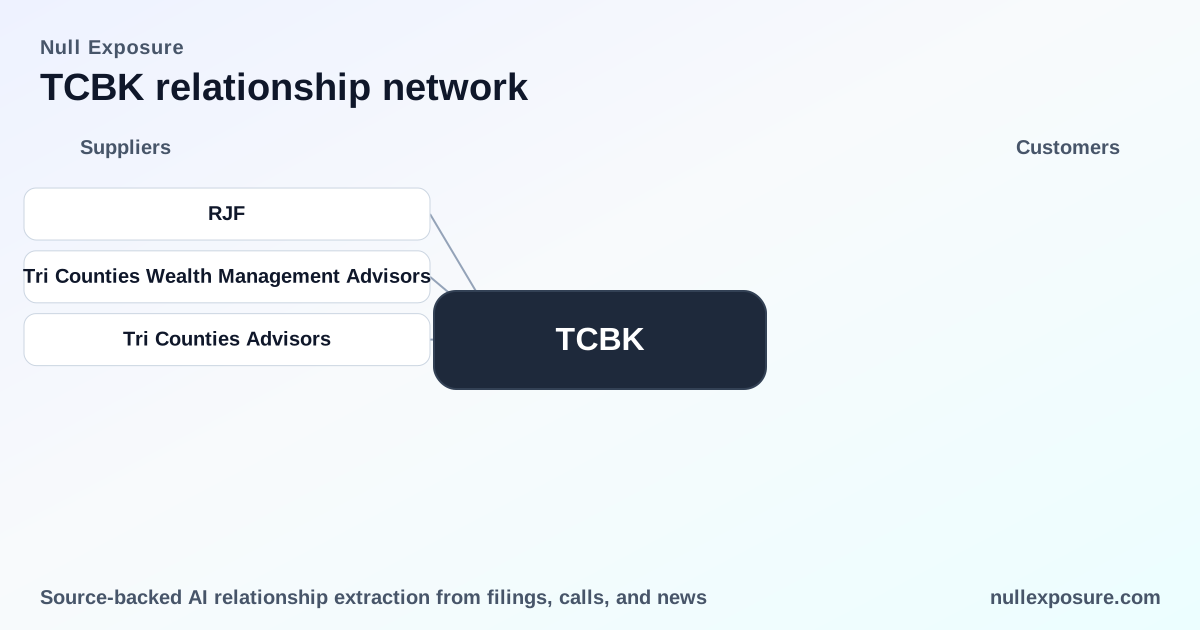
TriCo centralizes wealth delivery in three related channels: Tri Counties Advisors, Tri Counties Wealth Management Advisors, and an affiliation with Raymond James Financial Services. Tri Counties Advisors and the bank’s wealth arm operate as the face of brokerage at branch locations, while Raymond James provides national-scale clearing and regulatory infrastructure through affiliation. This hybrid model captures retail deposit relationships and converts them into advisory and brokerage flows, supporting fee-based revenue while relying on third-party clearing and service platforms.
Detailed supplier relationships you need to know
Raymond James Financial Services, Inc.
TriCo provides brokerage services through Tri Counties Advisors via an affiliation with Raymond James Financial Services, which supplies national broker‑dealer infrastructure and regulatory support for retail brokerage activities. According to TriCo announcements in March 2026, brokerage services are provided by Tri Counties Advisors through affiliation with Raymond James (source: AIJourn and Yahoo Finance coverage in March 2026, https://aijourn.com/trico-bancshares-announces-quarterly-cash-dividend-4/ and https://sg.finance.yahoo.com/news/trico-bancshares-reports-fourth-quarter-113000376.html).
Takeaway: affiliation with a large broker‑dealer reduces regulatory and clearing risk for TriCo’s advisory channels but introduces dependency on an external market infrastructure provider.
Tri Counties Wealth Management Advisors
TriCo staffs brokerage services at bank offices through Tri Counties Wealth Management Advisors, which acts as the in-branch wealth management unit capturing branch client flows into advisory relationships. MarketScreener’s Q4 2026 coverage described that brokerage services are provided at the Bank’s offices by Tri Counties Wealth Management Advisors (source: MarketScreener, March 2026, https://www.marketscreener.com/news/earnings-flash-tcbk-trico-bancshares-reports-q4-revenue-109-40m-vs-factset-est-of-108-2m-ce7e58d2d08df426).
Takeaway: in-branch wealth advisors are a direct revenue channel that deepens customer relationships; operational continuity here is critical to sustaining fee income.
Tri Counties Advisors
Tri Counties Advisors is the registered advisory vehicle that interfaces with clients and routes brokerage activity through its Raymond James affiliation; corporate disclosures in March 2026 explicitly note that brokerage services are provided by Tri Counties Advisors under that affiliation (source: AIJourn, March 2026, https://aijourn.com/trico-bancshares-announces-quarterly-cash-dividend-4/).
Takeaway: this entity is the operational bridge between TriCo’s retail distribution and the national clearing broker, and therefore central to the firm’s wealth revenue capture.
Company-level constraints that shape supplier risk
TriCo’s operating model and supplier posture are informed by explicit company-level signals:
- Government‑issued securities exposure: Many investment securities are U.S. government and agency instruments, which constrains asset-liquidity profiles and interest-rate sensitivity but reduces credit risk versus corporate holdings. This is a company-level disclosure rather than a supplier-specific note.
- Large national vendors: The company states that several vendors are large national enterprises, indicating heavy reliance on market-dominant providers for core services such as data processing and payments.
- Outsourced service-provider posture: TriCo outsources key components of its infrastructure (data processing, card payment services, and third-party payment routing), creating critical operational dependencies where the vendor performs both customer-facing and settlement functions.
From an operational perspective, these signals translate to the following constraints and characteristics:
- Contracting posture: TriCo uses long‑standing affiliations and vendor contracts (affiliations with major broker-dealers and large vendors) rather than vertically integrating all services.
- Concentration: Broker‑dealer affiliation and a small set of large vendors create concentration risk—a disruption at a single large provider could have outsized effects.
- Criticality: Outsourced providers are mission-critical for payment flows, clearing, and advisory operations; contingency planning is therefore essential.
- Maturity: Relationships appear established and formalized (registered advisors, broker‑dealer affiliations), indicating operational maturity but limited internal redundancy.
What this means for investors and counterparties
- Revenue diversification is real but dependent: fee income from wealth management reduces pure interest-rate volatility, yet this diversification is dependent on a small number of service partners.
- Operational risk requires active monitoring: because payment and clearing duties are outsourced, investors should watch vendor concentration indicators, service-level disclosures, and any regulatory notices involving those partners.
- Credit profile benefits from conservative securities positioning: government and agency holdings lock in a conservative balance-sheet posture that supports the bank’s dividend policy and book value resilience.
For more supplier-level due diligence and counterparty mapping tools, visit https://nullexposure.com/.
Investment implications and recommended actions
TriCo is a stable regional bank with constructive fee-adjacency through its wealth channels and a conservative balance-sheet posture. Key monitoring items for investors: vendor concentration reports, any change in broker‑dealer affiliation terms, and operational incident disclosures tied to third‑party providers. Institutional counterparties should treat the Raymond James affiliation and the in-branch wealth units as operationally critical partners when assessing exposure.
If you need granular supplier intelligence or a tailored counterparty risk briefing, start at https://nullexposure.com/—the right place to map supplier dependencies and stress scenarios.
Conclusion: TriCo’s blended model achieves balanced revenue streams while embedding operational dependencies that are manageable but material; investors should reward stable fee capture but require regular vendor transparency before increasing exposure.