Texas Community Bancshares (TCBS): Funding relationships and what they mean for investors
Texas Community Bancshares operates as a traditional community bank: it collects deposits, originates residential and commercial loans, and supplements deposit funding with wholesale borrowings to earn a net interest margin and fee income from lending and deposit services. The company monetizes primarily through interest spread on a loan portfolio concentrated in real estate, supported by both retail deposits and wholesale advances that provide liquidity when deposit flows and loan growth diverge. Learn more about supplier exposure and counterparty analysis at https://nullexposure.com/.
The single critical counterparty: the Federal Home Loan Bank of Dallas
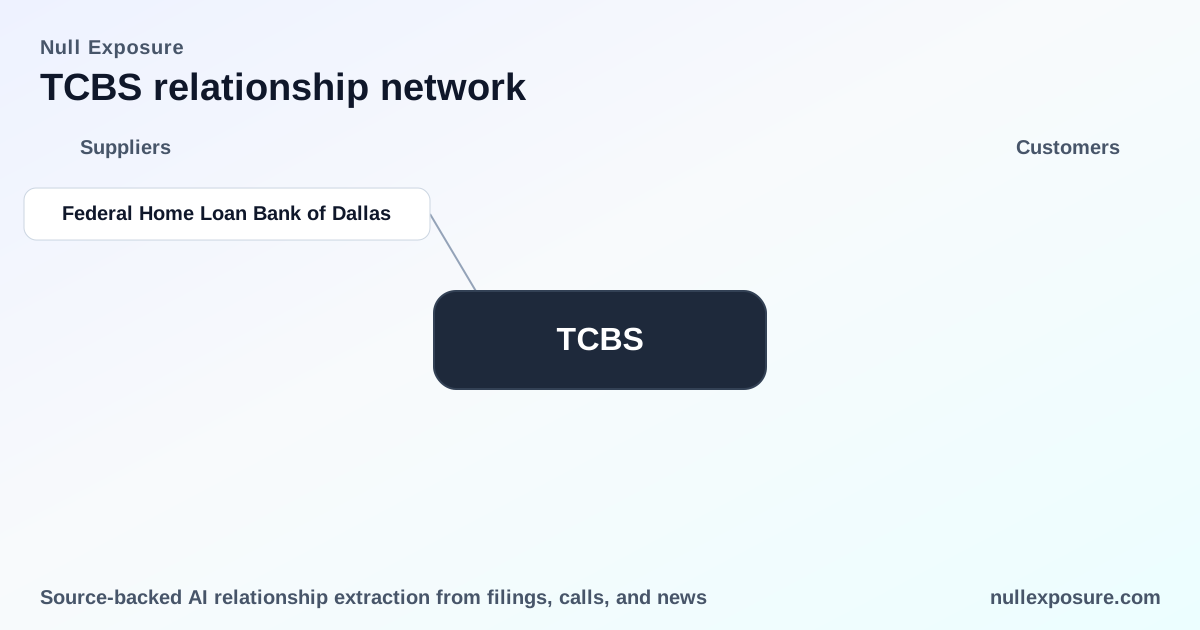
Texas Community Bancshares lists the Federal Home Loan Bank of Dallas as a direct source of wholesale funding. At December 31, 2024 the company reported $49.9 million of outstanding advances from the Federal Home Loan Bank of Dallas, a material component of short- to medium-term liquidity, according to the company’s 2024 Form 10‑K. A MarketScreener news summary from March 2026 reiterated that borrowings from the Federal Home Loan Bank of Dallas are an integral part of the bank’s funding mix alongside deposits and internal cash flows.
What that funding relationship actually means for operations and risk
The relationship with the Federal Home Loan Bank of Dallas functions as a core liquidity backstop and a predictable source of term funding for a community bank of TCBS’s scale. Advances from the FHLB are typically collateralized and priced off benchmark rates, so their use signals active balance sheet management: smoothing loan originations, supporting commercial real estate exposure, and managing short-term deposit liquidity mismatches. The $49.9 million advance is material relative to TCBS’s market capitalization and asset base, and therefore a driver of funding concentration and counterparty risk.
Company-level operating signals and constraints (how the bank contracts and manages risk)
Several company-level disclosures convey the bank’s contracting posture and operational maturity without attaching those signals to any single supplier:
- TCBS discloses the use of a third-party interest-rate sensitivity modeling program prepared quarterly to evaluate rate risk and guide capital, liquidity and performance objectives; this indicates the bank outsources specialized ALM and model production rather than keeping models fully internal, implying a contracting posture that favors external expertise for risk analytics.
- The firm’s disclosure of $49.9 million in advances places wholesale funding in the $10m–$100m spend band, a scale that is sizeable for a regional community bank and reflects a medium level of maturity in wholesale funding (established borrowing lines rather than ad hoc overnight needs).
Taken together, these signals describe a bank that operates with externalized analytics, a moderate dependency on a single wholesale funding channel, and a predictable, contractual funding posture aligned with regulated community-banking practices. These are company-level characteristics derived from regulatory filings rather than vendor-level guarantees.
Explore how counterparties influence finance-sector suppliers at https://nullexposure.com/.
Supplier map — every relationship in the record
- Federal Home Loan Bank of Dallas — Texas Community Bancshares reported $49.9 million of outstanding advances from the Federal Home Loan Bank of Dallas at December 31, 2024, establishing the FHLB as a primary wholesale lender and liquidity provider (2024 Form 10‑K). A MarketScreener news item in March 2026 reiterated that FHLB borrowings form part of the bank’s funding and lending strategy.
Key implications for investors and operational counterparties
- Funding concentration is real and measurable. With nearly $50 million in FHLB advances recorded, investors should treat FHLB access as a funding-critical relationship: a disruption in that channel would force heavier reliance on deposit repricing or asset sales.
- Interest-rate management is outsourced. The bank’s use of a third-party modeling program signals reliance on vendor analytics to evaluate rate sensitivity; this reduces internal model risk but introduces vendor operational and governance risk.
- Scale and ownership structure constrain flexibility. TCBS’s small market capitalization (approximately $45.3 million) and high insider ownership (about 30% insiders, ~11.6% institutional ownership) limit rapid capital-raising options and can concentrate decision-making; those features increase the strategic value of a reliable wholesale funding counterparty.
- Business model remains traditional and localized. Public disclosures and news coverage confirm lending is weighted toward residential and commercial real estate, so borrowing lines are used primarily to support cyclical loan demand rather than speculative growth initiatives.
How investors and operators should act on this profile
- For investors: treat the FHLB relationship as a primary operational dependency and factor it into stress tests of liquidity and net interest income under rising-rate scenarios. Review the bank’s collateral policies for FHLB advances in the next 10‑K/10‑Q to assess repossessable assets and margin calls.
- For counterparties and counterpart risk teams: prioritize monitoring of advance balances and the vendor model engagements because vendor-driven ALM could influence hedging strategies and capital adequacy assessments. Confirm that internal governance reviews of third-party models occur at least quarterly as stated.
- For potential partners or acquirers: recognize limited capital flexibility due to small market cap and concentrated insider ownership; any strategic transaction will need to internalize the FHLB relationship and the bank’s liquidity profile.
Final takeaway: Texas Community Bancshares runs a conventional community banking model but uses material FHLB advances and externalized interest-rate modeling to manage growth and liquidity. Those supplier relationships are strategic and contractually significant, and they should be front and center in any investor or counterparty diligence.
If you want a deeper supplier-level breakdown or a side‑by‑side comparison with peers, visit https://nullexposure.com/ to see full supplier profiles and risk analytics.