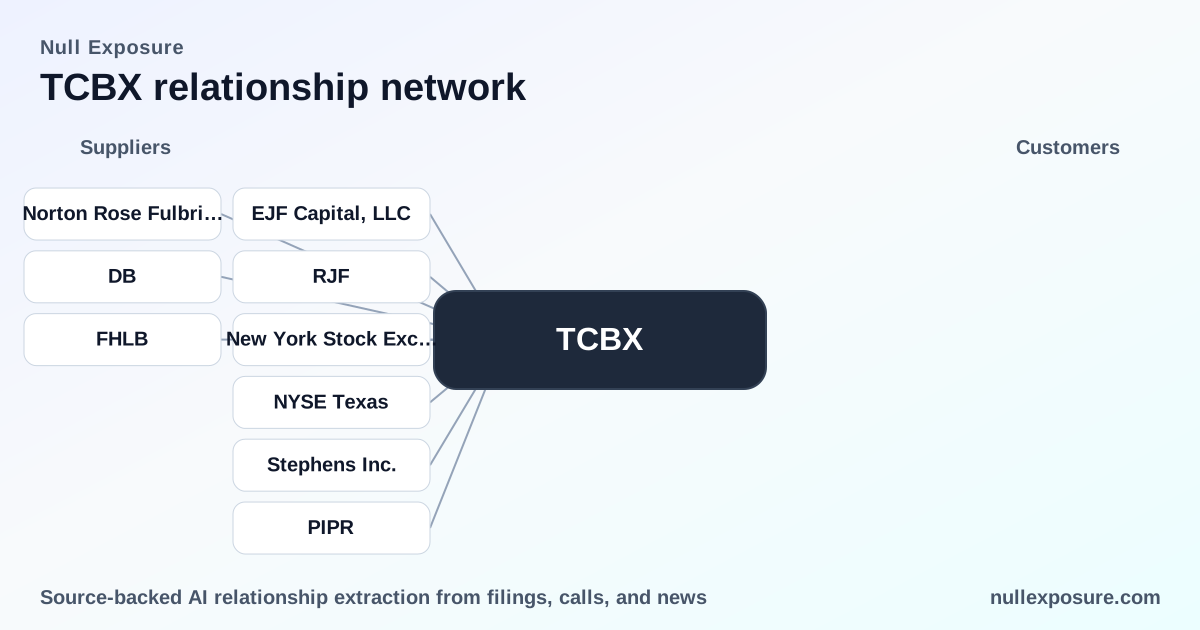
Third Coast Bancshares (TCBX): Supplier relationships and operating constraints that matter to investors
Third Coast Bancshares, Inc. runs a Texas-focused regional bank that monetizes through traditional commercial banking: interest spread on loans, fee income from deposit and treasury services, and capital markets activity such as securitizations and a public equity listing. The company leverages third‑party providers for core processing, legal and capital markets execution, and occasional structured financing partners to extend balance-sheet capacity — a model that amplifies growth but concentrates operational and funding dependencies. For a deeper supplier-risk view and to map these relationships across due diligence, visit https://nullexposure.com/ for an integrated supplier intelligence perspective.
How Third Coast makes money and why suppliers matter
Third Coast reports roughly $201 million in trailing revenue and a market cap near $625 million; the bank delivers high operating margins and healthy return on equity driven by commercial lending and disciplined cost management. Capital-market engagements and external service contracts are not peripheral — they are core to the bank’s ability to scale infrastructure, access liquidity, and execute complex transactions such as loan securitizations. Sourcing for core data processing, legal counsel, investment banking, and structured finance partners is therefore a strategic lever for earnings growth and risk management.
What to watch in the operating model
- Contracting posture — long-term obligations exist. The company issued subordinated notes due 2032 and maintains multi-year lease commitments; this indicates predictable financing and operating cost schedules that support capital planning.
- Service-provider dependency is material. Third parties supply the bank’s core processing and hosting; outages or vendor issues translate directly to customer experience and regulatory exposure.
- Government counterparties and wholesale liquidity are integrated. Federal Reserve BIC arrangements and FHLB advance capacity are explicit sources of funding and regulatory linkages that influence liquidity strategy.
- Maturity and sophistication of relationships are mixed. Some partners are investment banks and law firms used episodically (capital raises, listings), while core technology vendors and long-dated noteholders represent ongoing, mission‑critical relationships.
Explore supplier mapping and concentrated exposure analysis at https://nullexposure.com/.
Operating-model implications for investors
- Concentration risk: reliance on a small set of critical vendors and funding facilities increases single-point vulnerability.
- Execution leverage: when advisors and financiers succeed (as in the bank’s securitization), earnings and capital efficiency improve materially.
- Regulatory and counterparty linkage: government-backed funding arrangements reduce funding cost but raise dependency on policy and regulatory access.
All identified supplier and partner relationships — what investors need to know
-
EJF Capital, LLC — Third Coast executed a first‑of‑its‑kind commercial real estate loan securitization in partnership with EJF Capital, signaling the bank’s ability to access structured-capital markets to free capital and scale lending. This was reported in MarketScreener in March 2026.
Source: MarketScreener article, March 2026. -
Raymond James & Associates, Inc. (RJF) — Raymond James acted as financial advisor to Third Coast on a material capital/strategic transaction, providing underwriting and advisory capabilities that support the bank’s execution in public and private capital markets. This engagement was noted in a March 2026 Yahoo Finance report.
Source: Yahoo Finance coverage, March 2026. -
Norton Rose Fulbright US LLP — Norton Rose Fulbright served as legal advisor on the same transaction where Raymond James advised, providing regulatory and transactional counsel necessary for public disclosures and capital-market documentation. This was reported alongside the Raymond James engagement in March 2026.
Source: Yahoo Finance coverage, March 2026. -
New York Stock Exchange — Third Coast completed a transfer of its common stock listing to the New York Stock Exchange to improve liquidity and market visibility, a strategic corporate-markets step reported in March 2026.
Source: Alphastreet / Yahoo Finance coverage, March 2026. -
NYSE Texas — The company also completed listing on NYSE Texas concurrently with the NYSE transfer, an action intended to broaden market access and trading venues for shareholders as reported in March 2026.
Source: Alphastreet / Yahoo Finance coverage, March 2026. -
Stephens Inc. — Stephens was one of the joint bookrunners on Third Coast’s IPO, establishing an earlier capital-markets relationship that supported the bank’s public-entry funding; this was documented in Renaissance Capital coverage from the IPO period (FY2021).
Source: Renaissance Capital IPO coverage, FY2021. -
Piper Sandler — Piper Sandler acted as a joint bookrunner alongside Stephens and Deutsche Bank during the bank’s initial public offering, supplying underwriting distribution and market placement services during the IPO. This appears in Renaissance Capital coverage of the FY2021 offering.
Source: Renaissance Capital IPO coverage, FY2021. -
Deutsche Bank — Deutsche Bank joined as a joint bookrunner on the IPO, adding global institutional distribution to the bank’s equity issuance capabilities during FY2021.
Source: Renaissance Capital IPO coverage, FY2021. -
Federal Home Loan Bank (FHLB) — Third Coast uses FHLB advances as a committed wholesale funding source; the company discloses substantial borrowing capacity under FHLB arrangements, which materially supports loan funding and liquidity management. This was referenced in March 2026 reporting.
Source: Yahoo Finance / Alphastreet coverage, March 2026.
Risk and opportunity synthesis
Third Coast’s supplier and capital‑markets relationships reveal a dual profile: a proven ability to execute complex transactions that unlock capital (positive earnings and capital efficiency implications) alongside concentration and operational dependencies that elevate vendor and funding risk. The bank’s use of FHLB advances and a Federal Reserve Borrower‑in‑Custody arrangement provides diversified liquidity channels, but also links funding availability to external policy and collateral valuations. The long‑dated subordinated notes create predictable capital structure mechanics that support regulatory capital planning.
Investors should weigh the value of market execution capability (evidenced by securitization and successful listings) against provider concentration in technology and funding pipelines. Stress testing earnings and liquidity under vendor disruption and wholesale-funding shocks is essential for a conservative valuation.
For a structured supplier-risk report and to benchmark Third Coast’s relationships against peers, visit https://nullexposure.com/ for detailed intelligence and scenario analysis.
Bottom line and next steps
Third Coast monetizes through scale in commercial lending enhanced by active capital markets and selective outsourcing; its partner ecosystem is a force multiplier but also a focal point for operational and liquidity risk. Monitor the bank’s securitization pipeline, FHLB and Fed arrangements, and continuity planning with core service providers to assess earnings durability.
If you want a tailored supplier exposure brief, head to https://nullexposure.com/ and request a focused analysis on TCBX’s counterparties and contractual maturity schedule.