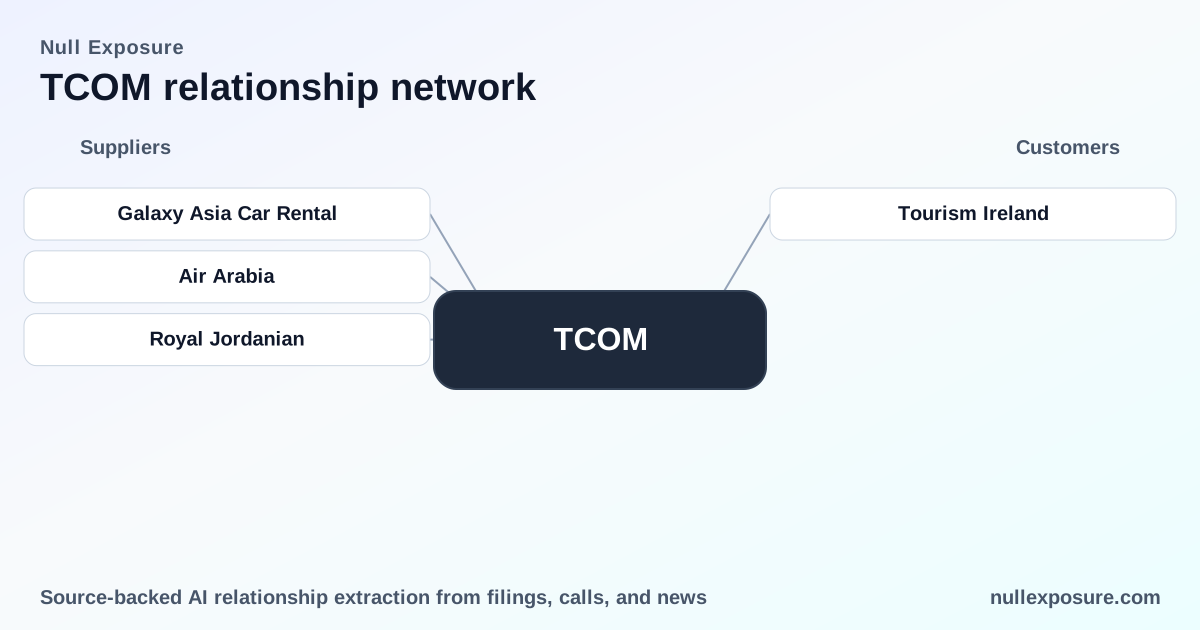
Trip.com Group (TCOM) — Supplier Relationships and Strategic Reach
Trip.com Group operates a global travel marketplace, monetizing through transaction fees and merchant margins on accommodation and transport bookings, corporate travel services, and advertising/marketing services for suppliers. The company leverages scale across channels to capture take-rates and ancillary revenue while driving customer acquisition costs down through platform effects; Trip.com reported Revenue TTM of $62.4B and a high reported Profit Margin (53.3%), underscoring strong unit economics as bookings scale. For a mapped view of supplier exposures and strategic relationships, visit Null Exposure.
Why recent partner announcements matter for investors
Trip.com's announced partnerships broaden its supplier footprint in Southeast Asia and the Middle East, which directly supports volume growth, pricing control, and product completeness for regional customers. These deals are not one-off marketing plays: they expand critical inventory (car rental and regional carriers) that feed both retail and corporate channels, increasing the stickiness of Trip.com's platform and supporting incremental commissions and service revenue.
Key takeaway: low-capex, high-leverage supplier partnerships accelerate revenue per user without materially changing capital intensity — a durable model for scaling profitability given Trip.com's platform economics and established margins.
Reported supplier relationships and what they mean
Below are the supplier relationships disclosed in the supplied coverage, with concise plain-English summaries and source references.
Galaxy Asia Car Rental
Trip.com announced a strategic partnership with Galaxy Asia Car Rental, a leading car rental operator in Malaysia, expanding the company’s ground-transport inventory in Southeast Asia. This relationship increases Trip.com's ability to capture car-rental bookings in a market where localized suppliers drive supply availability and price competitiveness. Source: Finviz reporting on Trip.com's Dec. 9 announcement (reported March 10, 2026) — https://finviz.com/news/276622/tripcom-tcom-has-gained-more-than-22-over-the-past-6-months
Air Arabia
Trip.com launched a partnership with Air Arabia during Arabian Travel Market in Dubai to strengthen its short- and medium-haul flight inventory in the MENA region, improving regional connectivity for customers and corporate travel clients. Adding low-cost carrier inventory increases Trip.com's addressable booking volume and enhances pricing options for price-sensitive segments. Source: Travel and Tour World coverage of ATM Dubai partnerships (reported March 10, 2026) — https://www.travelandtourworld.com/news/article/trip-com-group-unveils-exciting-partnerships-with-royal-jordanian-air-arabia-at-arabian-travel-market-dubai/
Royal Jordanian
Trip.com established a partnership with Royal Jordanian at the same Arabian Travel Market event, giving the platform better access to full-service regional routes and potential codeshare inventory that supports higher-yield bookings and corporate travel accounts. This expands Trip.com's network quality in the Levant and Gulf corridors. Source: Travel and Tour World coverage of ATM Dubai partnerships (reported March 10, 2026) — https://www.travelandtourworld.com/news/article/trip-com-group-unveils-exciting-partnerships-with-royal-jordanian-air-arabia-at-arabian-travel-market-dubai/
For a consolidated supplier exposure map and to benchmark these partnerships against Trip.com’s broader supplier set, see Null Exposure.
What the relationships imply for Trip.com’s operating model
The supplied relationship data and company profile point to several company-level operational characteristics:
- Contracting posture: Trip.com pursues commercial partnerships that are product-focused and distribution-oriented rather than equity investments, signaling a preference for scalable, low-capex supplier agreements that maximize inventory breadth while preserving balance-sheet flexibility.
- Concentration: The reported partners (regional carriers and a national car-rental leader) indicate low single-supplier concentration risk at the platform level — Trip.com aggregates many suppliers so individual partner exposure is manageable.
- Criticality: Supplier inventory such as flights and car rentals are functionally critical to customer experience and conversion; strengthening these supply lines reduces booking leakage to competitors and supports higher long-term retention.
- Maturity: Partners named are established, revenue-generating companies in their markets, implying commercial maturity and operational reliability rather than experimental startup ties.
No supplier-level contractual constraints were flagged in the provided material, so these are company-level operational signals rather than relationship-specific warnings.
Investment implications and risk checklist
- Growth leverage: These partnerships increase addressable bookings in target regions without incremental capex; given Trip.com's strong margins (Operating Margin TTM 16.5% and reported EBITDA of $16.6B), incremental volume will flow efficiently to the bottom line.
- Margin resilience: Trip.com's platform model and diversified supplier base support margin resilience versus asset-heavy travel providers.
- Regional diversification: Adding Southeast Asian car rental and MENA carriers diversifies revenue sources geographically and by product, reducing single-market sensitivity.
- Operational risk: Supplier performance, regulatory changes in cross-border travel, and competitive distribution agreements remain execution risks; investors should monitor conversion lifts and realized take-rates post-integration.
- Market sentiment: Analyst coverage skews positive (29 Buy/Strong Buy vs 1 Hold) with an analyst target price around $76.12, which frames market expectations versus current valuation metrics (Trailing PE ~7.6, Price-to-Sales ~0.55).
Midway check: explore supplier-level intelligence and mapping for portfolio due diligence at Null Exposure.
How to monitor impact going forward
Investors should track three measurable signals to evaluate these supplier relationships' contribution to Trip.com's financials:
- Booking volumes and revenue by region (look for incremental growth in Malaysia and MENA segments).
- Take-rate changes on transport and ancillary bookings (improved take-rates indicate better monetization of added inventory).
- Customer retention and NPS in markets where the partnerships launch (product completeness should raise retention).
Bottom line and action steps
Trip.com's recent supplier deals in Southeast Asia and the Middle East are strategically aligned with its low-capex, high-leverage marketplace model, improving product completeness and regional reach without balance-sheet strain. For investors focused on platform-driven winners in travel services, these partnerships strengthen Trip.com's distribution moat and incremental monetization vectors.
For deeper supplier mapping and to compare Trip.com’s partner exposures across geographies and product lines, visit Null Exposure for full visibility and analyst-grade supplier intelligence.