BlackRock TCP Capital (TCPC): advisor-led BDC that monetizes middle‑market debt spread and fee income
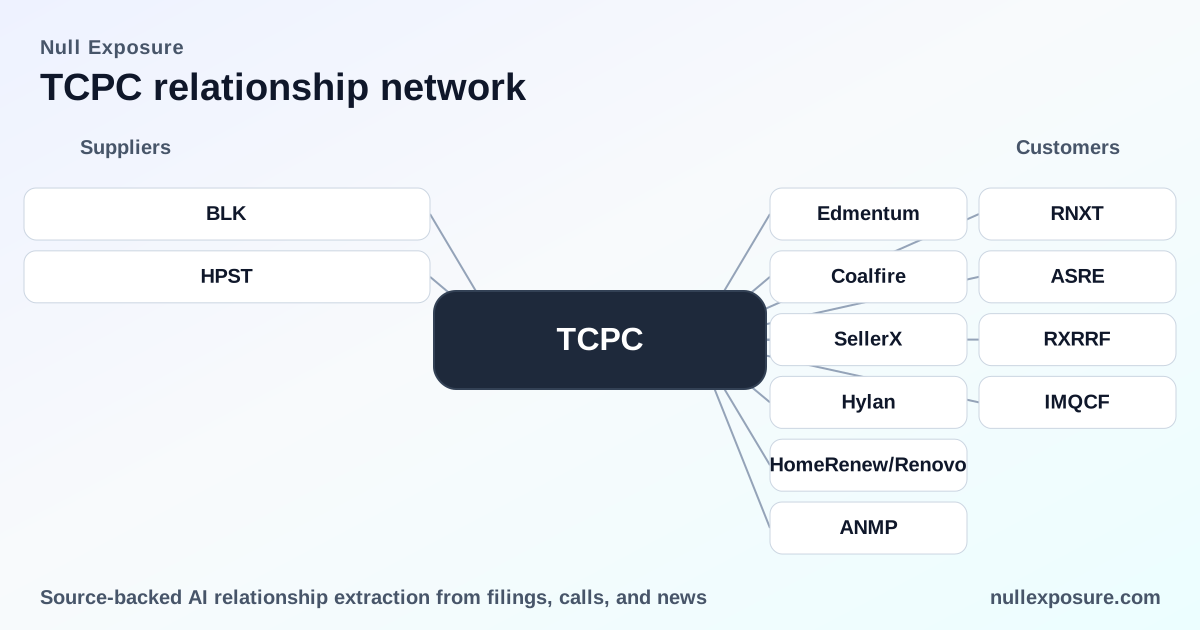
BlackRock TCP Capital Corp operates as a business development company that earns interest and fee income from senior‑secured and subordinated debt to middle‑market and small businesses, while distributing a large portion of cash flow to shareholders as dividends. The company’s economics are driven by net interest spread on loan and bond investments, incidental investment fees, and an outsourced advisory model that allocates portfolio sourcing, underwriting and monitoring to an external advisor tied to the BlackRock platform. For investors evaluating counterparty exposure and supplier risk, the two supplier relationships disclosed in TCPC’s FY2026 filings define how deal flow, brand licensing and portfolio management are delivered. Learn more at https://nullexposure.com/.
Direct supplier relationships: what to know
BlackRock, Inc.
BlackRock’s indirect subsidiary functions as TCPC’s Advisor and is contractually responsible for sourcing, researching, structuring and monitoring investments, effectively operating as the company’s external investment engine; TCPC also has a royalty‑free license to use the BlackRock and TCP names. According to a TradingView write‑up of TCPC’s FY2026 SEC 10‑K, the Advisor is the party that performs core investment management responsibilities (https://www.tradingview.com/news/tradingview:006fc58e02324:0-blackrock-tcp-capital-corp-sec-10-k-report/).
HPS (HPS Investment Partners)
TCPC leverages HPS via the Private Financing Solutions platform to expand deal flow and investment opportunities in the middle market, integrating HPS resources with BlackRock’s sourcing capabilities to support originations. This linkage is noted in the same TradingView summary of the FY2026 10‑K (https://www.tradingview.com/news/tradingview:006fc58e02324:0-blackrock-tcp-capital-corp-sec-10-k-report/).
Why these supplier ties matter to investors
The Advisor relationship is the operational fulcrum of TCPC’s model: TCPC outsources the entire investment lifecycle to an external manager that controls deal origination, underwriting and portfolio monitoring, so the quality of underwriting, fiduciary arrangements and fee mechanics determine net returns to shareholders. The royalty‑free license to use the BlackRock name provides a market‑recognition benefit without direct licensing expense, but it also institutionalizes brand and governance linkages between TCPC and BlackRock (license language documented in the company disclosures).
HPS’s participation expands origination channels and gives TCPC access to a broader private financing platform, increasing potential deal flow and syndication options. The commercial benefit is greater access to middle‑market opportunities, which is the core income source for the BDC.
Explore platform‑level exposure and supplier analytics at https://nullexposure.com/ to benchmark these relationships against peers.
Operating model implications and company‑level constraints
Several constrained signals in TCPC’s disclosures reveal how the business is structured beyond the named suppliers:
- Contracting posture and fee economics: TCPC operates under an Amended and Restated Investment Advisory Agreement that reduced the base management fee from 1.50% to 1.25% on assets at or below 200% of NAV and includes a Fee Waiver Agreement to protect distributable income in early quarters. These provisions indicate an advisor‑led cost structure where fees are material but negotiable and the advisor actively calibrates economics to support income stability.
- Counterparty concentration and borrower profile: TCPC’s credit book is concentrated in middle‑market and small‑business borrowers (enterprise values typically $100 million to $1.5 billion), so portfolio performance will be sensitive to economic cycles that affect mid‑cap credit fundamentals.
- Criticality and maturity: The Advisor is responsible for sourcing and monitoring, making it a single point of operational criticality; the firm’s SBIC vehicle, however, is described as having advisor oversight where the advisor "does not have any previous experience managing an SBIC," highlighting a maturity gap in that specific sub‑program.
- Global platform access: While TCPC’s portfolio is middle‑market focused, its advisor partners operate on a global platform, which can expand origination but also introduces cross‑jurisdictional complexity and dependence on partner infrastructure.
These company‑level constraints point to an operating model that is highly dependent on external investment expertise, negotiated fee terms, and concentrated mid‑market credit exposure.
Financial and risk context investors should weigh
TCPC’s public financials underline the tradeoffs of the BDC structure. The company reported trailing revenue of roughly $201.8 million and a book value of $7.07 per share, while reporting a negative EPS (diluted EPS -1.06) and negative profit margin — reflective of financing costs, mark‑to‑market variability, and BDC accounting. Key risk signals:
- Earnings volatility and negative EPS can pressure dividend sustainability if credit performance deteriorates. Dividend per share is reported at $1 with an ex‑dividend date in March 2026, so distributable cashflow tracking is essential.
- The advisor relationship concentrates execution risk: if the Advisor underperforms in underwriting or monitoring, TCPC’s NAV and dividend profile will be directly affected.
- Valuation and market sensitivity: Price‑to‑book of 0.51 and a 52‑week trading range between $3.446 and $6.97 indicate market skepticism priced into the equity; the analyst target price sits at $4.333.
For a deeper look at counterparties and exposure mapping, visit https://nullexposure.com/.
Practical takeaways for investors and operators
- Supplier concentration is material: investment outcomes are tightly coupled to the Advisor’s sourcing and monitoring capabilities, and secondarily to HPS participation for deal flow. Underwriting quality and alignment on fee economics are fundamental value drivers.
- Contracted fee protections moderate short‑term distribution risk, but investors should model downside credit scenarios given the middle‑market borrower base.
- Operational and program maturity gaps exist in specific vehicles (for example, the SBIC advisory experience), which creates operational execution risk that underwriters and operations teams must mitigate.
Final read: decision drivers
For investors evaluating TCPC as a supplier‑exposed name, the critical questions are whether the external advisor platform delivers consistent credit performance and whether fee and licensing arrangements align incentives with shareholders. TCPC’s strategy monetizes middle‑market credit spread via an outsourced model; success depends on advisor execution, deal flow quality (augmented by HPS), and capital preservation in stressed cycles.
If you want to benchmark TCPC’s supplier relationships, risk posture and counterparty concentration against similar BDCs, start your analysis at https://nullexposure.com/.