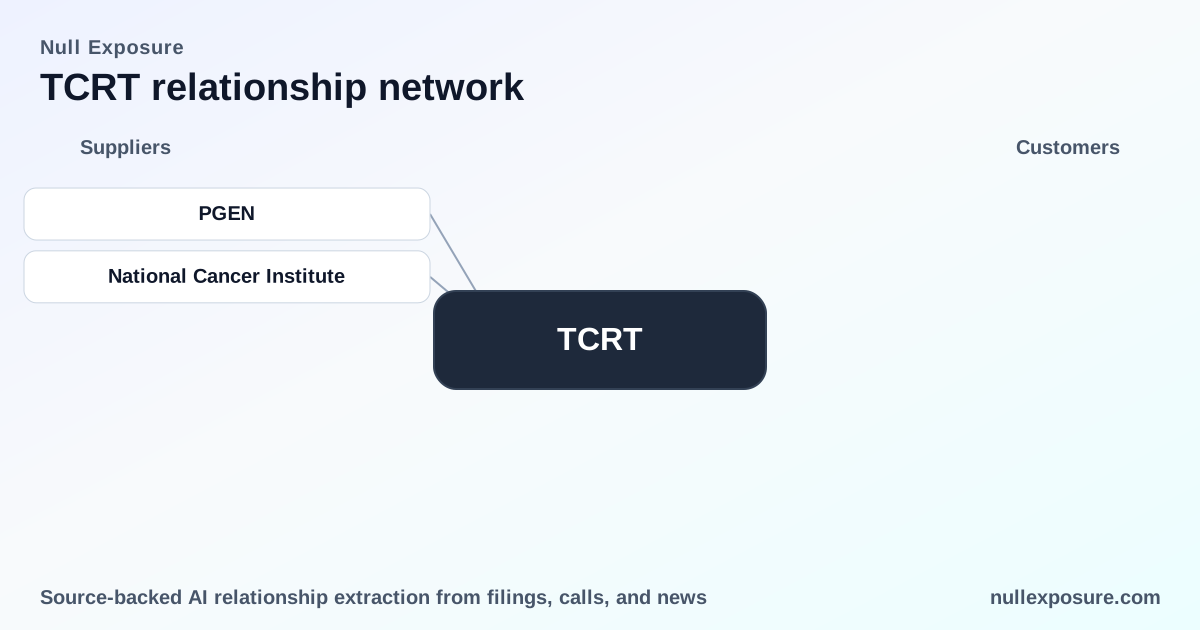
Alaunos Therapeutics (TCRT) — supplier map, licensing exits, and what those relationships mean for investors
Alaunos Therapeutics operates as a clinical‑stage immuno‑oncology developer that monetizes through licensing, strategic collaborations, and eventual product commercialization of cell and small‑molecule therapies. The company currently has negligible product revenue and a small market capitalization; its commercial value rests on intellectual property, licenses, and the ability to execute outsourced R&D and manufacturing. For investors evaluating counterparty exposure and supplier risk, the critical signals are recent license terminations with major research partners and an operational posture that relies on third‑party manufacturers and service providers. Learn more about our supplier intelligence at https://nullexposure.com/.
Why supplier and license relationships matter for a clinical-stage biotech
In asset‑centric biotech companies, supplier and licensing relationships are the infrastructure that converts IP into clinical data and, ultimately, commercial value. Terminated licenses with upstream research partners directly reduce the optionality of clinical programs, while outsourced manufacturing and CRO reliance concentrate operational risk with third parties. For investors assessing Alaunos, focus on: licensing continuity for TCR‑T programs, legal exposure from service disputes, and recurring spend commitments to advisors and consultants.
If you want a structured view of supplier exposures across multiple therapeutics companies, start here: https://nullexposure.com/.
What the filings show — the relationships you need to know
Precigen — license termination referenced in FY2024 filing
Alaunos’s FY2024 filing discloses that it terminated its license agreements with Precigen (PGEN), which affects the company’s ability to restart TCR‑T clinical trials unless licenses are renegotiated or new approvals are obtained. This is an operationally material change because those licenses underpinned access to TCR‑T intellectual property and regulatory pathways (QZ.com report, March 10, 2026: https://qz.com/alaunos-therapeutics-inc-tcrt-quarterly-10-q-report-1851698421).
National Cancer Institute — contract and license terminations in FY2025 filing
Alaunos’s FY2025 filing details the termination of several R&D agreements and licenses, including with the National Cancer Institute, as the company shifts its strategic focus away from certain TCR‑T activities. Terminating an NCI relationship reduces both scientific collaboration leverage and potential non‑dilutive support channels historically available to academic partnerships (QZ.com earnings report, March 10, 2026: https://qz.com/alaunos-therapeutics-inc-tcrt-reports-earnings-1851773800).
Precigen — repeated mention in FY2025 filing
The FY2025 earnings filing repeats the point that Alaunos has terminated licenses with Precigen in the same disclosure set that lists NCI terminations, underscoring this as a deliberate programmatic shift rather than a one‑off administrative change (QZ.com earnings report, March 10, 2026: https://qz.com/alaunos-therapeutics-inc-tcrt-reports-earnings-1851773800).
Operational constraints and what they imply for execution
The filings and extracted evidence establish several company‑level operating signals that shape counterparty risk:
- Contracting posture: outsourced manufacturing and CRO use. Alaunos discloses that it engages contract development and manufacturing organizations (CMDOs) for active pharmaceutical ingredient manufacturing and relies on clinical research organizations (CROs) for trials and research services. This creates single‑point operational dependencies: if a CMDO or CRO relationship fractures, program timelines and costs accelerate.
- Service provider engagement and legal friction. The company acknowledged engaging Cantor Fitzgerald as a strategic advisor and disclosed a breach complaint filed by KBI Biopharma relating to a master services agreement, indicating service disputes and advisory fees are active governance items for the investor to monitor.
- Spend profile and maturity. Consulting agreements disclosed in filings show fixed retainer payments of $15,000 per month to named consultants, placing these engagements in a $100k–$1M annualized spend band. That level of external advisory spend aligns with small, early‑stage companies contracting tactical expertise rather than scaling internal functions.
- Manufacturing segment signal. The explicit outsourcing of API manufacturing to third‑party vendors signals capital‑light operational design but increases dependence on vendor delivery quality and regulatory compliance.
These constraints are company‑level signals derived from the filings; they are not assignments of risk to any single named supplier unless the excerpt explicitly names that supplier.
Investment implications — risk and valuation checklist
- License termination is a hard negative for program optionality. The termination of licenses with Precigen and the NCI removes near‑term pathways to resume or expand TCR‑T clinical trials without new agreements, directly lowering the probability that those programs contribute to value in the near term. This is a core valuation hit for a company whose market value is driven by program optionality.
- Operational concentration increases execution risk. Reliance on CMDOs and CROs concentrates operational risk off‑balance‑sheet. If the company needs to restart programs, expect time‑consuming renegotiations and potential manufacturing transfer costs, which will be liquidity‑intensive for a small cap.
- Legal and vendor disputes are real cash risks. The KBI complaint signals potential contingent liabilities and management distraction; investors should watch litigation disclosures and reserve planning in subsequent filings.
- Modest institutional ownership and tiny market cap compound sponsor risk. With limited institutional ownership and a market cap in the single‑digit millions, insider and catalyst visibility dominate share movements and any new commercial milestone will require positive licensing outcomes or capital raises.
Actionable next steps for investors and operators
- For due diligence: request copies of the terminated license agreements (redacted where appropriate) and timeline options for renegotiation with Precigen and NCI; this will quantify the pathway to restore TCR‑T optionality.
- For operational monitoring: demand transparency on CMDO and CRO contracts (terms, notice periods, transferability) and track the KBI litigation progress in court records and periodic filings.
- For portfolio managers: treat Alaunos as a liquidity‑sensitive, event‑driven holding whose upside requires concrete licensing outcomes or new partnering announcements.
Explore supplier risk across biopharma and see comparative profiles at https://nullexposure.com/.
Final read: risk‑weighted summary
Alaunos’s supplier and licensing disclosures present a clear reduction in program optionality following the termination of licenses with Precigen and the National Cancer Institute, coupled with an operational model that is heavily outsourced and advisory‑driven. For investors, the combination of license exits, third‑party manufacturing dependency, and active service disputes elevates execution risk and compresses the credible near‑term value pathways. Operators and partners will need to focus on renegotiating IP access, securing stable manufacturing partners, and resolving outstanding service disputes to restore investor confidence.
If you want a deeper supplier‑level analysis or a tailored report comparing supplier exposure across similar biotech names, request it here: https://nullexposure.com/.