TScan Therapeutics (TCRX): supplier risk and market outreach that investors should price in
TScan Therapeutics operates a proprietary T cell receptor discovery platform and is a clinical-stage immunotherapy company that monetizes through licensing, partnered development and eventual product commercialization of TCR-based therapies. Today the company funds R&D and builds value by advancing clinical-stage candidates, licensing foundational technology, and outsourcing scale manufacturing and trial services to third parties while using investor events to maintain visibility with capital markets.
If you evaluate supplier relationships and counterparty risk for biotech investments, these dynamics are the essential inputs. Learn more on the platform that aggregates counterparty signals: https://nullexposure.com/
The investor outreach relationships that matter — who TCRX engaged with publicly
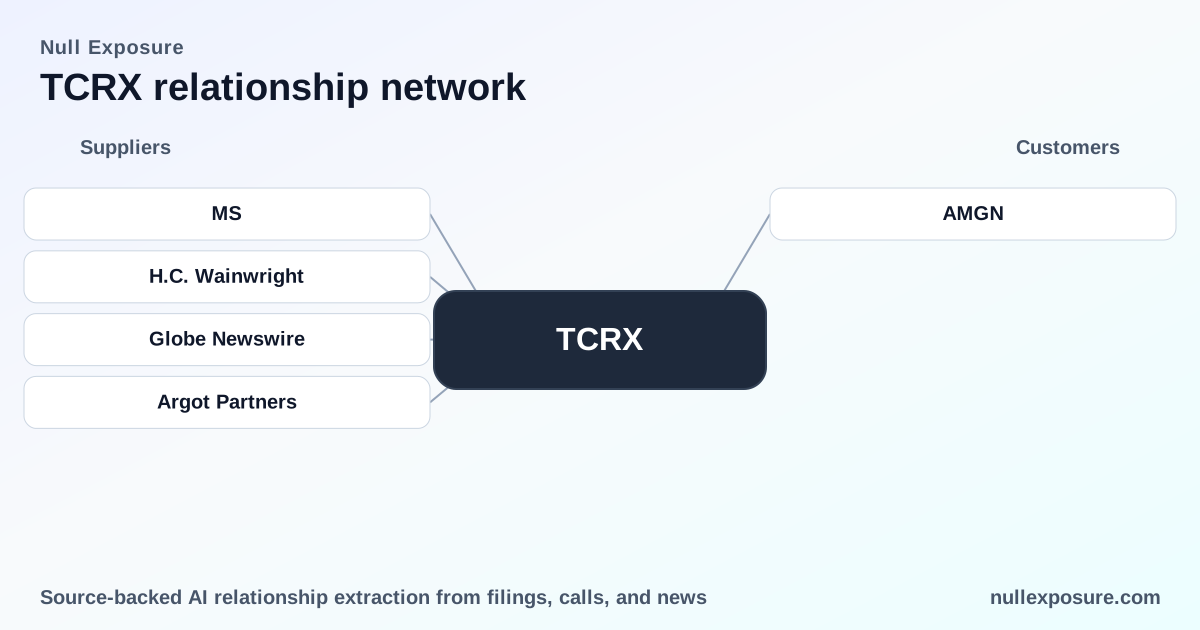
TScan published a press release announcing a cluster of investor events and associated contacts; the disclosure surfaces four named third parties that matter to investor relations and market visibility.
-
Morgan Stanley — TScan announced it will participate in the Morgan Stanley 23rd Annual Global Healthcare Conference with a fireside chat scheduled at the Sheraton New York Times Square on September 9, 2025. This is a classic investor-relations activity intended to broaden analyst and institutional visibility. Source: GlobeNewswire press release distributed via Yahoo Finance, Sept. 3, 2025.
-
H.C. Wainwright — The company scheduled a presentation at the H.C. Wainwright 27th Annual Global Investment Conference on September 10, 2025, signaling continued engagement with healthcare-focused sell-side forums that influence coverage and buy-side attention. Source: GlobeNewswire press release distributed via Yahoo Finance, Sept. 3, 2025.
-
GlobeNewswire — GlobeNewswire served as the distribution channel for TScan’s investor announcement (Nasdaq: TCRX), a standard PR conduit used to synchronize regulatory and market disclosure. Using a recognized wire ensures the firm’s conference participation and investor contacts are auditable and broadly available. Source: GlobeNewswire distribution noted on the Sept. 3, 2025 release.
-
Argot Partners — The press release lists Argot Partners and a named contact for investor inquiries (Melissa Forst), reflecting outsourced investor-relations support and PR routing for media and investor requests. Outsourced IR is consistent with a capital-markets strategy that leverages boutique communications firms to amplify conference participation. Source: GlobeNewswire press release distributed via Yahoo Finance, Sept. 3, 2025.
Each of the above entries was disclosed in the same Sept. 3, 2025 press release posted to Yahoo Finance; the release coordinates TScan’s conference calendar and investor contact points.
What the supplier constraints say about TScan’s operating model
Company disclosures reveal a consistent supplier and IP profile that drives contract posture and operational concentration.
-
High supplier concentration and critical single-sourcing. The company is reliant on a single manufacturer for its transposon and transposase components and identifies many critical reagents as single- or sole-source inputs. That creates a single-point-of-failure for clinical manufacturing and elevates supplier negotiation leverage.
-
Dependence on small specialist vendors. TScan states that some specialty materials are produced by small companies with limited commercial experience, which increases delivery and quality risk as activities scale from clinical to registration-enabling and commercial production.
-
Geographic exposure to APAC supply chains. Filings note reliance on China-based suppliers for certain raw materials and services, adding geopolitical, logistics and regulatory dimensions to supply continuity.
-
Licensing of foundational IP from an academic medical center. TScan obtained the worldwide exclusive license to its foundational technology from Brigham and Women’s Hospital, establishing intellectual property dependency and routine milestone/covenant oversight common to academic-origin biotech. Source: company filings and licensing disclosures.
-
Outsourced manufacturing and CRO reliance. The company leverages third-party CDMOs and CROs for clinical manufacturing and research, and has engaged a global CDMO to expand clinical capacity; this reflects a contracting posture that favors external scale but increases counterparty operational risk.
Taken together, these constraints describe a company that is clinically advanced but operationally immature for commercialization, with concentrated supplier relationships and material dependency on external manufacturers and small specialist vendors.
How those constraints change the risk profile for investors and operators
Contracting posture: Because TScan outsources critical manufacturing steps and relies on single-source reagents, its commercial readiness is conditional on successful tech transfer and CDMO scale-up. Contracts should prioritize redundancy, quality clauses, and inventory commitments to protect clinical timelines.
Concentration and criticality: Single-manufacturer exposure is the dominant supply risk — any disruption would materially impair development programs and valuation. Investors should treat supply continuity as a binary event driver that affects clinical milestones and financing needs.
Maturity and route-to-market: TScan remains clinical-stage with limited commercial manufacturing experience, meaning operational maturity lags scientific progress. The company’s engagement with global CDMOs is a positive step, but outsourcing introduces counterparty execution risk and margin pressure at commercialization.
Service-provider ecosystem: Use of CROs, CDMOs, and IR boutiques is standard for biotech at this stage, but the combination of single-source reagents and small-vendor specialty inputs amplifies overall counterparty risk.
If you want a deeper view of counterparty concentrations and supplier roles for small- and mid-cap biotech, review our analysis tools here: https://nullexposure.com/
Practical takeaways for investment and operational decisions
-
Value sensitivity to supplier continuity is high. With single-source reagents and a single manufacturer for key components, clinical timelines and valuation hinge on uninterrupted supply chains.
-
Partnerships and licensing are dual levers. The exclusive license from Brigham and Women’s Hospital secures core IP but also creates governance and milestone dependencies that investors should model explicitly.
-
Outsourced scale is necessary but not risk-free. Engaging a global CDMO to add capacity is strategically appropriate, but investors should demand transparency on tech transfer timelines, capacity ramp and QA metrics.
-
Investor outreach is active and coordinated. Participation in Morgan Stanley and H.C. Wainwright conferences, and use of GlobeNewswire and Argot Partners for PR and IR, reflect a management team that is actively shaping market narrative and liquidity.
Before allocating additional capital, investors should stress-test scenario outcomes for manufacturing disruption and IP covenant triggers, and require milestone-linked disclosures on CDMO readiness. For a structured supplier-risk briefing and cohort comparisons in biotech, visit: https://nullexposure.com/
Final assessment
TScan’s science-driven platform and institutional visibility present an attractive upside case, but supplier concentration, single-source critical reagents, and reliance on small specialized vendors create high operational risk that can move value sharply. Investors and operators should prioritize counterparty diversification, enforceable supply contracts, and transparent CDMO ramp metrics as the primary mitigants to protect timelines and valuation.