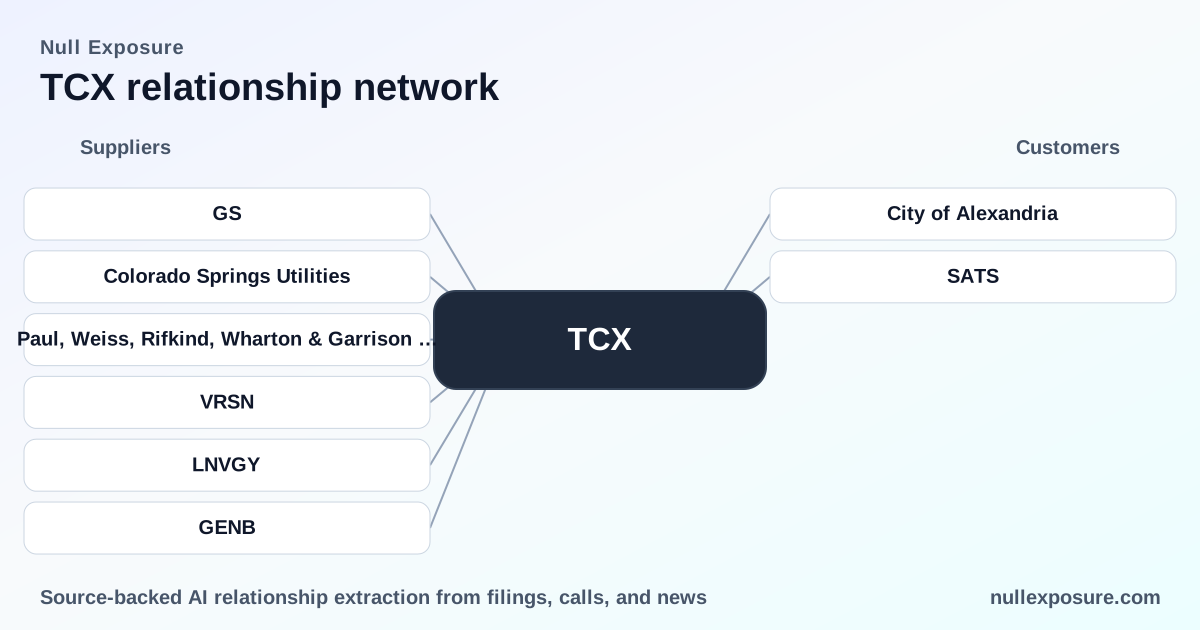
Tucows (TCX) supplier relationships investors should price in
Tucows operates as a hybrid Internet services and infrastructure company: it monetizes domain-name registry services, email and network-access products, and the Ting fiber ISP business through recurring subscriber fees, registration and hosting margins, and infrastructure financing arrangements. Revenue is a mix of low-margin registry volumes and higher-margin connectivity services, while capital deployment is driven by multi-year fiber build contracts and partner financing. For a deeper vendor risk profile and supplier exposure analysis, visit https://nullexposure.com/.
One-sentence commercial thesis for busy investors
Tucows runs two linked businesses — domain and service platforms that generate steady transactional cash flow, and a capital-intensive fiber ISP (Ting) that requires partner financing and long-term commercial commitments — which makes supplier relationships both operationally critical and financially material.
How the company’s contracting posture and cost structure shape risk
Tucows’ supplier footprint is defined by long-term contractual commitments, North American operational concentration, and large-scale capital spend:
- Long-term contracts dominate: The company discloses exclusivity and multi-year ISP rights (examples include 5-, 12-, and 15-year terms), establishing predictable revenue sharing and minimum commitments that lock in both revenue and cost obligations. That structure is favorable for revenue visibility but increases exposure to fixed payments during demand swings.
- North America is the operational center: Tucows carries foreign-exchange hedging arrangements to manage Canadian-dollar payroll, taxes and registry supplier payments, underscoring a principally North American cost and revenue geography.
- Large-scale capital and lease commitments: The company records multi-hundred-million-dollar lease commitments over multi-decade terms for fiber builds, indicating >$100M structural spend tied to network completion levels.
These are company-level signals that affect counterparty concentration, flexibility in negotiating pricing, and the balance between cash preservation and network expansion.
How Tucows connects with key partners and service providers
Below are the supplier and partner relationships surfaced in recent documents and reporting, each summarized in plain language with source context.
- Goldman Sachs — Goldman acted as placement agent on an asset-backed securitization used to support Ting’s U.S. fiber expansion, indicating institutional capital markets access for network financing. (PR Newswire, March 10, 2026).
- Colorado Springs Utilities — Ting was identified as the initial anchor tenant on a city-wide fiber network owned by Colorado Springs Utilities, positioning Tucows as a primary commercial operator on municipally owned infrastructure. (PR Newswire, March 2026).
- Paul, Weiss, Rifkind, Wharton & Garrison LLP — Paul Weiss served as legal counsel to Ting on a financing transaction, signaling use of top-tier counsel for structured capital and securitization work. (PR Newswire, March 10, 2026).
- Verisign (VRSN) — Verisign exercised contractual pricing rights in 2024 and raised .com registration costs by 7%, a direct input cost increase that raised Tucows’ cost of revenues. (Tucows FY2024 10‑K filing).
- Lenovo (LNVGY) — Under an ACP-related offer, qualified customers received router rentals and the option to buy a Lenovo tablet at a subsidized price, illustrating an equipment-subsidy partnership tied to customer acquisition and government-subsidized broadband programs. (PR Newswire, March 2026).
- Generate (GENB) — Generate, an infrastructure capital partner, accepted a two‑quarter deferral of a preferred return with $9.5 million of payment-in-kind added to redeemable preferred units, a move that preserved Tucows’ near-term cash while increasing future obligations to its partner. (Yahoo Finance coverage of FY2025 reporting, March 2026).
What the relationships reveal about operational leverage and counterparty risk
These relationships paint a clear picture: Tucows’ growth is financed by structured capital and anchored by municipal and institutional partners, while its operating margins are sensitive to registry pricing and equipment subsidy programs.
- The Verisign price increase is a direct example of input-cost pass-through pressure; registry pricing shocks flow to cost of revenues and compress margins unless offset by price increases or efficiency gains (10‑K, FY2024).
- The Generate deferral shows cash-preservation tactics and highlights subordinated economics with capital partners — useful in the short term but increasing long-term service obligations (FY2025 reporting covered by Yahoo Finance).
- The use of Goldman Sachs and Paul Weiss for securitization and legal work signals that Tucows pursues market-based financing rather than solely bilateral bank debt, which supports faster capacity scaling but introduces capital-market cyclicality (PR Newswire, March 2026).
- Municipal anchor-tenancy (Colorado Springs Utilities) and consumer-equipment partnerships (Lenovo) demonstrate distribution and adoption levers: municipal access reduces right‑of‑way friction and equipment offers lower acquisition friction for subsidized customers (PR Newswire, March 2026).
For investors, focus on how management balances cash preservation against escalating partner obligations, and how input-cost volatility (e.g., registry fees) is managed through pricing or product mix.
Visit https://nullexposure.com/ for a structured vendor-risk scorecard and deeper counterparty maps.
Risks to monitor in supplier exposure
- Concentration on a few critical suppliers (registry operators like Verisign) that can move pricing unilaterally.
- Long-dated, fixed-fee or minimum-revenue commitments tied to fiber builds that increase leverage during slower subscriber adoption.
- Capital partner economics that can be altered via deferred payments or PIK structures, shifting near-term relief into longer-term claims.
- Geographic concentration in North America, where regulatory, subsidy, or municipal dynamics directly affect deployment timelines and take rates.
Bottom line: what to price into TCX
Tucows combines recurring, transactional cash flow with capital-intensive growth dynamics; supplier relationships are both the engine (municipal anchor tenancies, equipment partners) and the lever (registry pricing, financing partners) of performance. Investors must price in higher input-cost sensitivity, material long-term contract obligations, and the potential for capital-structure complexity as fiber expansion continues.
For an actionable vendor risk assessment and to map these counterparties against financial impact scenarios, go to https://nullexposure.com/.
Key takeaway: supplier movements (registry pricing or financing changes) will drive margin and cash-flow outcomes more than short-term subscriber counts, and that asymmetry is the primary valuation lever to watch.